Friday, 31 January 2025

Film Review: Flight Risk (dir. Gibson, 2025)


"I'm gonna land this plane!!!" As in Guy Ritchie's The Gentlemen (2019), Michelle Dockery does all kinds of things that Downton's Lady Mary never got to do in the new Mel Gibson-directed Flight Risk. The mere sight of Gibson's name on the film seems to have been enough to send the majority of critics off the deep end, with the unreliable Mark Kermode deeming it "one of the worst films I've ever seen" (a bit much for the man who gave Mamma Mia: Here We Go Again [2018] 5 stars). 

Viewed without such prejudice, though, Flight Risk emerges as a knowingly hokey and perfectly enjoyable comedy-thriller that feels a lot like a 1980s/90s throwback. It's an unabashed airborne popcorn movie that lands somewhere between Airport 1975, Narrow Margin (1990) and Passenger 57 (1992). 

Dockery plays a US Marshal tasked with transporting a witness (Topher Grace) to trial and finding out that the pilot (Mark Wahlberg) taking the pair over the Alaskan wilderness is not all he seems to be. The film is basically a three-hander set on the tiny plane, and Gibson keeps the fun and tension quotients high as the trio play cat-and-mouse in the space.

Jared Rosenberg's quip-strewn script is only serviceable but the film is pleasingly distilled, and gains a lot from its slightly berserk casting choices. Topher Grace starts out doing comedy schtick as the chatty prisoner/witness but notably deepens the character later on. Gum-chewing and scenery-chewing, Wahlberg snarls and gurns with aplomb, but though his face is on the poster it's Dockery who's the star here and she's wonderfully committed, bringing surprising variety to the role whether kicking ass, responding to flirtatious overtures, or revealing what's actually at stake for the character in this scenario. What happened to the Gibson who had the sensitivity to make The Man Without a Face back in 1993 is quite another story, but Flight Risk remains a smashingly silly and fun ride.

Flight Risk in in cinemas now. 

Film Review: The Girl With the Needle (Pigen med nålen) (dir. Von Horn, 2024)


Despite retaining some of the same creative team, the three films made so far by Magnus von Horn have been strikingly different from each other. The director's Sweden-set debut fiction feature, The Hereafter, which I saw at Gydnia 10 years ago, about a teenager's return to his hometown following incarceration for a crime, was deliberately low-key, its measured mood disrupted by jarring violence; it was accomplished and slightly studied, with Dardennes and Haneke touches. Von Horn followed it up with Sweat (2020), a portrait of a social media influencer, which was brisk and colourful, and aggressively contemporary. 

Von Horn clearly adapts himself to his subjects, and his latest film, co-written with Line Langebek Knudsen, is something different yet again: a black-and-white maternal melodrama that plays out with the horrifying dream logic of a dark fairy-tale for adults. Set in between-the-wars Copenhagen, The Girl With the Needle  (Pigen med nålen) is based on a real-life case. The social period details feel right - the factory work, the shops, the dingy dwellings - but, from the opening montage of contorted, superimposed faces, von Horn goes for something more primal and ambient, and sustains a mood of quiet, creeping dread. The result is a compelling piece of work, and his best film to date.

As the working-class mother who gives up her baby, and as the woman who arranges for its care, Vic Carmen Sonne and Trine Dyrholm give richly detailed performances; playing the latter's daughter, young Avo Knox Martin is a remarkable find. Coming off of EO (2022) and A Real Pain (2024), the amazing DP Michał Dymek returns to black-and-white for the first time since My Friend the Polish Girl (2018), and gives the images a hallucinatory depth and clarity. Frederikke Hoffmeier's score is mostly an asset too, though some twitchy electronics feel misjudged. The sound of crying babies is perhaps the most eloquent noise here; it permeates the film, and, like many of the images, returns to haunt the viewer long after the screening. 

The Girl With the Needle is in cinemas now. 

Saturday, 25 January 2025

Film Review: Babygirl (dir. Reijn, 2024)


Apart from Jude Law making his daring escape from the law by hopping on a treadmill, my main memory of Ivo van Hove's staging of Obsession (2017) is that of Halina Reijn, as Giovanna, scattering rubbish all over the set. Now, working as a writer-director, Reijn scatters rubbish over global cinema culture and benefits from the A24 hype machine in doing so. Babygirl isn't quite as awful as Reijn's previous film, the exploitative Gen-Z-meets-Agatha-Christie Bodies Bodies Bodies (2022), but it's nearly as juvenile and just about as smug. 

Focusing on the affair between the CEO of an NYC robotics firm (Nicole Kidman) and the intern (Harris Dickinson) who instantly diagnoses the well-heeled boss's unfulfilled desire to be dominated, Babygirl evidently considers itself a brave, transgressive entertainment, and some of Reijn's statements about it have been wonderfully pompous: "Babygirl was an opportunity to bring my Dutch, more liberated ideas about sexuality to the US... I thought of Americana as a metaphor for the danger of suppression that still exists within me." 

These are big claims, since the end result is weirdly tame in its imagery and mightily confused in its sexual politics, ticking off contemporary platitudes about modish topics - consent, the orgasm gap - with all the depth of the average Cosmo article. What the modern woman really, really wants, Babygirl ultimately suggests, is to have Antonio Banderas and Harris Dickinson fighting over her. Well... aim high, I guess. 

It's billed as an erotic thriller, and Reijn has confessed to a fondness for the likes of Basic Instinct (1992), while indicating that her take is far more progressive: "We are in conversation with [film] history...but we're going to to do it in a different way." In part she succeeds, since Babygirl has precious little of the drive or dramatic impetus of a thriller; all of its tension and interest are in the (fairly promising) early scenes. On the plus side, Reijn and her collaborators have clearly thought the film out in visual terms - right down to the pink cellphone case brandished by Kidman's Romy - and the opening sequences craftily juxtapose corporate sterility and churning horniness thanks to Matthew Hannam's brisk editing. 


Though some moments (the first motel room tryst and a witless illicit-encounters montage) just make you feel embarassed for her, Kidman, looking fetching in Kurt and Bart's power-dress designs, is an asset in the role, too. Compensating for the script's deficiencies, she uses the close-ups to convey Romy's conflicted, unsettled feelings, and gives the in-control CEO a disarming wobbly walk that also suggests her vulnerabilities. A strainingly meta 'Botox moment' is a little much, but Kidman finds ways to bring some tenderness to Romy's struggle to integrate her competing selves, and to the relationship dynamic, notably in a quiet post-coital scene. 

As Samuel, Dickinson has his moments - especially, his laugh after he instructs Romy to "Get on your knees!", not entirely convinced by the part he's allocated himself in this relation. But his sexual savant role is so thinly conceived that we never get a read on the character's motivations. It's not the actor's fault that his sex appeal here has also been crazily overhyped (not only by 'the Internet' but by professional critics), including a sub-Claire Denis shirtless sway to George Michael's "Father Figure": an on-the-nose song choice, if ever there was one. 


Babygirl falls apart as its underwritten character's start confronting each other, and Samuel's abrupt banishment from the film just feels like a plot convenience. As the cuckolded theatre director husband, who's never once sexually satisfied his wife in 20 years of marriage, poor Antonio Banderas fares far worse, especially in a late confession scene that finds him mewling "What the fuck, Romy...?" in a tone that made me weep with laughter. 

The only sequence I'd save from the second half is a vibrant wordless one: Romy tracking Samuel down in a club. But indulging a campy pop aesthetic is clearly only part of the film's intention; on the contrary, given some painfully heavy-handed references, I think it's actually aiming for Ibsenesque intensity. Unfortunately, while we might buy Banderas's Jacob directing Hedda Gabler, we definitely don't swallow such touches as the couple's younger daughter being called Nora and having a fondness for dancing - you guessed - the Tarantella. 

Babygirl's thinness is especially evident in this last section, including a hasty reconciliation scene and the sudden wheeling on of a subsidiary male character for Romy to give a sound scolding to for the sake of a very cheap feminist huzzah. And maybe Reijn needs to watch Basic Instinct again, and more closely. Not only is Verhoeven's film more fun and more accomplished in its storytelling than Babygirl, it's finally more subversive, too. Suggesting that Sharon Stone's Catherine Tramell was "punished" for "dark desires" is not being "in conversation with film history": it's conveniently rewriting it. 


 Babygirl is in cinemas now.

Monday, 20 January 2025

Piece on late-career Sidney Poitier at BFI online


As the Sidney Poitier season continues at BFI Southbank, I wrote about his late career. The piece is up here. 

Feature on Andrzej Wajda at culture.pl


For culture.pl, I wrote a piece about Andrzej Wajda and his international connections (especially to Japan). You can read it here. 

Monday, 30 December 2024

Theatre of 2024 - 10 Favourite Productions


Till the Stars Come Down, NT
(Photo: Manuel Harlan)

The National Theatre started the year with one of its strongest shows: Bijan Sheibani's glorious production of Beth Steel's Till the Stars Come Down, set during an East Midlands Anglo-Polish wedding. Steel's play is another three sisters' story in essence, but a fresh and rich one, as the disappointments, hopes and fears of Sinéad Matthews' bride, and Lisa McGrillis and Lucy Black as her siblings, gradually come into focus. Firmly rooted in community and time but with a touch of cosmic magic besides, and playing out on a mirrorballed set by Samal Black that made the audience the wedding reception guests, Steel's play was laugh-out-loud funny (take a bow, Lorraine Ashbourne's peerless Auntie Carol), huge-hearted, sharply perceptive and, in its final stretch, unafraid of big emotions. Review here. 


Dear Octopus, NT
(Photo: Marc Brenner)

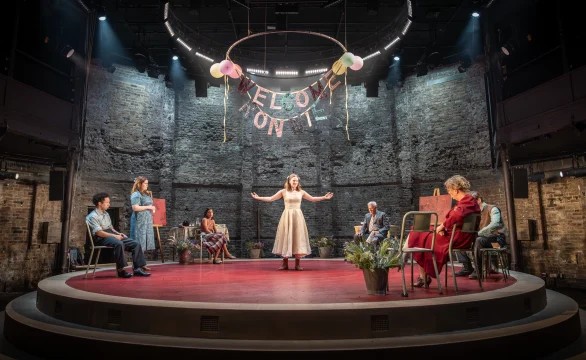
Another NT highlight was another ensemble family play, Dodie Smith's 1938 Dear Octopus - one of a more sedate vintage but rendered equally vivid and involving in Emily Burns' beautiful staging. The production worked by playing the text, with its old-fashioned surface but ever-relevant ambivalence about family, absolutely straight and without gimmicks, allowing the cast plenty of space; a performance of rare and magical translucence from Lindsay Duncan as the fussy but insightful and, it turns out, adaptable matriarch, was one standout of many. 

Roots, Almeida 
(Photo: Marc Brenner)

Adorable as the son in Dear Octopus, Billy Howle had a great year on stage (not that anyone except Lloyd Evans seemed to notice), delivering a compelling Jimmy Porter in  Look Back in Anger at the Almeida and adding a hilarious supporting performance to the theatre's cross-cast Roots - in which  Morfydd Clark shone as Beatie. An hour shorter than the leisurely Donmar production of 2013, director Diyan Zora took the action of Arnold Wesker's play at a clip but didn't stint on nuance or emotion. 


Nye, NT
(Photo: Johan Persson)

The founding of the NHS was  dramatised in two memorable shows this year. Nye, in Rufus Norris' production, had some of the forced larkiness characteristic of the director and didn't always do Tim Price's writing justice. (For Salt Root and Roe alone, I'll be Price's fan forever.) But there were potent moments throughout, and, back on the Olivier after his great turn in Lindsey Turner's pandemic-period Under Milk Wood, Michael Sheen gave another performance as robust as it was detailed.


The Human Body, Donmar
(Photo: Marc Brenner)

Concerned, among many other things, with the impact of the NHS on 'ordinary' lives rather than just those of policymakers, Lucy Kirkwood's  excellent The Human Body premiered at the Donmar with Keeley Hawes as the GP and budding MP reckoning with difficult personal and professional choices, as she gets sidetracked by an affair with Jack Davenport's returned-from-Hollywood actor. Paying tribute to 1940s British cinema (especially Brief Encounter), the intricate production, with its brilliantly multi-rolling cast and live filming, offered a rich portrait of post-WWII Britain, as well as an elegant farewell to the Donmar from Artistic Director Michael Longhurst (here co-directing with Ann Yee). 


Bluets, Royal Court
(Photo: Camilla Greenwood) 

Expressive live filming was also a key component of Bluets, in which Katie Mitchell made Maggie Nelson's highly interior, by turns perceptive and pretentious, text into a meditation on grief and loss for three performers, delivered to perfection here by Ben Whishaw, Kayla Meikle, and Emma D'Arcy. 


Twelfth Night, Orange Tree
(Photo: Ellie Kurttz)

Of what I saw at the Orange Tree this year, Trevor Nunn's widely praised Uncle Vanya - poorly designed, miscast and generally overacted - seemed much too generously received, but Tom Littler closed the year on a high note with a fantastic chamber Twelfth Night - a jewel of a production, with glittering performances from a cast including Jane Asher, Patricia Allison and Oliver Ford Davies, plus Stefan Bednarczyk's piano-playing master-of-revels Feste and Clive Francis again revealing himself as something of a comedy genius.  

Long Day's Journey into Night, Wyndham's
(Photo: Johan Persson)

Underwhelming reviews greeted several starry West End revivals this year - probably deservedly in most cases, but not when it came to Jeremy Herrin's loving and beautifully pitched production of Eugene O'Neill's great family play. I saw it twice, and the performances of Brian Cox, Patricia Clarkson, Daryl McCormack and Laurie Kyanston deepened to find fresh textures in the relationships each time. The traditional approach of Herrin's production was even more appreciated after witnessing the utter travesty that Luk Perceval's staging, from Kraków's Helena Modrzejewska National Old Theatre, made of the play, which it didn't seem to understand at even the most basic level. 

Beze mine jesteś nikim, Teatr Nowy
(Photo: HaWa)

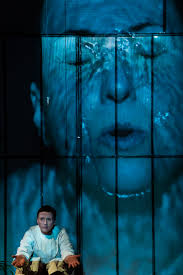
Along with a misbegotten musicalised version of The Secret Garden at Teatr Nowy, Perceval's production was by far the worst thing I saw on a stage in 2025. But, these disappointments aside, there was of course some fine work on Polish stages too. Nowy redeemed itself thoroughly with Agata Biziuk's production Beze mnie jesteś nikim  (Without Me You're Nothing), a penetrating exploration of domestic violence based on Jacek Holub's reporting, accomplished with cast of four and a haunting theatrical vision. 


What's Demeter?, Teatr CHOREA 
(Photo: Agnieszka Cytacka)

And, under the Festival theme of "Awakenings," Teatr CHOREA celebrated its 20th anniversary in inimitable style at Retroperspektywy with What's Demeter? - an exhilarating rollercoaster ride through two decades of risk-taking performances that also worked as a cohesive experience in its own right. An evening of multiple awakenings, indeed. (Report on the Festival here.) 

Also: Burza (The Tempest) (Teatr Jaracza) The Ballad of Hattie and James (Kiln), Hotel ZNP (Nowy), Hic Sunt Dracones (Retroperspektywy Festival)


Hic Sunt Dracones
(Photo: Agnieszka Cytacka)


Sunday, 22 December 2024

Cinema of 2024: 10 Favourite Films (Sight and Sound ballot)

The full list of individual Top 10s for the Sight and Sound Best Films of 2024 Top 50 is up at the BFI website. You can read the full set of lists here.

My Top 10: 


  1. Challengers (Luca Guadagnino, US, Italy)
  2. Emilia Pérez (Jacques Audiard, France, Belgium)
  3. All We Imagine as Light (Payal Kapadia, France, India, Netherlands, Luxembourg, US, Italy, Switzerland)
  4. When Fall is Coming (François Ozon, France)
  5. Perfect Days (Wim Wenders, Japan, Germany)
  6. Dahomey (Mati Diop, France, Senegal, Benin, UK)
  7. On Becoming a Guinea Fowl (Rungano Nyoni, Zambia, UK, Ireland)
  8. Pepe (Nelson Carlo De Los Santos Arias, Dominican Republic, France, Namibia, Germany)
  9. A Real Pain (Jesse Eisenberg, Poland, US)
  10. Blitz (Steve McQueen, UK, France, US)