Showing posts with label National Theatre. Show all posts

Wednesday, 31 January 2024

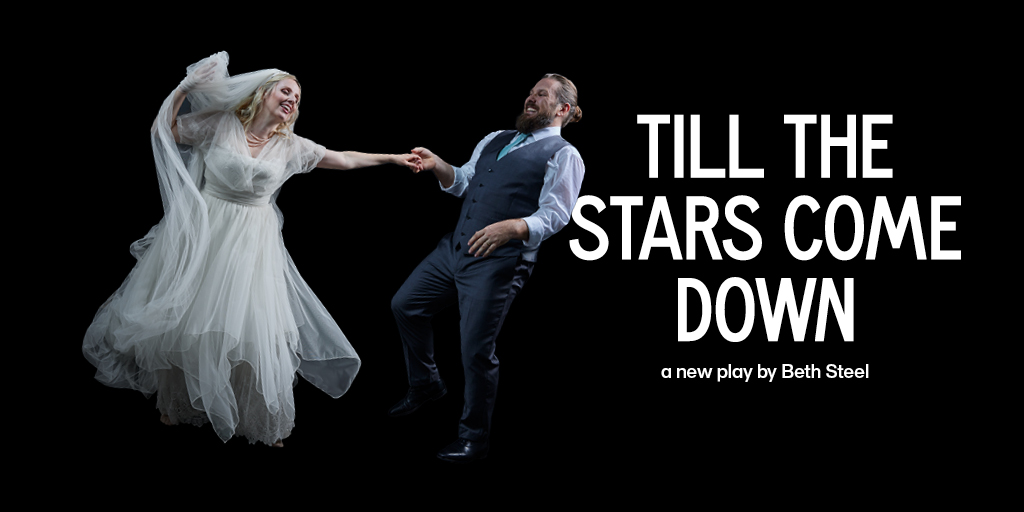
Theatre Review: Till the Stars Come Down (National Theatre, Dorfman)


An Anglo/Polish wedding taking place on a sweltering summer day last year is the focus of the new play by Beth Steel, which gets its world premiere in a vibrant, sometimes exhilarating production by Bijan Sheibani at the NT's Dorfman. Often described (in meant-to-be-praising yet slightly patronising-sounding terms) as a foremost contemporary dramatist of "working-class lives," Steel follows up The House of Shades with another intergenerational Nottinghamshire family drama, albeit one in which events are telescoped into a day rather than unfolding over decades.

Placing the audience on four sides of a set (by Samal Blak) that variously suggests pitch, sparring area and dance floor (and, as lit by the great Paule Constable, also gives off more cosmic vibes at times), the play's slightly Steel Magnolias-evoking opening scene plunges us without preamble into the dynamics of the family on the morning of the big day of Sylvia (Sinéad Matthews), as she, her two sisters, nieces, Dad, Aunt and assorted other relatives prepare for the ceremony.

The man Sylvia's marrying is Marek (Marc Wootton), a Polish immigrant who, having arrived in England on a Megabus with little money to his name, has since successfully set up his own business. Nonetheless, it's a union that certain family members - especially Sylvia's older sister Hazel (Lucy Black) - view with scepticism that's pretty close to outright hostility. And as the booze flows freely during the wedding reception, those xenophobic feelings are exposed, along with sundry other family rifts and secrets - including an illicit attraction that turns out to be a little case of history repeating.

At its big, messy heart, Till the Stars Come Down is yet another three sisters story. Sheibani's production works hard to get a Chekhovian flow of life and activity across, bringing characters of diverse ages into dialogue that's by turns wildly funny, perceptive and touching. (And there's surely a nod or two to the classic Polish wedding play, Wyspiański's 1901 Wesele, in there as well.) Steel's play also has something of the rude English humour and cusp-of-caricature vim of April De Angelis' Kerry Jackson, staged by Indhu Rubasingham in the same auditorium last year - especially in the way it puts un-PC remarks seldom heard onstage (yet heard in Britain itself every day of the week) into the mouths of working-class characters who it refuses to demonise - even if the spectre of "punch up at a wedding" cliché hovers (and is finally fulfilled) at times. 

Overall, the writing here feels fuller, though, and ultimately more adept at interweaving personal and social concerns. Despite the large presence of Polish migrants in Britain since Poland entered the EU in 2004, dramatists have seemed reluctant to explore their experiences or the resulting tensions in UK communities. Sensitive to the context of a post-industrial community, Steel confronts both directly: while Marek expresses pride in the achievements of Poles who've moved to the area, Hazel resents the overburdened services that she blames for her mother's death, and feels threatened by a perceived shift in power. The play's inclusion of only one Polish character could be critiqued, but it works dramatically on several levels, as latent suspicion turns to scapegoating, and pits the family group against the outsider. 

As the bride caught in between, and gradually finding her voice in order to confront a family of more dominant personalities, Sinéad Matthews, always an asset to a production, captivates here. Among her many gifts, Matthews is great at conveying a character's contradictory, unspoken emotions: just watch the mix of embarrassment, pride, sadness and pleasure that crosses her face as Sylvia listens to her dad and then her new husband give their speeches. And there'll probably be few more joyous moments on a stage this year than the one in which Sylvia gleefully shakes off her anxieties to leap up on the table to dance.  

Lisa McGrillis and Lucy Black match Matthews brilliantly as the sisters, the former bringing some beautiful plaintive notes to her characterisation of a once-confident, now-cautious divorcee who's moved from the area for reasons that gradually become clear; the latter treading a difficult but believable line between sharp humour and bitterness as her fears about her own marriage come to the fore. (Black is especially devastating in a scene in which Hazel witheringly maps out her husband's likely future if he leaves her; this is Steel's writing at its best.)

As the rambunctious Aunty Carol, Lorraine Ashbourne relishes the lion's share of the quips, whether lamenting that she's being asked to leave before doing the Macarena, getting down to "Toxic," or revealing a few rather toxic views of her own as the night wears on. And Marc Wootton is perfect as the personable spouse - astute, hearty, curious, adorable when horny, but increasingly disinclined to put up with Hazel's passive aggression, and frustrated at his wife's reluctance to challenge it. 

The production gives the pleasure of a true ensemble, and the cast work together wonderfully well to convey a sense of complicated family life, with further texture provided by Ruby Stokes as Hazel's disillusioned teenage daughter and Alan Williams as the deadpan Dad at odds with his brother (Philip Whitchurch), feeling stuck since his wife's death, and giving a longer view of Polish presence in the town. 

Some elements, such as a "stopped time" conceit, are underdone, and the play's final tonal shift is extreme, with an ending that feels truncated. But Steel's refusal to shy away from big emotions or contrive cosy resolutions is admirable in itself. Essentially, Till the Stars Come Down is about a family reckoning in contrasting ways with change and transition. Expressing the theme, the staging cleverly keeps things in motion, adding a revolve to the central dinner scene, and getting the cast to physically "orbit" each other as Max Richter's recomposed Vivaldi plays. Steel has written an insightful, caustic but large-hearted play full of recognisable characters; both literally and figuratively, Sheibani's highly entertaining production ensures that we see them in the round.


Till the Stars Come Down is booking at the Dorfman until 16 March 2024. Further information here. 

Friday, 7 January 2022

Theatre Review: Hex (National Theatre)


Its press night postponed twice and three weeks of performances cancelled due to Covid cases in the company, the National Theatre's new musical Hex seems to have fallen victim to the condition evoked by its title. Rufus Norris implied as much when he took to the stage before Wednesday night's performance, warmly welcoming the slightly sparse but nonetheless eager audience to a show he described as "particularly hard hit" over the previous weeks. The good news is that, all being well, Hex is now up and running again until 22 Jan. 

As it turns out, the show that Norris (direction and lyrics), Tanya  Ronder (book), Jim Fortune (music) and team have fashioned is a confounding mix of the enchanting and the inept. With a premise pitched somewhere between Into the Woods, Wicked and Tangled, Hex continues in the revisionist fairy tale mode, filtering the story of Sleeping Beauty through the perspective of the fairy who cursed her. 

A stunningly beautiful opening sequence introducing us to that lonely "Fairy in the wood" (played by Rosalie Craig as a part-melancholy, part-mischievous vision in tattered white tulle) promises much but the show only intermittently recaptures the spirit of that blissful opening, notwithstanding the sustained exuberance of Katrina Lindsay's design and the dynamism of Paul Anderson's lighting which create some memorable stage pictures throughout. 

A problem lies in Ronder's book which is patchy, to say the least. Lacking a strong dramatic centre, the show struggles to hold the characters in balance and the timeline is so confused in some stretches that it can be tricky to tell whether days or decades are meant to have passed. The ending is satisfying in terms of bringing the characters together but the themes don't quite emerge - at least not on a first encounter. In addition, Norris too often falls back on some of his bad habits of staging (familiar from his wonder.land and The Threepenny Opera productions, among others), with the cast facing out too much or scampering up and down wheeled-on ladders.

While the carryings-on of an ensemble of poncy princes and Prince-pricking thorns feel like forced fun, the show is at its strongest when at its darkest and most emotional. These are also the moments in which Fortune's score is at its most exciting and expressive, pushing beyond pop/rock parameters into more unpredictable, quasi-classical terrain. The independence anthem "Sixteen" delivered by Kat Ronney's Sleeping Beauty incarnation Rose feels too calculated and generic a belter, but the material written for the show's other women is much more arresting. 

While there's little Light Princess finesse to these proceedings, Rosalie Craig gives another thrilling performance full of swift wit, surprise and soulfulness. She's matched by an astonishing Tamsin Carroll  as  the devouring ogre-momma Queenie, who is disturbed by, then hellbent on satisfying, her cannibalistic appetites. At first it feels retrograde that the show, like wonder.land before it, falls back on making a female character the antagonist. But Carroll brings so much power to the part that she gives the character mythic stature and a tragic dimension that blows the crummier elements of the conception away.  Hex doesn't quite work as it stands, but I'm glad to have seen it: it has scattered moments of magic and daring, and two performances that are for sure the production's blessings.

Hex is in the Olivier at the National Theatre until 22 January. 


Wednesday, 12 February 2020

Theatre Review: The Visit (National Theatre)


"I don't know how long this visit will take," says Lesley Manville as Claire Zachanassian, imperious anti-heroine of Freidrich Dürrenmatt’s  The Visit, to the posse of townspeople who've been eagerly awaiting her arrival.

Audiences at this equally anticipated show - which presents Tony Kushner's new version of Dürrenmatt’s text in a production by Jeremy Herrin - could express the same sentiment. Originally coming in at a whopping 4 hours, Herrin's production has shed 30 minutes during its preview period and might get shorter yet. (Press Night is this Thursday.) It should, for while the show zips by excitingly for most of its duration, a still-overextended final Act indulges in an excess of Kushnerian speechifying and features directorial decisions that dissipate the tension just when the drama ought to be reaching a pitch.

Dürrenmatt’s plays are seldom performed in the UK - I only dimly remember Josie Rourke's production of The Physicists at the Donmar in 2012 - and The Visit hasn't been done in London since Complicité's production in the early 1990s. It's not hard to see why: among its idiosyncrasies, the play boasts a heroine - reckoned to be the richest woman in the world - who returns to her hometown accompanied by an entourage that includes a coffin, a panther and two blind eunuchs (played here, with panache, as a sinisterly upbeat Vaudevillian duo by Paul Gladwin and Louis Martin). 


Still, the play's focus on a gender-based reckoning in Claire's revenge on the man, Alfred Ill, who wronged her by impregnating her then denying paternity chimes with a modish #MeToo-ish emphasis on "toxic masculinity," female power and retrospective retribution, and, as adapted by Kushner, the material feels fresh. 


The playwright has very much claimed the property as his own, replacing the Swiss-German's Mitteleuropa absurdism with baroque Americana. The action is now relocated to post-war, recession-afflicted Slurry, New York, where the townspeople find themselves in a moral quandary when Claire arrives bearing  a billionaire dollars in exchange for a particular deed: namely, the murder of Alfred. 

While Michael Billington has suggested that the play might be read as a specific political parable, "reflecting on Switzerland's ambiguous relationship with Nazi Germany and on the wealth it acquired during the war," the new context works well, allowing Kushner to critique his own country's corruption and consumerist turn in ways that connect to his previous work, in particular his masterpiece Caroline, or Change, which heartbreakingly laid bare the economic underpinnings of human relationships. 


Billington also reckons that The Visit "gains from being staged with a resonant simplicity." But that's not the kind of production that Herrin provides. This Visit is busy, with Vicki Mortimer's teeming set spinning the action from train station to wood to store to town hall to graveyard. At times the resources seem used in an ostentatious, not-especially-expressive way, and perhaps some cuts already made to the production have resulted in the large cast of supernumeraries seeming surplus to requirements. Still, the heart of the piece lies in Claire's confrontations with the community, especially Alfred, and these scenes are brilliantly mined for comedy and tension here. 


Emerging like a vision from a cloud of train smoke, a white-haired, luxuriously costumed (by Moritz Junge) Lesley Manville gives a performance that is everything you could wish for. Either imposingly still or moving jerkily on artificial legs, relishing bitchy quips and well-composed arias about time and love's corruption, Manville operates in a completely different register from the beautiful naturalism of her most recent film role as the cancer-afflicted wife in Ordinary Love (2019) or her last NT role in Mike Leigh's great, underrated Grief (2011). An actress who's still taking risks, her stylization here brings freshness and drive to the stage: she does bold things I've never seen her do - like sticking her rump out to Hugo Weaving's Alfred on their first encounter and meowing in pleasure as he responds.

Weaving partners her perfectly throughout, his gruffness giving way to poetic rapture as he recalls the animalistic passion of their teenage trysts, and then dissolving into fear and paranoia (or is it...?) as he senses the town turning against him.


Of the large ensemble, Sara Kestelman - whose composed, pedantic teacher degenerates hilariously into a drunken mess - Richard Durden as a Justice-turned-butler, Nicholas Woodeson as the blustering Mayor, and Joseph Mydell as the Episcopalian Reverand  stand out. (It's hard to imagine seeing better "reaction acting" this year than Kestelman and Mydell's priceless responses to Claire and Alfred's reminiscences about their sexual past.) Meanwhile, Paul Englishby's fabulous score threads sneaky, jazzy, noirish textures throughout the action. 

With so much to enjoy, the final section's slackness is especially disappointing. The production doesn't go off the rails as badly as The Welkin, but there's a sense of anticlimax as Kushner resorts to shrill media satire - over-directed here - that lessens the impact of the vote scene and its aftermath - along with repetitious, patience-testing rhetoric. The play's revelation of a romantic dimension to Claire's revenge plot is not satisfying, either. If its final section can be tightened and finessed then this will be one of the stronger productions of the year. If not, then Herrin and his collaborators have still crafted a Visit worth making, one that offers the pleasures of both a glittering star performance and great ensemble work. 


The Visit is booking until 13 May at the National Theatre. 

Photos: Johan Persson


Tuesday, 21 January 2020

Theatre Review: The Welkin (National Theatre)


The last time I saw Maxine Peake on film was in Thomas Clay's great Fanny Lye Deliver'd (2019), a properly startling 1650s Shropshire-set "Puritan Western" in which Peake played the title character: a wife and mother who undergoes all kinds of awakenings when two strangers appear at the family farm.

Now, back on stage in James Macdonald's production of Lucy Kirkwood's new play The Welkin at the NT, Peake fast-fowards exactly 100 years to the 18thC. Here Peake plays one Lizzy Luke, a midwife who, along with 11 other women from a Norfolk-Suffolk border community, is called on to form a "jury of matrons" to pass a judgement on the fate of a child-killer, Sally Poppy. The women's task isn't to determine Poppy's guilt or innocence - that's already been decided by a jury of men - but rather to make a judgement on whether the girl is, as she claims, pregnant: a condition that would save her from the hangman's noose.


Kirkwood continues to prove herself a versatile writer in terms of form and subject matter, and The Welkin - a period 12 Angry Women, if you will - is a play whose ambitions are pleasingly big. Unfortunately, and despite the best efforts of Macdonald's production (boldly designed by Bunny Christie), the end results feel rigged, contrived, and a bit of a mess. The opening image - a "split stage" portrait of women's domestic toil - is sensational, and the production stays strong for most of its first half. It's grip slips, however, when  revelations start piling up; after one of these the play loses believability and never recovers, with moral issues and character nuance sacrificed to plot twists, not all of which make sense. (Included in the play-script, a final flourish that would have brought the proceedings together has sadly been snipped from the production.)


It doesn't help that Kirkwood's dialogue swings uneasily between juicy mock-Georgian rural diction, contemporary profanity and flagrant anachronism, with some psychobabble and "woke" statements designed to flatter a contemporary audience thrown into the mix. Laurence Ubong Williams appears as a doctor who genially informs the group that women's bodies represent "a history of disease." In a moment that might have popped out of some recent Twitter exchange, Philip McGinley's Mr. Coombes - there to oversee the women's deliberations - is lectured: "You're not here to speak; it's your turn to listen." A low point comes in a meant-to-be-moving interlude in which the women sing together - not a folk ballad that might have made some thematic and dramatic sense, but rather an iconic 1980s pop song. At such times I couldn't help thinking back to Charlotte Jones' excellent The Meeting, another female-centred "period" play but one which trusted the audience to find its way in the setting without heavy-handed contemporary signposts or pandering to current sensibilities.


Kirkwood's concern with how the justice system fails women certainly gives The Welkin some bite. Yet, despite the research evidently undertaken, there's a lack of sympathetic imagination at work in certain areas, not least the treatment of the crime itself, perpetrated as it is against the child of an upper-class family who are - no surprises here - vicious exploiters and abusers of the poor.


What keeps the evening going through the missteps is that this "jury of matrons" is comprised of a company of great actresses. While Ria Zmitrowicz overdoes it as the accused, June Watson, Jenny Galloway and Haydn Gwynne (sadly stuck with the worst of the "reveals") provide texture and humour in the (long) deliberation scenes. Best of all is Cecilia Noble who contributes another of her cherishable characterisations as the hardliner who sucks up to Gwynne's out-of-towner and identifies "a moral slippage in this country I find most troubling." The cast make the evening worthwhile, but it's disappointing that a play that promises to be an insightful exploration of the politics of women's work and women's bodies ends up as a lurid maternal melodrama.


The Welkin is booking until the 23rd May, and screens in cinemas as an NT Live on 21st May. Further information here. 

Images: Brinkhoff-Moegenburg


Wednesday, 30 October 2019

Theatre Review: The Antipodes (National Theatre, Dorfman)


The National Theatre's Dorfman has become the de facto British home to Annie Baker's plays over the last couple of years. Co-directed by the author with designer Chloe Lamford, The Antipodes becomes the third of Baker's works to premiere there following Sam Gold's production of the Pulitzer-awarded The Flick in 2016 and James MacDonald's staging of John last year. I missed John but quite admired The Flick, which, across a generous (for some, much too generous) three hour running time, highlights changing patterns of cinema presentation and consumption via the interactions of three employees in a small Massachusetts movie-house, as they mop floors, chat about films, and make ill-advised passes at one another. 


The Antipodes continues The Flick's concern with workplace dynamics - up to a point. The play presents a group of characters involved in a series of vaguely defined creative brainstorming sessions overseen by the slippery Sandy (Conleth Hill) in a corporate room that Lamford's design renders in all its swirly carpeted hideousness. Among the participants (who are played as an Anglo American crew here) are Arthur Darvill's Dave and Matt Bardock's Danny, for whom this project isn't their first rodeo with Sandy, and newbies Eleanor (Sinead Matthews), Adam (Fisayo Akinade), Josh (Hadley Fraser) and another (very different) Danny (Stuart McQuarrie) - plus note-taker Brian (Bill Milner)  and Sandy's endlessly sunshiney secretary Sarah (Imogen Doel).

Sandy's "method" is to get the group to tell personal stories, on topics ranging from loss of virginity to their biggest regret. As such, the dynamics of the group are again the focus - watch out for Darvill's Dave sidling up to Matthews's Eleanor to gleefully point out a phone-related faux pas she's just made - and suggestions of exploitation and inequality percolate within the interactions; witness the unceremonious removal of a participant who dares to raise questions about the whole premise of the endeavour by articulating the ways that personal "revelation" can mislead. 


But Baker twists the play into stranger, more surreal territory this time around. This is a piece concerned not just with storytelling and communication but with time, which gets not only discussed in the dialogue but dramatically distorted, for protagonists and audience alike. As always in Lamford's clever designs, details such as a circular light fixture and that swirly carpet function as expressions of the themes, and the thrust-staged production makes us complicit as observers around the conference table, as the tone shifts from relatable, awkward-funny revelation to a night-time sequence that digs into mythic and ritualistic aspects of story-telling. ("This is a sacred space," Sandy tells the group at the beginning, with his suspicious earnestness.)

The weirdness here, like Baker's mumblecore-influenced naturalism itself, can feel self-concious and calculated. But at their best her plays achieve effects that other writers don't get near. Though much shorter than The Flick, The Antipodes challenges and, with its increasingly apocalyptic undertone, unsettles at times. Yet watching the production I felt drawn into a state of relaxed, quite benign immersion that's somehow different from my experience at any other drama: a combined, overlapping sensation of boredom and rapture. 


This has to do with the particular mood that Baker creates, the absence of conventional dramatic tension, and, here, with the qualities that the actors bring "to the table." The company is much more assured than the cast of The Flick was, filling out the somewhat sketchy characters with details that, along with a marvellous late flourish which literally alters our perspective on them, variously complement or contradict their story-telling.

As Dave, Darvill pops his mustard coloured socks up on the table in a way that encapsulates male confidence and entitlement. Burly Matt Bardock pipes up with an excruciatingly graphic, finally moralising STD story, while Hadley Fraser plays Josh as buzzing and animated when he gets philosophical and touchingly apologetic when asking why, umm, he hasn't been paid for three months. 

Fisayo Akinade delivers the most challenging speech - a bizarre, elaborate creation myth for stories - beautifully, while Stuart McQuarrie makes a reminiscence involving a chicken a centrepiece of the show. Conleth Hill suggests a ruthless streak under Sandy's geniality, and Sinead Matthews, always a glory, delights as Eleanor recounts her first sexual experience, curls up on a pile of boxes to sleep, and takes to knitting - a detail that provides a supreme punchline. As the assistants, Bill Milner moves from unassuming note-taker to disturbing participant while Imogen Doel's Sarah loses not an ounce of her perkiness as she recounts a childhood experience that's apparently straight out of a Gothic fairytale. A primary pleasure of the evening is watching these actors interact.

Some bits of physical business don't feel fluid enough yet and Baker's writing has a random air at times, the relay of narratives sometimes smacking of research that feels half-digested. But the conclusion - which juxtaposes one character's loss of faith with another's reconnection with their first foray into creativity - blindsides you with its understated beauty, delivering a memorable, humane ending to this enigmatic exploration of the multiple stories we tell.


The Antipodes is booking at the National Theatre until 23 November.

Photos: Manuel Harlan. 

Thursday, 31 August 2017

Theatre Review: Follies (National Theatre)

 Znalezione obrazy dla zapytania Follies national theatre poster


“Do people really enjoy Stephen Sondheim’s sour sentimentality – songs like ‘Every Day a Little Death?’” wondered Pauline Kael in 1978. The answer, these days at least, seems to be a definite “Yes”: so much so that every major revival of a Sondheim musical becomes a cultural Event and even shows that were indifferently – or negatively – received at their premieres are now all treated as classics of the American musical theatre. As such, it’s no surprise that the hype machine has gone into maximum overdrive for Dominic Cooke’s production of Follies (1971) at the National Theatre, with the production billed as the latest dazzling take on a musical masterpiece.
Is the show a masterpiece, though? There’s no doubt that there are some wonderfully enjoyable bits throughout Cooke’s lush and lively production: whether it’s a charmingly staged “Beautiful Girls”; Janie Dee coarsening up to deliver a biting “Could I Leave You?”; a tap-happy “Who’s That Woman?”, exuberantly choreographed by Bill Deamer; Di Botcher’s knowing, gutsy take on “Broadway Baby”; or Imelda Staunton and Philip Quast wringing maximum emotion from a great “Too Many Mornings.”
A problem for me, though, is that Follies is just that: “bits” – a selection of skits, routines and turns in search of a dramatic centre. It’s no surprise that the show has had so much success in concert presentations, since there’s no plot to speak of, just a situation: the reunion of a group of former showgirls (plus spouses) on the stage they used to share, shadowed by their younger selves.
James Goldman’s book (rewritten for some productions but apparently presented in a slightly tweaked version of its original form here) provides scenes that are just sketchy little blurts. The piece seems to have many more protagonists than it knows what to do with, or that can be developed in any depth. As it is, the characters scuttle around Vicki Mortimer’s ever-revolving, crumbling-theatre set, dropping waspish quips or soppy revelations, stopping occasionally to sing. But don’t expect to learn much about most of them, as they’re shuffled on and off.
Clearly the structure is meant to evoke that of Follies shows, but that doesn’t make it particularly satisfying, conceptually or dramatically. There are few arcs, and so the show feels incohesive, thin, unintegrated: a selection of broads, belting. (At first it looks like Tracie Bennett is going to do something really fresh with “I’m Still Here”, starting the song in a more muted conversational style, but by the end the song’s become a generic camp show-stopper.)
Only four characters - Staunton’s Sally, Dee’s Phyllis, Quast’s Ben and Peter Forbes’s Buddy (played in their younger incarnations by Alex Young, Zizi Strallen, Adam Rhys-Charles and Fred Haig, respectively) - really come into focus, and I’m afraid their relations are mostly marked by the “sour sentimentality” that Kael identified as characteristic of Sondheim. Amid the quartet’s quarrels, Dee is the funniest and Staunton is most successful at bringing humane touches throughout – listen to her lovely light pause before Sally delivers her married name - but it’s not a happy development when we’re cued to understand that the character is simply, in Sondheim’s definition, “crazy.” If Staunton’s much-anticipated “Losing My Mind” feels self-conscious and slightly disappointing, to me, it’s possibly because it‘s part of the “Loveland” sequence: an expressionistic dream/nightmare vision of the characters’ different neuroses that I found to be a bit of a kitsch horror.
By this point, in fact, Follies seems to have degenerated into a something of a style exercise, and it seems that most of its number could be shuffled around and placed anywhere without the show losing too much. Compared to other theatre-maker Sondheim musicals, I’d rank it as better than the endlessly blasting Gypsy but inferior to the nuanced and truly touching Merrily We Roll Along. Cooke’s production is going to get lots of praise, and maybe it’s as good as it could be. But, for all its undoubted high spots, Follies is such a bitty piece of work that it’s hard to imagine any production really making the show cohere.

Thursday, 9 June 2016

Theatre Review: The Deep Blue Sea (National Theatre)


When Terence Davies directed his much-anticipated but ultimately disappointing film adaptation of Terence Rattigan’s 1952 play The Deep Blue Sea in 2011, he commented that he cast Rachel Weisz in the role of Hester Collyer because there was simply no other British actress whom he could imagine playing the part. As it turned out, Weisz seemed too young and a bit lightweight in this particular role, leading some of us to speculate who might have proved a better choice. For me, one immediate candidate suggested herself: Helen McCrory, an actress whose superb body of work encompasses classical and contemporary drama, TV, film and stage.
     
McCrory now gets her chance to play Hester in Carrie Cracknell’s major revival of The Deep Blue Sea at the National Theatre. It’s not the first time that McCrory and Cracknell have collaborated: the pair delivered a stellar contemporary reworking of Medea at the NT two years ago. Their re-teaming on Rattigan’s text is more conventional, but none the worse for that, for the result is a beautiful, sensitive and measured production of one of the greatest, most emblematic pieces of 20th century British drama.

Since Karel Reisz’s Penelope Wilton-starring 1993 Almeida production revived interest in the play (and in Rattigan’s then-underrated drama more broadly) The Deep Blue Sea has established itself as Rattigan’s masterpiece, a work that insightfully explores the complexities of love through the experiences of a middle-class woman who, having left her husband for a younger man, attempts suicide as the new relationship sours. For all the drama’s intimacy – it unfolds entirely in the sitting room of Hester and Freddie’s shabby boarding house flat – the piece has its wider resonances. Indeed, Dan Rebellato, in his Introduction to the Nick Hern edition of the play, argues for The Deep Blue Sea as “a much broader, more social play, concerned with the pain suffered by those caught between their desires and a society which will not tolerate them” (xxi). (Mike Poulton’s new play, Kenny Morgan, currently at the Arcola Theatre, probes the real-life events that inspired the drama, one of several recent plays that have used  - or exploited - elements of Rattigan’s biography for dramatic purposes.)

Cracknell’s production attempts to give a sense of that wider social context, and of other lives unfolding around Hester’s. The ambient transition between Acts 1 and 2 (the production’s most self-conscious, dissonant moment) offers a glimpse into some of the other flats in the building. These elements feel half-baked, though, and could have been taken further; the large ensemble cast seems squandered. In addition, although Rattigan’s stage directions specify that the action takes place in “a big room”, designer Tom Scutt arguably overdoes it here with a spacious set, lit in melancholy, vaguely aquatic tones by Guy Hoare, that doesn’t quite help to convey the claustrophobia and entrapment of Hester’s predicament.


Helen McCrory in The Deep Blue Sea (Photo: Richard Hubert Smith)

McCrory’s performance conveys it, though. Her illuminating interpretation captures the character's clear-eyed assessment of her situation, her sexual passion for Freddie, and her deep despair. A calm surface conveying hidden depths, McCrory’s fiercely intelligent, economical delivery matches perfectly the beautiful restraint of Rattigan’s writing (listen to the way she inflects “Just my love” when asked if she has a message for Freddie). It also allows moments of heightened desperation to really resonate. Alongside some of the structural shifts and weak additions that messed with the dramatic tension of the material, part of the problem with Davies’s film version was that Weisz’s Hester seemed so much younger than her husband William (as played by Simon Russell Beale) that the transgressiveness of the character’s absconding with a younger man was considerably diminished. This isn’t a mistake that this production makes. Moreover, McCrory goes beyond the individual character to create an archetypal figure here: something similar to what Pedro Almodóvar, in his remarks about Cocteau’s La Voix Humaine, described as “a woman sitting next to a suitcaseful of memories, waiting miserably for a phone call from the man she loves” (Almodóvar on Almodóvar, p.80).

Though adept at indicating the way in which the character's frustrations at the direction of his life lead to his callous treatment of Hester, Tom Burke, as Freddie, might do more to suggest the charm and charisma that made Hester fall for him. The other performances are extremely well judged, however. McCrory’s scenes with Peter Sullivan, as the cuckolded William, are especially good, with awkwardness giving way to tenderness as the pair fall into reminiscence about their shared past.

The boarding house characters - variously offering moralistic judgement, advice, and practical help - are also vividly drawn. Yolanda Kettle and Hubert Burton are funny and touching as the well-meaning Welches, and Marion Bailey brings to the production the kind of wonderful naturalness she brought to another landlady character, Mrs. Booth, in Mike Leigh’s Mr. Turner (2014). (This production is particularly good at suggesting a complicity between its three very different female characters.) As the mysterious Mr. Miller, Nick Fletcher hits just the right note of shrewd detachment and compassionate concern. Fletcher’s wrenching final scene with McCrory brings out the still-potent poignancy and wisdom of Rattigan’s humane vision, in which a lover may prove lethal but a near-stranger might be a saviour, in the end.

The Deep Blue Sea is booking at the National Theatre until 21 September.


Thursday, 2 June 2016

Theatre Review: Sunset At The Villa Thalia (National Theatre)


Alexi Kaye Campbell remains best known for The Pride, his 2008 play (which debuted at the Royal Court and was later presented Off-Broadway) which juxtaposed two versions of gay experience: one set  in the repressed '50s, the other in the libertine 00s. Just opened in the National Theatre’s Dorfman auditorium, Campbell’s new play, Sunset at the Villa Thalia, is also structured with a significant, albeit much less radical, time leap. Its second Act moves ahead nine years to assess the fall-out of various decisions made by its quartet of protagonists.

The drama opens on the Greek island of Skiathos in 1967, on the cusp of the coup that placed the military in power for seven years. An English couple, Theo and Charlotte, are staying on the island, as Theo, a writer, works on his new play. Theo and Charlotte have made the acquaintance of an older American couple, Harvey and June. Harvey, it emerges, works for the US government, and may be implicated in the political unrest engulfing the country. Under his highly persuasive influence, Theo and Charlotte end up purchasing the villa in which they’re spending their trip, buying it off of Stamatis and his daughter Maria, who are emigrating to Australia.

Fast-forward nine years and Theo and Charlotte appear to have settled  into life on the island, and are raising a family there. But the reappearance of June and Harvey, jaded from  their recent experience in Chile,  brings both personal and political tensions to the fore. 
 
Talky, intimate and low-key, Campbell’s play is old-fashioned in its virtues, taking a potent political situation and dramatising it through the highly relatable personal interactions of its protagonists. At times the piece might put you in mind of Clare Peploe’s  1988 film  High Season, which explored the relations between ex-pats and Greek islanders in a more comedic vein, or even of Luca Guadagnino’s recent, much more highly strung A Bigger Splash.

At first it looks like the play will simply be pitting an arty British couple against a pair of brash American imperialists, but Campbell complicates this set-up in subtle and intriguing ways, giving the actors many more nuances to play with. The cast is superb, with terrific, detailed work from Ben Miles as the charismatic Harvey, Pippa Nixon as the increasingly self-righteous Charlotte, and Sam Crane as the dreamer Theo. Elizabeth McGovern very touchingly conveys the loneliness and quiet despair underpinning June’s breezy persona, and there’s vivid support from Christos Callow and Glykeria Dimou as the  islanders.

Playing out on Hildegard Bechtler’s superbly realistic villa terrace set, and with evocative lighting by Natasha Chivers and a fine sound design by Tom Gibbons, Simon Godwin’s production finds the writing’s strengths and conjures place and period wonderfully well.  I’m not too sure that Campbell’s suggestion that the purchase of a property abroad can wreak damage comparable to American interventionism stands up to much scrutiny, and in its final stages the play comes perilously close to taking an anti-migration stance, implying that the Greeks' decision to move out of the country (and the decision of the English to move in) has violated some kind of natural, spiritual or historical order.   Still, this is an absorbing new play that, in its quiet way, gives much to debate, making for a rewarding, worthwhile evening.

Reviewed for PopMatters. 

Wednesday, 1 June 2016

Theatre Review: The Threepenny Opera (National Theatre)

Rory Kinnear in The Threepenny Opera (Photo Richard H. Smith)
My review of Rufus Norris's production of The Threepenny Opera at the National Theatre is up at PopMatters. You can read it here.

Thursday, 25 February 2016

Theatre Review: Cleansed (National Theatre, Dorfman)


My review of Katie Mitchell's production of Sarah Kane's Cleansed at the National Theatre is up at PopMatters.  You can read it here. 

Tuesday, 24 November 2015

Theatre Review: Evening at the Talk House (National Theatre, Dorfman)


Notwithstanding a few gems, and unless the next couple of weeks yield something really special (Anita Dobson and Katie Price job-sharing in panto, anyone…?), 2015 can’t be considered to have been an absolutely vintage year for London theatre, overall. And things have now reached a new low at the National with Ian Rickson’s production of Wallace Shawn’s latest play Evening at the Talk House. When Rickson’s production started previewing last week, it wasn’t long before the verdict was in via Twitter, with several people deeming the play to be “the worst thing ever staged at the NT” or even “the worst thing I’ve ever seen in my life.” “What does Twitter know?” sniffed the man seated next to us before last night’s performance began.  Well, in this case, quite a lot, as it happens.

It’s true that knee-jerk reactions on social media can mean that a stark “good or bad” consensus can build around a production too quickly these days. This happened almost exactly three years ago at the Royal Court, with Martin Crimp’s In the Republic of Happiness,  a play that that was immediately – and, in my view, unfairly - dismissed by most early commentators online. 

Actually, Evening at the Talk House shares some similarities with Crimp’s play: notably, a jaundiced view of the contemporary world and the workings of power therein.  But where  In the Republic of Happiness was illuminated  by moments of great theatrical brio and passages of very beautiful, intelligent writing, Evening at the Talk House is a leaden, pitifully half-baked creation. There’s a hint of Agatha Christie – and even of Theatre of Blood –  to the premise, which concerns the reunion of a group of theatricals at the club they used to frequent, and the strong suggestion that one of the assembled company may mean the others  harm.

But, after a relatively promising (if exposition-heavy) first twenty minutes (which includes the production’s only arresting image, as the protagonists silently reunite, while Josh Hamilton’s playwright, Robert, introduces them to us), the play gets worse as it goes along. It’s as if Shawn had written down a list of issues that were irking him - declining cultural standards, TV versus theatre, the terror threat and the response to it, the seductions of nostalgia - without really bothering to shape them into a cogent dramatic form. Sure, there’s enough topicality to certain references to generate a few uneasy audience titters. But the approach to the themes is so feeble that the play builds no tension, no cumulative force. The revelation of what some of the characters are up to isn’t shocking or even chilling, as it’s clearly meant to be. Rather, it’s just silly and unconvincing.  

Rickson’s dour, lackadaisical production can’t get a rhythm going, for all that The Quay Brothers’ design tries to inject a bit of mild Gothic ambience into the proceedings. The actors (including Shawn himself in the decidedly masochistic role of a luckless, beaten-up actor named… Dick) don’t find their footing, either. There’s a wonderful moment when Sinéad Matthews and Anna Calder-Marshall, as the club’s hostesses, first appear together. But even these two great actresses – specialists in magnetic eccentricity, the both of them – don’t distinguish themselves here. (Using her beautiful raspy-squeaky voice for all its worth, Matthews’ valiant effort to bring some emotional truth to a final encounter is palpable – and painful.)  Ultimately, the limp material seems to have defeated everyone. Written without insight, wit or shapeliness, Evening at the Talk House is inert on the stage, lacking even the energy or the craziness to be labelled a true folly.

Booking until 30th March. 


Tuesday, 15 July 2014

Theatre Review: Medea (National Theatre, Olivier)


As Lucy Jackson has summarised recently, the myth of Medea is one that continues to resonate and reverberate powerfully in our culture, inspiring fresh revisionings in literature, art, film and on stage. That said, the 2012 incarnation of Euripides’s text - Mike Bartlett’s soap-opera-verging-on-sitcom variation for Headlong, which set the story in a contemporary English suburb  - struck me as mostly ridiculous, despite the committed efforts of Rachael Stirling in the lead.

Carrie Cracknell’s major new production for the National, which had its first preview on Monday, proves a much more assured, arresting and absorbing experience than Headlong’s. (This, despite the coughers, over-laughers and people who had certainly NOT switched off their fucking mobile phones who sadly constituted some of the first performance’s audience.) It’s a potent new version that - in aspects of its aesthetic as well as its overt, bracing feminism - feels all-of-a-piece with Cracknell’s recent projects: her much-admired A Doll’s House for the Young Vic and this year’s Blurred Lines at the NT Shed.  I don’t want to comment too specifically on the staging at this early point in the run, so as not to spoil the pleasure of discovery for others. But suffice it to say that Cracknell and Ben Power (who contributes a supple, fluid and robust translation) succeed in finding a contemporary context for the story that (unlike Bartlett’s) doesn’t make you cringe, that still allows for grandeur, and that cuts to the dark heart of the play’s exploration of the damage wrought by betrayed and thwarted love. Tom Scutt’s design - initially underwhelming; gradually revelatory - captures  precisely the production’s mixture of the intimate and the epic, the feral and the domestic. As does the score by Goldfrapp (a band whose charms have mostly been lost on me, I have to confess), who come through here with a series of evocative soundscapes that move compellingly from twinkling atmospherics to swelling choral surge.  
The production won’t be as divisive as the National’s spectacularly polarising Edward II was last summer, but it’s still one that audiences will debate and argue over, I think. There are, it must be said, some odd aspects: the under-utilising of Dominic Rowan as Aegeus , for one.  And while the all-female Chorus is a marvellous touch, and mostly brilliantly integrated, I could have lived without the Pan’s-People-via-Pina-Baush contortions that Lucy Guerin’s choreography puts them through at various points. 
Still, the production grips and moves. And at its centre is a performance by Helen McCrory that is as thrillingly rich and inspired as you could wish for.  Fierce yet fragile, bitingly witty and savage in self-laceration, the captivating McCrory shrinks the auditorium to intimacy as she also finds a devastating vulnerability and, yes, tenderness in the character, honouring all the contradictions of a woman turned “expert in terror, expert in pain.”  It is, already, a performance to haunt you, and one that, in the production’s stunning final third, communicates the play’s tragedy with the force of a thunderclap.

The production runs for 1 hour 40 minutes without interval. Booking until September 4th. http://www.nationaltheatre.org.uk/shows/medea?dates=all#tabpos 


Thursday, 26 September 2013

Theatre Review: The Light Princess (National Theatre, Lyttelton)


Jerry Springer: The Opera, London Road, the sublime Caroline, or Change: the musicals staged at the National Theatre during the reign of Sir Nicholas of Hytner have all been, in different ways, radical, challenging affairs that have stretched the form in new directions - a deliberate attempt, it would seem, to get away from the cosier, Broadway-leaning inclinations of Trevor Nunn’s tenure as artistic director of the theatre. The Light Princess, Tori Amos and Samuel Adamson’s swooningly ambitious adaptation of George MacDonald’s 1864 fairy-tale, demonstrates once again Hytner’s commitment to creative, non-conservative musical theatre programming. This much-anticipated show – the first foray for both writers into the musical genre – has been long in development, as my two interviews with Adamson (here and here) attest. But, on the evidence of last night’s staggeringly confident and rapturously received first preview, it’s been worth every single second of the wait.

Taking MacDonald’s story about a young girl cursed to have no gravity merely as their starting point, Amos, Adamson and director Marianne Elliott – herself flying high after War Horse and The Curious Incident of the Dog in the Night-Time – have fashioned a fantastically fierce, fresh, frank and funny feminist fable. You won’t find an evil spinster Aunt dispensing a curse in this version; instead, this story is – true to form for Amos – more concerned with the damage Daddies do.

The action unfolds in two warring kingdoms, Lagobel and Sealand (gorgeously rendered in Rae Smith’s sumptuous design), where the teenage heirs to the respective thrones, Princess Althea and Prince Digby, have reacted to the deaths of their mothers in contrasting ways. The response of the Princess - played and sung with breathtaking passion, biting wit and luscious sensuality by the stunning Rosalie Craig - is weightlessness, which is presented here as a psychologically-motivated escape route for the avoidance of pain. In contrast, Digby (excellent Nick Hendrix: as sweet of voice as he’s buff of bicep) has become heavy-hearted and solemn in his grief. When the two meet in the Wilderness that separates their territories, a love affair ensues – one that certainly doesn’t win the approval of their fathers or the populace.

Aided and abetted by many of her collaborators on her previous NT-originated successes (including Smith, choreographer Steven Hoggett and puppetry director Finn Caldwell), Elliott makes the production another thrilling “total theatre” experience: one that’s equal parts cutting-edge and traditional. A lovely animated prelude outlines the histories of the kingdoms, but a simple sheet serves initially as a lake for our two lovers to liaise in. As per War Horse, the creatures of the kingdoms are puppets, designed this time by Toby Olié. The most graceful of these is Digby’s majestic falcon companion Zephryus (Ben Thompson); the funniest a little pink mouse who gets a mighty gross-out moment. And the Princess’s lightness is conveyed by two means, with the undulating Craig sometimes borne aloft by wires, at others by the bodies of black-clad acrobats.

You might fear (as I did) that all this activity will swamp the story. But no. The narrative feels very intricately worked out by Amos and Adamson in terms of theme, imagery and metaphor, and all the elements enlisted by Elliott contribute to its lucid, expressive telling. There are some brilliantly surreal stage pictures which I won’t reveal, but suffice it to say that the director and her team find wonderful ways to bring the story’s revision of fairy-tale tropes to life and into a contemporary teen context that still feels timeless enough, not least in a sublime scene in which Althea’s father King Darius (Clive Rowe) enlists the help of a series of suitors to bring his daughter down to earth. (As in Wicked - a spiritual sister to this show in its revisionist attitude, near-homophonous heroines and firm female-focus - a song called “Defying Gravity” could easily find a home here.)

Then there’s the music. Supple and robust, delicate, playful and strident by turns, Amos’s score is a glorious thing, intricate, demanding and complex at times, instantly hummable at others, and Adamson’s book matches it for beauty, cheek and charm. Amos’s emotional range as an artist has always astounded, and she brings that to bear here in a quirkily structured, diverse score that can move fluidly from wild humour to melancholy, from swaggering aggression to the most tender of laments, in an instant. With her regular collaborator John Philip Shenale overseeing the orchestrations, liberal use of strings and woodwind, and - yeah! - a Bosendorfer in the pit (where dynamic Music Director/Supervisor Martin Lowe can be seen displaying his customary infectious exuberance), it’s perhaps no surprise that The Light Princess is closest to Amos’s classically-inspired Night of Hunters project musically. And yet it’s totally fresh and distinctive too: Amos is in no way resting on her laurels or repeating herself. There’s a stirring soul and gospel moment here, a pop/rock flourish there, but everything feels cohesive and organic, the music emerging from the protagonists and their ever-shifting emotional states.

There are some jaw-dropping duets, not only for Althea and Digby but for other characters too: a stunning sustained sequence finds the Princess’s loyal companion Piper (brilliant Amy Booth-Steel) fiercely challenging the King for his belligerence. Disgracefully wasted in The Hothouse, the great Clive Rowe does not go to waste here as the patriarch made tyrannous by loss. At one point scarily bellowing his belief in his own authority, he later gets a standout aria that’s one of the production’s most intensely moving moments. And the contributions of an exceptionally well-drilled ensemble are also very fine.

Meanwhile, Amos’s lyrical dexterity – her delight in word play, allusion, assonance and alliteration – is also on display. Book and lyrics allow genuinely complicated emotions into them, and when Digby speaks about being indoctrinated by his father’s beliefs, one hears the voice of many Amos characters, challenging themselves to overcome their reliance upon others’ opinions and judgements. There’s a gorgeously rebellious spirit to this musical, and a clear political dimension too: here the “duties” of marriage and monarchy – as expressions of patriarchal power – weigh a girl (and a boy) down. (Which makes the conclusion, for all its cheeky twists, look a tad too conventional, it must be said.)

For those of us to whom Amos’s music has meant so very much over the years, it’s especially exciting and moving to see her venturing into this new form and thriving there. But I think it’s fair to say that even those who aren’t dedicated Toriphiles will find plenty to engage and beguile them here. “I don’t fly; I float,” Althea is given to reminding those around her. This show flies and floats. It’s an awesome achievement for all concerned and deserves to run and run.

The Light Princess is currently booking until January 2014. Further information at the National Theatre website.

Friday, 16 August 2013

Another Sorta Fairytale: A Second Conversation with Samuel Adamson About The Light Princess


Samuel Adamson: Photo by Simon Annand

Back in summer 2008 I had the opportunity to talk with Samuel Adamson about The Light Princess, the musical adaptation of George MacDonald’s 1864 fairy-tale that the playwright was collaborating on with Tori Amos for the National Theatre. (You can read that interview here.) At the time Adamson confirmed that there was still “a lot of work” to be done on the show, and, a full five years on, The Light Princess will be making its much-anticipated debut at the NT’s Lyttleton in September. In the interim, Amos and Adamson have worked on refashioning and redrafting the piece, while not slacking on their other individual projects. The ever-industrious Amos has released four major studio albums in the intervening five years, while continuing to tour extensively everywhere from Anaheim to Zabrze. Adamson, meanwhile, has had his plays Mrs. Affleck and Frank & Ferdinand produced at the National, contributed to Headlong’s 9/11-themed Decade project, and adapted Alexander Ostrovsky’s Larisa and the Merchants for the Arcola. His latest work, Gabriel, is currently at Shakespeare’s Globe. Adamson kindly took some time out from a busy rehearsal schedule to talk frankly and insightfully about the evolution of The Light Princess, the pleasures and challenges involved in the show’s development - and how “music is it.” Here’s our conversation.


AR: Sam, it’s been five years (!) since we first spoke about The Light Princess. Musicals famously take a long time to develop and you said back in 2008 that there was “a lot of work” still to be done on the show: that you and Tori were “still discovering it.” I’m sure that you won’t want to give too much away at this stage, but could you talk a little about some of the ways in which The Light Princess has evolved in these last few years, in terms of its characterisation, structure, themes, tone? In what ways has it become, as Tori said in an interview, “a different show” from that which you had five years ago?

SA: Both Tori and I have been working on lots of other things in that time, and yes, all musicals have a long gestation. Most take at least this long. What I really think is this: Tori and I didn’t know each other that well when we started. We thought we did, but we were too reverential with each other back then. Tori’s a tough cookie, but we’re both quite polite people. She did her work, I did mine, we tiptoed around the fact that often we were not writing with one voice. I suppose I was a bit awed by the enormity of her talent. She’s an astoundingly original composer. I don’t think she’s written one melody I haven’t been moved or surprised by in some way, often because of its harmonic complexity, those wild chord structures that come deep from her gut.

And yet reading back over the interview, I can see why Tori and I are still together. We have a mutual respect for each other’s work and the different demands on us. There was hope for us as a writing team, back then. Hope that given time we would be rigorous with each other, that we would have the courage to really analyse whether we were speaking as one. It’s a cliché, but it’s like a marriage. I needed to spend a lot of time with Tori, really get to know her as a writer and person. She needed to do the same with me. We needed to become friends and sparring partners, and leave the project to then come back to it. We needed to really ask ourselves how writing a musical was different from our other work, even when that other work was collaborative. At first, I spent a lot of time fitting in with Tori’s schedule and travelling to work with her in Cornwall. That’s changed over time: she’s worked a lot with me in London, as well. We’re not afraid to be honest with each other, to question each other. So the piece has evolved because Tori and I have evolved. Whatever happens to our musical, we are a proper team. I haven’t really answered your question, but regarding all four of those things you mention, we have been on journeys related to our own lives and our relationship to each other. So big changes! Honestly, when I gave the interview last time, we were nowhere near finishing, and I knew that, I bloody knew it, Alex, which is why I said “there’s still a lot to do”!

What have been some of the main challenges that you and Tori have had in redrafting and rewriting the piece? How has the process of reworking the text compared to some of the other adaptations you’ve worked on: All About My Mother, for example?

Although The Light Princess started with an existing story, we have departed from that source in all sorts of ways. It’s not an adaptation in the sense All About My Mother was. The form of the play of Mother is unlike the original film, because film and stage are completely different. But the content didn’t differ, so much. This really has been about building everything from the ground up: characters, story, themes, music, lyrics, dialogue. And most of the story is conveyed by music, by song; it’s unlike a “straight” play in every way imaginable, so the process has been unlike any play I’ve worked on. It’s a musical, and a music-dominant one: it’s nearly through-sung. The challenges? Being patient, I think. With each other and with our collaborators and with our characters, who have often needed wrangling. Also, the challenge of making songs truly dramatic. In a musical, or at least in the integrated musical Tori and I found ourselves wanting to write, at the end of 90% of the songs or musical sequences, the character must be in a different place from the place where he or she started. And in 100% of them, the story must have moved on, and moved on engagingly. Songs are dramatic scenes, in the theatre. This isn’t necessarily true of other kinds of song-writing, where you can swirl around an emotion or an event but the character (if there is one) or the narrative (if there is one) can remain unchanging. You can have a song about a break-up in a relationship and the emotion of the song can be extremely powerful because everything except the music is essentially in stasis. You broke my heart, you broke my heart, you broke my heart you bastard, end song. This doesn’t work in a musical, really: the intensification of “you bastard” isn’t enough. Even if the music has taken you to a completely different place, the words haven’t taken the character to a new place. You can have purely emotional songs in musicals, but only for one or two song moments. Elsewhere songs and musical sequences need to drive forward the plot.
 
That’s a great point. One of the things I’ve always admired about Tori’s song-writing is that her songs tend to be mini-dramas with definite emotional arcs. Her characters are usually in a different place, a different psychological state, by the conclusion of the song.


Yes, Tori is to her very core a story-teller, and that is why the theatre is a natural home for her. But the discipline of active, dramaturgically sound musical narrative with stakes and jeopardy for three-dimensional characters was a challenge we both had to meet. With time, we began to see that we could work as if we were one writer. Tori is all about story and character. She feels dilemmas and predicaments and wants and obstacles deeply. So she is the “book” as much as I am and I like to think that I am part of the “score”. I don’t compose notes or write harmonies and she doesn’t write dialogue lines or build the overall architecture, but we have both had enormous roles in the other’s job. In addition, she has welcomed me as a lyricist. Rewriting is fun. I’m not sure it was what Tori was used to. But she’s used to it now, that’s for sure. She loves it. When we need new music, or when something existing needs rethinking in order to make the moment clearer or to help with staging, or simply to make things better, you cannot keep that woman away from the piano. Always, of course, wearing heels.

When we spoke before, the show had really been developing from your close collaboration with Tori (in heels), but obviously you’ve been workshopping the piece intensively since then. How has that workshopping process been helpful in terms of the show’s development?

I might as well tell you that early on we had what was, for me, a tough workshop … After that, and, by the way, after Night of Hunters, we really pulled our socks up. Tori and I wrote two big sequences, one in each act, in which music, lyric and dialogue were truly integrated, and this changed the entire score, story, tone, form and, most excitingly, our process. We got our confidence back. The next workshop was much more creative. Tori and I had our own room at the National Theatre Studio, and with Tom Brady, our pianist, we would rewrite most days, whilst the actors and Marianne Elliott, our director, were trying things out in another room. I’d go home at night and rewrite lyrics and write new ones and refine story and Tori wrote music where she was staying. We’d meet early in the mornings and present our work to each other and then make it better all day. We reworked a lot of existing material in our little room with tea on the go and sandwiches and people popping their heads in every now and then like we were exotic animals at London Zoo. It was pretty exhilarating, like how you imagine movies were written under the studio system, two Dorothy Parkers in the Writers’ Block. No booze, though.

We learned a lot from seeing actors putting the material on its feet, and having Marianne interrogate the story. I think that workshop was three weeks – which was very luxurious, not something either of us took, or take, for granted. Only a subsidised theatre could allow writers such time and space to refine their ideas. The bulk of our writing has happened at home, at my house and at Tori’s in Cornwall, but that workshop was a really productive one, very tiring and exciting. At the end of it, we felt we had a show. That really was the start of life proper for The Light Princess. And I’ve really felt the benefit of that workshop now we’ve started rehearsals. Of course rehearsals mean changes for the writing but on the whole the rigorous testing-out of the words and music happened in the workshop.

Have you had occasion to sing to Tori again, following the rendition of a Carousel number that you talked about last time?.

Poor Tori. I sing to her all the time. On the phone, in her office, in my kitchen, down the flipping street. I have to: the best way to convey lyrics to her is to sing them at her. She has been wonderfully patient. Only once did she lose her temper, and start clicking her thumbs at me to keep me in time. I thought, “Fair enough”. I can read music, I can hold a tune, but I’m pitchy, and it’s not attractive, and Tori has been remarkably kind to me. She acts, you know. We read to each other. It happened very early on. She performed her songs to me, and she just expected me to read scenes back at her. I thought, “Fair enough”. We act and sing up a storm together. You’ll just have to believe me.

There’s an Amos/Adamson duet album somewhere in the future, clearly! Given that the show is recommended for ages 13+ it’s obvious that you’re not going for a cosy family musical here, but something darker and more subversive. Was this a conscious decision or something that just naturally evolved as you developed the themes of the piece? From the publicity blurb, grief seems to be major concern in your version in a way that it’s not, so explicitly, for MacDonald.

 A conscious decision. What is lightness? Why is the girl light? I must be clear about this: I love the original story. It’s a delight. [But] I think for a contemporary theatre audience, it’s not enough to say “the princess never cried and found everything hilarious till the prince sacrificed himself for her”. She’s not a very interesting character in a dramatic context if she is not only light-bodied, but also light-minded. Lightness, for us, is a form of grief. A retreat. An emotional buffer against the darkness of the world. We explore this in our story: why she is like she is and what life teaches her to get over it. The same for the prince. So it’s a story about finding out who you are as you’re entering adulthood. It’s for everyone older than 13. It’s really not for young kids. MacDonald’s central idea remains, his very brilliant, beautiful and powerful metaphor. The girl must understand loss, and cry, “feel weight”, before she can come to earth. And the theme of sacrifice remains, as well. But we’ve made the story our own, and we spend time giving our two lead characters a voice, so that we can truly understand why the princess is light, what it means to her, what it says about her and her world.

I presume that one of the key characters in the story, the evil aunt who curses the Princess, hasn’t been reinstated in your version. What have been the challenges of creating a new kind of antagonist or “conflict” for the show?

There’s no story without conflict. I’m not going to tell you exactly what it is: you’ll have to come and see it! Suffice to say the prince and princess are from opposite sides of the tracks and the princess has to take on evil in her world. We weren’t that interested in lightness being a curse. More that it was the princess’s personal response to bleakness. The evil aunt is of course a fairy-tale trope, and in the context of the original story, which is a delicious satire of the fairy-tale, she’s crucial; she’s the Maleficent character who propels the plot, and MacDonald takes some pleasure in satirising her. His readers were familiar with the archetype. For us lightness is a complex emotional and psychological state, not an enchantment, so she wasn’t necessary. Our story chooses to be about fathers and children, in a fairy-tale context, not stepmothers or evil aunts and children. That’s just the path we’ve chosen.

I’m glad you mentioned MacDonald’s “delicious satire of the fairy-tale.” Re-reading the story recently I was surprised by just how funny and irreverent it is – in its attitude both to the fairy-tale genre and to Victorian social morality. Given the great humour of your and Tori’s work, I wonder how you’ve gone about translating the comedy of the text into a musical context. Are you being as irreverent with the musical genre as MacDonald is with the fairy-tale?

That’s a really interesting question, Alex. In fact MacDonald’s irreverence with the fairy-tale genre is something that got us into a bit of hot water early on. Tori was writing comic songs that I think she thought were “musical” and I was writing dialogue that sent-up fairy-tales. It was pastiche we were up to, and we were up to no good really, because neither of us is that kind of writer. Pastiche is different from humour. When MacDonald was writing, it was fresh, radical even, to make fun of the fairy-tale. Now, everyone does that. And the second you start, unless it’s a very sophisticated take like Into the Woods, which has obviously been done, it’s very easy to end up in Men in Tights territory. What we found was that it was a mistake to send up the fairy-tale. Instead we had to find the centre of the girl’s story: who is she, how does she feel, what does she want? In pursuing all of those things, we began to see it on the one hand as more modern, but also, curiously, on the other, as more traditional in terms of its form and tone. I went back to Grimm and Andersen and Angela Carter and really looked at how fairy-tales work and why they are timeless. I said to Tori, I want to start this show with the words “Once Upon a Time”. I wrote this phrase: “Once upon a once a, once upon a time, lived a princess and a prince in kingdoms gold and blue” and Tori set it to music. I said, we can’t send it up like the Shrek, movies or make it sophisticated, sardonic and essentially metropolitan like Into the Woods. And we can’t hope to achieve the light, knowing irreverence of MacDonald, who lived in a purer time. I want to tell the story straight. Find humour of course – but not place it in any particular time. So we put our protagonist on a traditional Red Riding Hood-type journey through the forest. The rite-of-passage.

As for the musical theatre form, I hope it’s fresh in a few ways: there’s a piano in the pit for starters, which is surprisingly rare. The songs rarely - if ever - conform to traditional AB, AB, CB structures. We’ve looked a lot at musicals. Tori and I both love musicals. Disrespect musicals at your peril if you’re writing one: the best are finely wrought. We’re not trying to reinvent the form, though hopefully we’ve done our own thing. I’m obsessed with the notion of music as the engine for story. There’s a part of me that thinks it’s as much “opera” as “musical” but honestly all these terms are unhelpful, as anyone who creates or sees music theatre knows. There it is: it’s a piece of music theatre.


In the comment you made for PopMatters about collaborating with Tori last year you talked about her music having “the expansive drama of opera” and referred to “the twists and turns of her compositions, her complex harmonies … with their sudden curves into brightness.” Could you comment any further about the variety of musical styles in The Light Princess?

I’d prefer not to give too much away about the score! Tori’s music is rhapsodic and folk-like at times; jagged and rhythmic; there are extended sequences of musical story-telling that I’d describe as tone poems. I’m not being too indiscreet if I say that the orchestral world of Night of Hunters is not dissimilar to The Light Princess. One thing you do get with this score is that Tori has written every note. Certainly Martin Lowe our musical supervisor and John Philip Shenale our orchestrator have made invaluable contributions, but Tori has written all of the underscoring, all of the dance music, in addition to all of the music for the songs and sequences. That’s rare in musicals: it’s difficult for the composer because it means she has to be on hand at all times during rehearsals. Someone else is often engaged in rehearsal to create music for dance sequences based on the show’s themes. Tori is having none of that! She’s there all day every day. Every single note is story and character-based, as per our journey together as writers. And every single note is the note Tori wanted in relation to the notes around it. Even for transition or underscoring, the music has been carefully composed after many discussions with me. I do think she has written a very cohesive score. We weave themes not just through individual songs, but through the course of the evening. It’s a score that will bear repeated listening, I hope! It’s full of little surprises, little thematic cells that appear then reappear in new guises. It’s also one of the benefits of taking our time. We’ve been able to do lots of interesting things with leitmotifs. Pardon the pun.

Both your work and Tori’s reveals a fascination with complex, nuanced female protagonists. How does the Princess fit in? What kind of heroine is she?

She is a smart, funny, grieving, truculent, defensive, adventurous, contradictory and ultimately loving teenager. The story is her journey towards adulthood in a world that doesn’t understand her.

Let’s talk about some of your other collaborators on the show. You’re working again with Marianne Elliott, fresh from her great success with another very challenging literary adaptation, The Curious Incident of the Dog in the Night-time. What makes Marianne an ideal director for The Light Princess, in your view?

I’ve been lucky enough to work with Marianne on several projects. She doesn’t stop. I like that in directors. Some do stop. They have short days and things like that. Marianne just keeps working. I’m not going to say that’s always easy. Marianne never lets up. If there’s something she doesn’t like, and you can’t convince her of it, or you don’t address it, she will not let it go. Ever. She’s very meticulous, very funny, very dry. She has a first-class bullshit-detector. She has a strong visual sense. She loves fairy-tales. She knows how to run a room full of big personalities. She’s developed a very specific method with actors, though it’s quite traditional in some senses; actioning every line, all that. We have a great team — Steven Hoggett, the choreographer, Rae Smith, the designer — and many of us have worked together before, so there’s a shared language. Marianne is the best skipper I know.

The cast assembled for the show is exciting, and I know that some of the performers have been attached to the project for quite a while. I wonder if you’d care to comment on the cast, and, in particular, your two accomplished leads, Rosalie Craig and Nick Hendrix?

I think Rosalie has been with us since the beginning. She can do it all. She has helped us, inspired us. It’s a challenging role, a big sing, and Rosalie has been training for it for some months. Nick also came to us through the audition process. He’s a young actor with a great voice. It felt right for us and the character of the prince, as it’s very powerful and he has a lovely falsetto, but he trained first as an actor, and it’s not traditionally “music theatre”. Not that there’s anything I don’t love about a music theatre voice. We have plenty of big powerful show voices. Laura Pitt-Pulford, Amy Booth-Steel, Jamie Muscato, Kane Oliver Parry, Clive Rowe — these are talented people with great pipes. The casting process was pretty rigorous. Finding those double- and triple-threats was fun. And it wasn’t just Rosalie who inspired us. Certain vocal lines in the show have been fashioned around the talents of particular actors. Tori doesn’t get precious about keys and things like that — we cut the dress to fit the girl; Tori’s phrase. And the suit to fit the boy. I think Tori’s loved writing for men, by the way. Only the week before last we fashioned something for Kane — he’s an incredible rock tenor.
 

Over the years, Tori’s spoken about how working on The Light Princess has influenced her approach to her concept- and narrative-driven projects, from American Doll Posse’s character studies to Night of Hunters’s dynamic adaptations of classical pieces. Do you feel, similarly, that working on the show has influenced your other recent projects? I was interested to see how central song and dance were to Larisa and the Merchants, and you have Gabriel currently at the Globe.

To put it simply: if I could, I’d work with musicians all the time. Let’s face it, music is it. What else is there, really? I’m not being facetious. Music is it.

To what extent do you see The Light Princess as “complete” now – and how likely is to continue to evolve through the rehearsal process? Do you and Tori anticipate more rewriting?

We’re in rehearsals now, and daily little things come up. This week, I’ve been observing in the main rehearsal room, keeping an eye on story, book and lyrics, while Tori’s been in another room painstakingly going through every bar of the orchestration with the musical supervisor. Always things to do. But the core of the show is there.

What’s been most rewarding for you in terms of working on The Light Princess – so far?

Tori. Her musical gifts, her energy, her persistence, her grace under fire. Being a small part of her world from a privileged position — watching her perform on tour and so on.

And what are you most looking forward to about the next few months before the show opens?

I love rehearsals. I’ve learned over the years to savour them as they’re over so quickly. Just sitting there, observing. Tori whispered to me yesterday, in a moment when she and I as the writers weren’t really needed and boredom was creeping up on us: “Just keep observing: patience comes from observation. Watch what all these people are doing. Think about what it takes to do it.” We both sit there with our scores and scripts and tea and pipe up when it’s necessary. We’re lucky.

What are your hopes in terms of what audiences will get from The Light Princess?
 
Well, I hope they enjoy it! I hope they get swept up in the fairy-tale romance of it. I hope they see in the central characters and their journey towards adulthood a little bit of themselves.

A couple of quick questions to end. What was the last book you read that had an impact on you?

Rose Tremain’s Restoration — a great novel I only recently encountered.

The last films?

Frances Ha and Amour.

The last theatre productions?

This House, The Amen Corner and Death in Venice.

The last album?

Alison Balsom’s Sound the Trumpet conducted by Trevor Pinnock. I’m biased, because I’ve just worked with Alison and Trevor on Gabriel at the Globe, but it’s a glorious album.

Complete the following sentence: “Writing a new musical is …

 … like living in a scene from Who’s Afraid of Virginia Woolf? ”

 The Light Princess previews at the National Theatre from 25 September, and opens on 9 October. Adamson and Amos talk about the production in an NT Platform on 18 October.
Further details here.