Showing posts with label Piotr Pacek. Show all posts

Tuesday, 13 August 2019

Film Review: Nic Nie Ginie (Nothing is Lost) (dir. Kalina Alabrudzińska, 2019)


It's only 5 years since Łódź Film School inaugurated the "Diploma Film," a final project for the year's contingent of graduating students. But in that short time the initiative has firmly established itself as an important and anticipated tradition for the School.

Last year, with Monument, Jagoda Szelc produced the best of the Diploma films yet: a hypnotic and unsettling mood piece that finally revealed its hand as a shrewd meta-reflection on the experience of studying at the school itself. The confidence of Szelc's vision was stunning and was probably made possible by the fact that she had already completed and released a first feature, the distinctive Tower. A Bright Day (2017). 

An assistant director on Tower was Kalina Alabrudzińska, who now steps into the director's chair herself with this year's Diploma film Nothing is Lost (Nic Nie Ginie). A much more accessible offering than Monument, Alabrudzińska's film, which she describes as "a sad comedy," doesn't attempt to replicate its predecessor's oddity or intensity, instead treating serious subject matter in a much lighter way. Screened at Koszalin's 38th Youth & Film festival, where it won the prize for Best Directing, the result is an attractive ensemble drama that will likely have far wider general audience appeal than Monument's trippier vision.


That said, Nothing is Lost actually starts out as "meta" as Monument ended up - with a cheeky reflection on "group therapy" scenes in cinema. Such a session is getting underway as the film commences, and finds the characters wondering: "Are we gonna sit in a circle like this? There are scenes like that in movies. Usually the most boring scenes..." This self-reflexive opening establishes the humourous tone of the film, which never becomes a mere mope-fest. Doubtless mindful to incorporate as many of the graduating actors as possible, Alabrudzińska uses the context of the therapy meetings to bring together a group of diverse characters - and then to branch out into snapshots of their lives and relationships outside the sessions.

As  the "lost" or searching protagonists start to open up and "find" something in the therapy, the set-up sometimes gives off Breakfast Club vibes. But, working from her own script, Alabrudzińska prevents the film from degenerating into a series of predictable emotional showdowns. Bonding scenes and so-called "breakthrough moments" tend to be underplayed, and not everything resolves in the way you anticipate (or at all). 

As such, the film avoids obviousness, allowing its characters to retain a bit of mystery. The storytelling is helped by the contribution of cinematographer Nils Croné, who gives the images a clear, warm, burnished look that's very inviting, and by the crisp editing of Piasek & Wójcik (following their work on Ewa Podgorska's brilliant Diagnosis), which moves us fluidly between the therapy sessions and the characters' individual lives.


Still, while the technical side is more than proficient, Nothing is Lost's main asset is its performers, and those who've been lucky enough to see these actors' often amazing stage work over the past year (in new extravaganzas like Fever, devised pieces such as Slippery Words, or contemporary classics like Angels in America) will be particularly delighted to find them taking to the camera with equal assurance.

Alabrudzińska's writing allows the actors to develop characters who are relatable but who go beyond conventional "types." Michał Surosz is lovely as a guy so dedicated to saving a particular endangered species of turtle that all his other relationships are neglected. Wiktoria Filus charms as a single mum trying out Tinder, and Jan Hrynkiewicz delivers delectably mean put-downs with aplomb as the group's most caustic participant. Zuzanna Puławska is funny and touching as a mother-dominated people-pleaser, and charismatic Piotr Pacek shines as an actor with interpersonal issues - so much so that he feels rejected by nature itself. (The film makes nature a motif, in fact: plants, trees and the aforementioned turtles all feature in the protogonists' attempts to connect.)


And in case it seems that the focus is entirely on personal concerns, Nothing is Lost doesn't shy away from the wider context of darker elements of contemporary Polish political reality, either. The most ambitious sequence here is a night-time nationalist gathering attended by Hrynkiewicz's character and featuring Elżbieta Zajko as a firebrand delivering hate speech, with Kamil Rodek and Mateusz Grodecki on hand as colleagues, the latter playing guitar and singing that "The day of mighty Poland is coming."


Some of the smaller roles need further development; one senses a few of the actors' eagerness to go further into the characters than their fleeting appearances allow. But Robert Ratuszny and Faustyna Kazimierska - memorably opening a beer bottle with her teeth! - maximise their brief screen time, while, in one of the best sequences, Karol Franek Nowiński flashes his great grin - surely one of the best smiles the Polish screen has seen - as a pharmacist who pleases Pacek's character by revealing himself to be a fan - before their exchange is given a great comic twist. And Ksenia Tchórzko gets a lovely appearance as a dog-sitting neighbour, when the film belatedly digresses to focus on the therapist, Remek (excellent Dobromir Dymecki), himself.

Such moments cut to the heart of the concern with human interaction which is the main preoccupation of Nothing is Lost. In the introduction to Powidoki / Afterimages, a poetic book of visual essays about Łódź Film School, (di)rector Mariusz Grzegorzek describes the School as "a special place" where "there flows a source of energy that connects people." In its wise and wry portrait of the challenges and possibilities of making contact, Alabrudzińska's likeable film taps into that source.


Nic Nie Ginie / Nothing is Lost  will screen in the Panorama section of the Polish Film Festival in Gdynia (16 - 21 September). 


NIC NIE GINIE /////// teaser ////// scenariusz i reżyseria Kalina Alabrudzińska from LODZ FILM SCHOOL on Vimeo.

Wednesday, 5 June 2019

"At the Beginning of the Road": Łódź Film School Actor Interviews (i): Piotr Pacek

Piotr Pacek (Photo abewu.pl)


As the place that produced the likes of Wajda, Polański, Kieślowski and Skolimowski, Łódź Film School remains the most storied and prestigious of such institutions in Poland. Recently featured in Variety's 2019 list of Best Film Schools, under the current Rectorship of Mariusz Grzegorzek, Łódź continues to nurture new talents in cinema and theatre. This was evidenced by the three terrific Diploma Shows (Fever, Angels in America, Slippery Words) presented this year at Teatr Studyjny and featuring this year's contingent of graduating Acting students. I had the pleasure of interviewing some of the actors over the last few months for pieces that will be published in full in my book of actor interviews next year. In the meantime, though, I wanted to share some shorter versions of the conversations here, as the actors reflect on their time at the School and look forward to future opportunities.

First up: Piotr Pacek, who features in the great Diploma show, Pomysłowe Mebelki z Gąbki (Fever), directed by Mariusz Grzegorzek (for which he won two prizes at the 37th Polish Theatre School Festival last month), and in the Diploma film Nic Nie Ginie (Nothing is Lost), directed by Kalina Alabrudzińska.

Alex Ramon: Tell me a bit about your background and when your interest in acting started.

Piotr Pacek: It was at school. I grew up in a small town near Bydgoszcz, where I was born. I was part of a theatre group in my class, when I was 15 or so. But the main thing was that I always loved movies and I remember many films from my childhood and adolescence that were really important to me: Tim Burton's Batman, Taxi Driver, Amadeus, Dr. Strangelove, The Deer Hunter, The Shining, Mean Streets, Midnight Cowboy, Goodfellas, Platoon. Seeing these films, it was just... pure love.

AR: So it was film rather than theatre that inspired your interest in acting?

PP: Yes, movies moved me so much. Watching them, analysing them, I felt: "This is my world." They were the place where I was looking for myself. It wasn't until I came to the school in Łódź that I really fell in love with theatre as well. The training here focuses more on theatre than film, which is a shame in some ways, but it's also through that that I got into stage work and began to love it.

AR: Who are some of the actors that inspire you?

PP: Answering about favourites is hard because there are so many great actors. But for me Robert De Niro is number one. I love Brando and Clift too, and Joaquin Phoenix and Philip Seymour Hoffman. When it comes to Polish actors, I admire Zbigniew Cybulski, Janusz Gajos, Bogumił Kobiela, Leon Niemczyk. In terms of the younger generation, I like Tomasz Kot and Borys Szyc. We have a lot of great actors here. I was lucky enough to work with Łukasz Simlat on a TV series and that was great. He's a great actor and a great person.

AR: Is there such a thing as a Łódź Film School actor or "method"?

PP: I think you make your own method. You're free. The best thing here is that you're getting all these different experiences and that you can experiment and discover things. For me, that's what's counted most in the training.

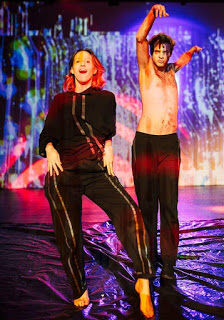
Anna Paliga and Piotr Pacek in Fever

AR: I love the Diploma show, Fever, so much. It really tests you all as actors in making you take on multiple roles, and incorporating elements of comedy, drama, singing, dancing, parody, the grotesque... How was making the show for you?

PP: It was a great time, and it still is. What I like is that it's a modern play. Some people say that theatre is over; this play shows otherwise. I very much like the Boss [Film School rector Mariusz Grzegorzek]. He's a great artist and I learned so much from him. He valued our input; it was a real collaboration and I think we made a good show. Every time we perform it it's a great adventure, you know.


Mateusz Grodecki and Piotr Pacek in Fever 

AR: Do you have any favourite moments to perform in the show? 

PP: I really like the Hutsul stuff; it was something I didn't know about before and I fell in love with it. The "Four Miles from Warsaw" sequence at the end is always powerful and challenging to do. I love the quiet scene that Mateusz Grodecki and I play as father and son. He's great and it's a very sensitive moment in all the craziness. At the beginning with "Swollen Problems" [a reality TV show parody], it was hard for me to catch the form, but I think that after a few performances I got it and now I enjoy it more and more.

Poster for Nic Nie Ginie (Nothing is Lost)

AR: And how was the experience of making the Diploma film Nic Nie Ginie (Nothing is Lost)?

PP: Along with Fever, it's been a highlight for me. Like I said, we don't have so much time with the camera at school and I learned a huge amount from Kalina [Alabrudzińska]. She's a great director and working with her was something special. We had a script but improvisation was encouraged too, and I felt very comfortable. Kalina and the crew really created that kind of atmosphere. Growing up, movies meant so much to me; now, my dream came true: I made one!

AR: In fact, you made two: you're also in Lech Majewski's Brigitte Bardot Cudowna (The Wonderful Brigitte Bardot).

PP: Yes, that was a crazy experience! I was kind of nervous because it was the first feature film I made and I was acting in English. But I learned a lot and I'm really curious to see the result.

AR: Do you think it's a good time for Polish film generally? 

PP: I think it's getting better, I think it's coming up. The success of Ida and Cold War was very important. We have some great directors, both from new and older generations: Smoczyńska, Szumowska, Holland.

Piotr Pacek (Photo: abewu.pl)

AR: Have you enjoyed living in Łódź during your studies? 

PP: Yes, I've felt very much at home. It's a weird city, just walking around you feel this different vibe: buildings from before the war, from the Communist times, then the revitalisation... It has that multi-culti element.

AR: Do you feel you can tap into the film history of the city, too?

PP: Yes, it's important. As soon as I came here I felt I was in a good place. I'm working on something now with rehearsals in Warsaw... almost everything is made there and it's necessary to be in the centre. At the same time, I don't feel like Warsaw is my place. It's a totally different city, faster-paced.

AR: Personally, I prefer Łódź.

PP: Me too, me too.
Piotr Pacek (Photo: Tomasz Wysocki) 

AR: What is your upcoming project? 

PP: It's an adaptation of Szczepan Twardoch's very popular novel Król (King) that Jan P. Matuszyński [The Last Family] is making into a series. It's exciting to be part of. I see it this way: I'm at the beginning of the road. And the best thing for me is meeting and working with people who love the craft.

AR: Are there international filmmakers you'd like to work with too?

PP: Kubrick... but he's dead! I always love Martin Scorsese.

AR: And any dream roles you'd like to play?

PP: (laughs) A drug addict!

AR: A drug addict for Martin Scorsese, right? 

PP: Of course! After school I'd definitely like to go to New York and try stuff. That whole scene meant so much to me, Strasberg, De Niro... So I'd like to go there, for sure. Just to touch it, you know. It's one of my dreams.

Fever is performed for a final time at Teatr Studyjny, Łódź, on 17 June. Nic Nie Ginie screens at TR Warszawa, Warsaw, on 8 June and is presented in competition at Młodzi i Film Festival in Koszalin, 10 -15 June.


NIC NIE GINIE /////// teaser ////// scenariusz i reżyseria Kalina Alabrudzińska from LODZ FILM SCHOOL on Vimeo.

Fever photos: Filip Szkopiński.