Showing posts with label Richmond. Show all posts

Thursday, 26 February 2015

Concert Review: Chas & Dave (Richmond Theatre, 25th February 2015; touring)


Shouting, standing, boogieing in the boxes, and – of course! – singing along, the crowd out for Chas & Dave on Wednesday night were perhaps the rowdiest that Richmond Theatre’s seen for a while, with the theatre turned for the duration of the show  into pretty much the equivalent of an East End boozer.
 
The great love and affection that many have for Messrs Hodges and Peacock has dimmed not a jot over the years. And it’s not hard to see why, for the duo’s “rockney” mix - boogie woogie, skiffle, pub singalong, a spot of music hall - is as distinctive as it is irresistible, a throwback to vibrant working-class culture that still feels surprisingly fresh. In fact, in doing their own thing so brilliantly, honestly and unapologetically, I’d argue that  Chas & Dave – sampled by Eminem, covered by Tori, parodied by The Two Ronnies, openers for Led Zep and inspiration to Libertines - are pretty much as punk as you can get.
 
Whipping briskly through the two-hour set, the pair – accompanied by Chas’s son Nik, dynamic on drums –  were in storming form, delivering a mix of covers and originals that passed from New Orleans to Edmonton Green (via Margate, natch) and demonstrated the strength of the pair’s musicianship, which has so often been overlooked. “We’re gonna be doin’ everything tonight,” Hodges promised, and the pledge was pretty much kept up, as the set started with their 70s material, including a  cover of Clarence “Frogman” Henry’s “I Don’t Know Why (But I Do)” and  a rollicking and rapturously received “Gertcha”.
 
 
The pair are great at covers, actually, giving each song their distinctive stamp and performing the (mostly US) material without recourse to American accents (take heed Adele et al., ya fakers).  A chunky “When Two Worlds Collide” (from their new album, That's What Happens [2014]) was sublime, showcasing the interplay of Hodges's great piano-playing with Peacock's supple bass at its best, while arrangements of “My Blue Heaven” and “The Sunshine of Your Smile” were also pleasingly inventive.

Still, it’s their own material - quirky, funny, full of affectionate detail and rapid-fire word-play - that most have really come to hear, and the second  half – beginning with a double of “London Girls” and “Margate” that drove the young woman in front of us into near-orgasmic raptures of delight – was simply a blast, offering a break-neck “Diddle Um Song,” a cheeky “Rabbit,” a spontaneous “That’s What I Like Mick (The Sandwich Song)” when someone called for it, and that immortal kiss-off “Ain’t No Pleasing You”, before "The Sideboard Song” brought the night to a raucous close.    
 
 
If there’s a criticism to be made, it’s that the pair tend to go full throttle for the whole show when modulating the set with some quieter numbers (as their albums tend to do) might give a fuller sense of their artistry. That artistry should not be underestimated, though. And neither should the cathartic, empowering potential of a mass singalong of “Ain’t No Pleasing You.” Catch 'em where you can. Altogether now…
 

Thursday, 21 February 2013

Theatre Review: Maurice's Jubilee (Richmond, & touring)


Much media chatter, of late, has centred on the so-called “grey pound” in relation to cinema and the current crop of films – The Best Exotic Marigold Hotel, Quartet, the peerless Amour, the about-to-open Song For Marion – appealing to an under-recognised older audience keen to see their own experiences on screen. Theatre – a medium that’s presumed to attract an older audience already – hasn’t formed part of this discussion thus far. And yet the fact is that dramas based exclusively around elderly characters have been just as much of a rarity on stage as they have been in the cinema.

Which makes Nichola McAuliffe’s Maurice’s Jubilee both a novelty and a cause for celebration. A surprise hit at last year’s Edinburgh Fringe, Hannah Eidinow’s production of McAuliffe’s play (in which the actress also takes one of the three roles) now embarks on a nationwide tour. And the piece looks likely to win itself many more admirers on its travels as it capitalises quirkily on the oddly Royalist sympathies of our post-Jubilee, post-King’s Speech moment.

The Maurice of the title (Julian Glover) is an ailing 89-year-old former jeweller who’s been married to Helena (Sheila Reid) for many years. Cancer-stricken, and by turns quipping and querulous, Maurice has another significant woman in his life, though: the Queen, whom he claims to have shared an intimate moment with on the evening before the coronation, when he was entrusted with the task of collecting the Crown Jewels from Buckingham Palace and transporting them to Westminster Abbey. The memory of that encounter has been central to Maurice’s life ever since, and he fully believes that the Queen will honour the engagement she made with him back then and turn up for tea at the house on his 90th birthday. Helena is dismayed by her husband’s fixation, but his care assistant Katie (McAuliffe) thinks that there might just be a way to make Maurice’s dream of a reunion with Her Majesty come true.

McAuliffe was last seen on stage in Alan Bennett’s The Lady in the Van, and a touch or too of Bennett seems to have seeped into the themes and the language of Maurice’s Jubilee, which suggests a companion piece of sorts to the playwright’s 2007 novella The Uncommon Reader. But I’m happy to report that this three-hander is a good deal more satisfying and appealing than Bennett’s current effort, People, at the National Theatre, an institution that’s the butt of one of Maurice’s Jubilee’s funnier jokes.


The play’s premise – that Maurice’s obsession with his encounter with the Queen has alienated his wife and led to estrangement from his son – stretches credibility and the plot become increasingly fanciful as it progresses - right up to a cheeky final twist. However, if McAuliffe’s writing sometimes resorts to whimsy and formulaic comedy (yes, there are Viagra gags) the affectionate, generous tone of the piece proves hard to resist, ultimately.

As do the grace notes that the actors bring to the material. Julian Glover is aces as Maurice, particularly in a lengthy, delicately-delivered monologue in which his encounter with the Queen is recalled. The ever-sprightly Sheila Reid subtly suggests a lifetime of hurt feelings underpinning Helena’s merry pretensions. And McAuliffe makes Katie a cheerful, humorous woman whose own domestic situation - unmarried, childless, living with an elderly father - is not presented in crude, Another Year-style contrast to the happiness of the long-married couple. All three actors have prodigious ease on stage and it’s a pleasure to watch them interact throughout.

The warmth of the script and the performances extends to the design: Christopher Richardson provides a cosy set for Helena and Maurice’s living room (the pair has “down-sized” from a Barnes house to a Penge bungalow following - note topical touch - the loss of shares and savings in Bradford and Bingley and Northern Rock). McAuliffe’s writing also revels in particular daily detail - Trebor mints, Flog It! on the telly, Edmundo Ros on the stereo - which gives the play a palpable sense of everyday domestic life and counters the more far-fetched aspects of the plotting. The tour lasts until April (dates and venues below). But it wouldn’t be too much of a surprise to see this slight but charming crowd-pleaser making its way into the West End – somewhere near Peter Morgan’s The Audience, perhaps?


Touring to: Brighton Theatre Royal (26 February – 2 March), Birmingham New Alexandra Theatre (5-9 March), Malvern (11 – 16 March), Bromley Churchill Theatre (26-30 March) and Cambridge Arts Theatre (2-6 April).

Reviewed for British Theatre Guide.


Monday, 21 January 2013

Gig Review: The Counterfeit Stones (Richmond & touring)


“Knock up your daughters!” shrieks the none-too-subtle (and none-too-PC) poster for The Counterfeit Stones’ current tour. It’s a tag-line that sums up the unashamedly brash tone of this show – part tribute concert, part spoof – that zips through Rolling Stones hits with raucous glee, and features gags that veer cheerfully from the corny (“a Mars a day helps you work rest and lay”) to the crass (a running joke about Brian Jones’s death crosses the line into tastelessness).

Alongside the Bootleg Beatles, The Counterfeit Stones are counted among the most successful tribute bands on the circuit; they’ve been on the scene since the 1990s, and have developed quite a substantial following in that time, judging by the amount of fans enthusiastically braving the cold for Saturday night’s gig at Richmond Theatre. Fittingly, the tone of the evening is quite different to that of The Beatles tribute show, Let It Be, which is currently (and, in the opinion of this reviewer, undeservedly) doing very good business in the West End. A tackier and livelier proposition, The Counterfeit Stones present themselves openly as “a cartoon version” of rock’s best bad boys, an approach that’s evident even in the choice of names, the current line-up comprising Steve Elson as (yup) Nick Dagger, Bill Lennon as Keef Rickard, John Prynn as Charlie Mott, Alan Mian as Bill Hymen, by Holger Skepeneit as Nicky Popkiss and the very versatile David Birnie tripling up as Byron Jones, Mick Taylor-Made and Ronnie B Goode.

It’s quickly apparent that The Counterfeit Stones certainly aren’t afraid of silliness, then. But what redeems the evening from being an unadulterated exercise in kitsch and camp is the fact that the group are actually accomplished musicians capable of performing a wide range of Stones material with verve and panache. Highlights of the set include a crisp “Not Fade Away,” a jangling, percussive “Out of Time,” a punchy, cutting “Paint it Black,” a surprisingly emotive “You Can’t Always Get What You Want,” a dynamic “Sympathy For The Devil,” and a blistering “Gimme Shelter.”

The endlessly preening, prancing and pouting Elson has the moves like Jagger, all right, and pulls off the singing, the outfits and the cheeky banter with equal aplomb. Album cover parodies and pastiche film footage clips – including a memorably surreal appearance on The Sooty and Sweep Show that ends with Nick and Keef crooning “As Tears Go By” as the puppets get stoned – add to the fun, while the Richmond audience reveled in some well-judged local refs, including an inevitable Jerry Hall mention.

With the Rolling Stones still very much on the touring circuit, The Counterfeit Stones offer a very pleasing evening for those disinclined – or simply unable – to stump up the inflated ticket prices demanded by Mick and co these days, making this irreverent yet accomplished act a good-value and entertaining alternative to the real thing. You get what you need.

Tour dates and details here.

Friday, 23 November 2012

Theatre Review: Headlong's Medea (Richmond, & touring)


There’s just one very good reason to see Headlong’s Medea, which updates and relocates Euripides’s tragedy to contemporary England. It’s not Ruari Murchison’s set design – clever though it is – which places the characters variously inside and outside an archetypal two-storey suburban home that opens and shuts like a large doll’s house. And it’s certainly not Mike Bartlett’s text, by far the weakest element of the enterprise. The reason to see the show is, simply, Rachael Stirling, blazing and brilliant in a great performance that overrides some – though, alas, not all – of the problematic elements of the production.

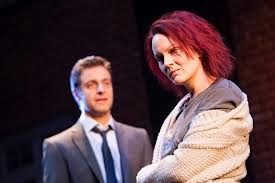
Red-haired here and by turns husky, harsh and velvet-voiced, Stirling’s Medea dominates – as every good Medea surely should – from her first appearance, with Stirling’s vocal resemblance to her mother Diana Rigg (who of course played the role to great acclaim in the early 1990s) adding another layer to the performance. Bartlett, who also directs the production, makes the character palpably an “outsider” figure in her community, a woman who’s about to be evicted from the house she shared with her husband Jason (Adam Levy), the latter having left her for their landlord’s daughter, Kate, who he’s going to marry. This event has made the couple’s son Tom mute and sent Medea herself into a black depression that’s interspersed with tirades against her errant ex and against a woman’s lot in general.

By turns proud and paranoid, bitter and desperate, Stirling “kills” in the role. But if only every element in Barlett’s production were as strong. It’s not so much the modernising that’s the problem – indeed, it could be argued that Bartlett hasn’t been as radical as he might have been in his adaptation of the text – but simply that the writing isn’t adequate to the task at hand. Complete with references to Strictly Come Dancing and Richard Curtis flicks, the dialogue is sub-soap opera standard for the most part, but there are occasional lurches into a more heightened mode. Medea reminds Jason about saving him from “the Grecian sea” and pauses at one moment to muse: “Is everything preordained? Do you believe in fate?” These jarring juxtapositions mean that the production struggles to find a suitable tone. For the most part, it’s more comic than tragic, and the OTT final moments simply haven’t earned the emotion that they evidently seek to incite.

There’s the odd effective episode, notably a touching late scene between Medea and her ever-silent son, but a couple of moments feel like indulgences (a painful cookery scene scored to Bowie’s “Aladdin Sane,” for one). Overall, the familiarity of the context tends to dampen rather than accentuate the tragic dimension of the piece, and, for all its contemporary allusions, Bartlett’s adaptation gives startlingly little insight into what might motivate an infanticide.

Since Medea is provided with an escape route – courtesy of a kindly neighbour (Paul Shelley, the only cast member to give a performance that’s a match for Stirling’s) – it might have been more effective if Bartlett had not had his heroine wreak vengeance – or at least not in the unconvincing manner in which it happens here – thereby subverting our expectations and providing this Medea with a different fate. It’s a tactic that may have proved more in keeping with the overall tone of the production, for as it stands this Headlong plunge into Greek Tragedy proves a disappointment, albeit one that’s just about worth seeing for Stirling’s commanding work.

At Richmond Theatre until 24th November. Further information at Headlong's website.

Reviewed for The Public Reviews.


Wednesday, 3 October 2012

Theatre Review: Relatively Speaking (Richmond Theatre, & touring)


2012 has certainly turned into something of an impromptu Alan Ayckbourn fest in British Theatreland. Ayckbourn’s seventy-fifth play Neighbourhood Watch toured earlier this year before pitching up at London’s Tricycle; Jeremy Herrin’s production of Absent Friends appeared in February at the Harold Pinter Theatre and that theatre is now playing host to Trevor Nunn’s just-opened revival of A Chorus of Disapproval. Meanwhile, Ayckbourn’s attempt at a ghost story, 1994’s Haunting Julia, is touring again, and it’s now joined on the circuit by Lindsay Posner’s production of Relatively Speaking— Ayckbourn’s 1967 comedy and first West End success—produced by Theatre Royal Bath Productions. None of these outings has done much to win over those unconvinced by Ayckbourn’s status as a major British dramatist. And, alas, Posner’s forced and charmless production proves to be perhaps the weakest yet.

The plot centres on a series of—allegedly hilarious—farcical misunderstandings. Ginny (Kara Tointon) informs her boyfriend Greg (Max Bennett) - who’s just proposed to her—that she’s going to visit her parents in Buckinghamshire, and that she doesn’t want Greg to accompany her on the trip. Greg, however, decides to follow her there, with the intention of asking her parents’ permission to marry her, and pitches up at the house of Sheila (Felicity Kendal) and Philip (Jonathan Coy) before Ginny arrives. It turns out, though, that the couple aren’t Ginny’s parents at all, but that Philip is actually Ginny’s lover, whom she’s attempting to rid herself of.

As with much of Ayckbourn’s work, it’s tempting to call Relatively Speaking “sitcom-esque.” But to do so seems a slight on even the most inept sitcom. The play’s premise is paltry, without an ounce of the credibility that even the broadest situation comedy requires, and Ayckbourn’s development of it never builds up a head of steam.

In the programme essay, Al Senter valiantly attempts to make a case for the play as capturing its historical moment and reflecting “the profound changes that were convulsing British society during the 1960s.” But, despite a smidgeon of male nudity and a suggestion of pre-marital sex in the (deathly) opening scene, this kind of social awareness simply isn’t in the text. Indeed, it seems almost inconceivable that, while Relatively Speaking was enjoying its first West End run, Joe Orton was penning his biting satires and Simon Gray’s razor-sharp Butley (itself so beautifully revived by Posner last year) was only a couple of years away.

This could be forgiven, of course, if the play offered some genuinely witty lines and exchanges. But Ayckbourn’s trite, rhythm-less dialogue continually lets you down. Primed to laugh, the audience latches—sometimes maniacally—onto any opportunity, no matter how meagre, with the result that a line as innocuous as “Shall we play bridge?” is greeted by gales of overzealous guffaws by the end.

The characterisation is so insipid that the actors are up against it from the start. Tointon tends to read her lines flatly, with the same intonations, while Kendal flaps around in a vain attempt to make Sheila’s ditziness endearing. There’s a moment close to the end when it seems that Ayckbourn is going to give this character a chance to show some real spark and awareness, but the opportunity is quickly sacrificed. Bennett has some effective moments and Coy delivers the crispest performance. But overall this is a weak production of a  terminally bland play.

Reviewed for British Theatre Guide.

Tuesday, 15 May 2012

Theatre Review: Steel Magnolias (Richmond Theatre, & touring)


Soap queens and theatre grande dames constitute the astutely-assembled cast of David Gilmore’s engaging revival of Steel Magnolias, Robert Harling’s 1987 talk-fest about the lives, loves and losses of six Louisiana women. Best known in its 1989 film adaptation directed by Herbert Ross, Harling’s play is a slight but affectionate and heartfelt affair. Written following the untimely death of the playwright’s sister, the piece unabashedly celebrates the humour, supportiveness and fortitude of a group of (mostly wealthy and all white) Southern women, whose mixture of strength and fragility provides the piece with its title.

Harling’s sharply-drawn crew of characters comprise the widowed Clairee Belcher (Cherie Lunghi) and her sparring partner, the batty curmudgeon Quiser Boudreaux (Cheryl Campbell); the new-to-town Annelle (Kacey Ainsworth); and mother and daughter M’Lynn and Shelby Eatenton (Isla Blair and Sadie Pickering), who gather in the beauty shop owned and run by Truvy Jones (Denise Welch) to gossip, confess and “crack wise.” The piece unfolds over several years, and the main thrust of the plot reveals around the diabetic Shelby’s determination to have a child against doctors’ advice and her mother’s wishes, the fallout from which decision motivates the drama’s inevitable tragic turn.

As with David Esbjornson’s West End production of Driving Miss Daisy last year, fans of Ross’s film may miss the additional scenes and characters that added texture and nuance to the movie, and find the play to be a little thin and static by comparison, the obviousness of the material accentuated. At the same time, the single salon setting - nicely designed here by Helen Goddard - brings a distilled, sharp focus to the piece, and the play seems more convincing, lively and inhabited than did Driving Miss Daisy, as well as a good deal less calculating in its effects than the obnoxious Calendar Girls, a production whose “demographic” this one would seem to target.


Gilmore’s direction can’t be called inspired - proceedings come to a dead halt during what feel like bewilderingly lengthy scene changes - but the actresses keep things as buoyant and as truthful as they can. Responsible for one of the least-heralded great stage performances of recent years as the MND-afflicted matriarch in The Company Man at the Orange Tree a few years ago, Isla Blair gives an understated, moving performance here as M’Lynn. Carefully communicating the character’s concern for her daughter as she takes her first steps into an independent life, Blair brings a wry humour and captivating stillness to the stage, making M’Lynn’s final outburst of anger and grief all the more affecting.

Cherie Lunghi does a witty, elegant job of work as Clairee, and Kacey Ainsworth is funny and touching as she charts Annelle’s shift from timid new recruit to voracious bible-thumper. Denise Welch, better known these days for her appearances in tabloids and on Loose Women than her acting roles, subverts expectations with a warm and endearing performance as Truvy, the role amply filled by Dolly Parton in the film. And an unrecognisable Cheryl Campbell does a full-on comic turn as a squawking, highly-strung Ouiser, moving from what feels like broad caricature into genuine eccentricity; at one priceless moment, she cackles with glee at her own reflection. As Shelby, Sadie Pickering struggles by comparison, hampered by a studied-sounding Southern drawl, but she manages a couple of affecting moments.

Ultimately, Gilmore’s production doesn’t match Ross’s film for emotional impact. But, attuned to the play’s combination of sharp humour and sentiment, it generates its laughs and tears on cue.

 
At Richmond until 19th May. Full tour dates and details here.  

Reviewed for The Public Reviews.


Monday, 13 February 2012

Theatre Review: Muswell Hill (Orange Tree Theatre)


Muswell Hill is the third play by Torben Betts to be staged at Richmond’s Orange Tree Theatre in the last 11 years. I missed the first, Clockwatching, in 2001 but did catch the second, The Company Man, in 2010 [review here], and found it to be an uneven but sometimes very beautiful family drama that was most memorable, in Adam Barnard’s production, for a staggering performance by Isla Blair that didn’t receive anything like the acclaim that it deserved. Directed by Sam Walters, Betts’s new play is less structurally ambitious than The Company Man, and without a central performance to equal Blair’s. But it’s a more focused and consistent piece of work, and one that offers some considerable pleasures.

The drama unfolds on a nicely-detailed kitchen set by Robyn Wilson (one which recent Bush Theatre attendees will have fun comparing to those in The Kitchen Sink and Our New Girl) in the North London flat of a young couple, Mat (Leon Ockenden) and Jess (Jasmine Hyde), who are hosting a dinner party. Those attending are two garrulous chums of the couple - the twitchy firebrand Simon (Dan Starkey) and the pernickety widow Karen (Katie Hayes) - and Jess’s adopted sister Annie (Tala Gouveia), an aspiring (and, it emerges, none-too-talented) actress/singer who brings along her fiance, the much older Tony (Timothy Block), an oily and pretentious theatre director who’s teaching Annie “all about Shakespeare. And David Hare.” It’s the 13th January 2010, and news of the Haiti earthquake is filtering through on the group’s iPhones and on Mat’s ever-present laptop. And as the wine flows freely, tensions and anxieties predictably begin to surface, as it emerges that the assembled company are all, in one way or another, dissatisfied or disappointed with the direction of their lives.

It’s an exceedingly familiar - even shopworn - dramatic set-up that Betts has resorted to here, and the spirits of Alan Ayckbourn and, especially, Mike Leigh loom a little too largely for comfort at times. Betts’s play may also put those who saw it in mind of David Lewis’s How To Be Happy, which was staged at the Orange Tree last November, and boasted similarly sharp humour and a final melancholy twist, and which also attempted to place middle-class malaise in the context of wider global and political concerns.

I liked How To Be Happy better than Muswell Hill overall, and not only for its musical selections (though Schubert and The Ronettes beat Mozart and Norah Jones in my book). But in spite of its derivativeness, Betts’s play still has much to recommend it. In particular, it brilliantly skewers the oddities of contemporary communication and a world in which global news stories form a mere “backdrop” to domestic travails. The characters squint and jab at their iPhones, responding to the events unfolding in Haiti with knee-jerk, superficial sympathy, and often only half-heartedly engaging with those who are physically present. In this atmosphere, the often ghastly and pedantic Simon’s rants against the state of the world - which culminate in a startling tirade against his hosts - gain a certain piquancy and force. When he exhorts those assembled to “riot, riot, riot!” there’s a collective in-take of breath in the auditorium.

A strength of Betts’s writing is its even-handedness. His characters are drawn in more than one dimension: he doesn’t dash to demonise them, and instead allows the audience’s sympathies to shift throughout. (I must admit that I failed to warm to Ockenden’s Mat at any point, though whether that’s due to Betts’s characterisation or the actor’s interpretation is difficult to judge.) But Gouveia, Hayes, Block and Starkey pitch their performances perfectly, while Jasmine Hyde beautifully and understatedly conveys the discontent that has led Jess to become involved with another man. The quality of these performances and the sharpness of Betts’s writing at its best make for a witty and perceptive evening that gets the Orange Tree’s spring season off to a sprightly start.

Note: I’d recommend a pre-show supper for this one, since the monkfish stew smells very, very good.

Muswell Hill is booking until 10th March. Further information at the Orange Tree website.

Monday, 24 October 2011

Concert Review: Kate Rusby (Richmond Theatre) (23/10/2011)


“We’ve never played here before; we wondered if anybody would come,” confessed a characteristically self-deprecating Kate Rusby towards the end of her enchanting concert at Richmond Theatre yesterday evening. Well, Rusby need not have worried, for the folk fans of Surrey and its surrounds were out in full force last night and gave the singer and her band - Damien O’Kane (guitar/banjo), Ed Boyd (guitar), Julian Sutton (accordion), Duncan Lyle (double bass) and John Joe Kelly (bodhrán) - a very warm welcome indeed.

Though nursing a slight cough passed on to her by her and O’Kane’s two-year-old daughter, Rusby performed like a trouper and was in excellent voice throughout the night, sounding confident and clear. With no brand new album to promote - her last, the entirely self-penned Make The Light, was released a year ago - Rusby constructed a thoughtful set-list that ranged widely over her catalogue, offering a pleasing mixture of traditional and original material. And although much of her older work was of course arranged for fiddle and whistles, the competence and energy of the players ensured that the absence of these instruments in the current set-up wasn’t felt as too much of a lack.

Following an enjoyable, assured warm-up set by Kelly, Boyd and the wry O’Kane, the gig proper began with a lovely version of “Playing of Ball,” the opening track from 2001’s Little Lights, and was followed by a rollicking take on “The Cobbler’s Daughter.” (“We’ll get our songs involving deaths out of the way early on,” Rusby quipped. “And then you can relax into your Sunday evening.”) The newer self-written songs also sounded especially supple and strong, with the plaintive “Only Hope” outstanding, while “Walk the Road” - the closest that Rusby’s yet come to an anthem - concluded the first half on an especially stirring note.

It’s fair to say that, stylistically, Rusby’s work hasn’t developed much over the years, and, across an album, her music can sometimes seem to lack variety. But in a live context - and interspersed with her disarming, often hilarious banter - her music feels vibrant and fresh, and the songs sometimes gain new depths and resonances as well. The concert’s emotional highlight came towards the end of the second half with an exquisite, moving performance of “Let the Cold Wind Blow,” while other standouts included a spry, cheeky “Game of All Fours” (“If you’re under 16, then this is a song about a card game. If you’re over 16, make of it what you will”), a gorgeously rootsy “Over You Now,” and a great fun set of tunes from the band. The one-song encore of “Underneath the Stars,” which Rusby took solo, was, appropriately, celestial.

Rusby’s apparently artless, girl-next-door persona belies the talent and tenacity of a musician who’s been on the scene for 20 years now and who’s able to captivate an audience by creating an atmosphere of palpable warmth, intimacy and ease. “This theatre’s gorgeous… I think we’d like to live here,” Rusby mused. And judging by the affectionate response that she received, it seems that Richmond’s residents would be happy if she chose to do that very thing. A delightful evening.

Reviewed for The Public Reviews.

Tour dates and venue information here.

Tuesday, 13 September 2011

Theatre Review: Dr Marigold & Mr Chops (Richmond Theatre)


Fresh from his successful stint at the Edinburgh Festival in Emmanuel Darley’s Tuesday at Tescos, and having only recently completed a run of Being Shakespeare in the West End, the indefatigable Simon Callow now hits the road with Dr Marigold and Mr Chops. Callow first performed this double-bill of Charles Dickens texts as a Christmas show in 2009, in a production directed by Patrick Garland, and the show has now been revived for a national tour, with Richard Twyman taking over directing duties. Callow is, of course, an actor who has practically cornered the market in one-man shows in recent years, and these colourful monologues - adapted by Dickens himself from two Christmas stories that he wrote and performed on his famed reading tours in the 1860s - provide pretty much an ideal showcase for the actor’s talents.

Callow delivers the monologues on a set by Christopher Woods that suggests the run-down backstage area of a theatre or circus, with red curtains, stacks of theatre paraphernalia and faded posters surrounding him. In the first piece, "Mr Chops," the actor plays one Toby Magsman, a showman who narrates the cautionary tale of the title figure, a circus dwarf whose £12,500 lottery win provides him his long-awaited entrance into “society.” But this position proves rather less congenial than Mr Chops imagined and the story charts his discovery that an increase in social status can represent its own kind of sham and trap. Clearly relishing Dickens’s epigrams and baroque turns of phrase, Callow dexterously conjures the presences of a variety of circus folk here, in a piece that combines social satire with a vivid evocation of the life of sideshow performers.

"Dr Marigold," though, is the richer and more emotionally satisfying of the two monologues. It’s the tale of a ‘cheap jack’ or itinerant merchant, who, following the deaths of his wife and young daughter, adopts a ‘deaf-and-dumb’ girl with whom he forms a deep bond. Like much of Dickens’s work, "Dr Marigold" has been criticised for sentimentality, but underpinning its tender portrait of a healing relationship is a darker narrative that touches on poverty, loneliness, domestic violence and child abuse. And Callow proves himself an absolute master at shifting moods here, moving the audience from mirth to deep melancholy as he slides from Dr Marigold’s quick-fire salesman’s spiel to a devastating account of a bad marriage. Thus the piece really earns its emotional response and heart-warming finale.

There is, it must be admitted, a certain air of quaintness about a show like Dr Marigold & Mr Chops, which is an unashamedly old-fashioned entertainment. But this charming evening proves hard to resist, serving as a reminder of the rich humanity of Dickens’s writing and a demonstration of the skills of an actor whose sheer delight in performance is palpable and infectious.


Reviewed for The Public Reviews.

Review of Mr. Callow's Masterclass last year here.


Monday, 25 July 2011

Theatre Review: Rock Around The Clock (Touring)


Rock Around the Clock is pretty much the kind of show that you know whether or not you’ll enjoy before stepping into the auditorium. It’s the ultimate nostalgia-fest jukebox musical: a slick assemblage of 1950s and early 60s rock ‘n’ roll hits strung together without anything as distracting as even the semblance of a narrative to get in the way of the music. Over the course of two hours, six hard-working singers (Jamie Capewell, Will Mulvey, AnDre Washington, Kelsey Cobban, Ben Fitzpatrick and Sarah Accomando) and a four-piece band rip through songs made famous by Elvis, Buddy Holly, Fats Domino, Chuck Berry, Jerry Lee Lewis, Connie Francis, The Crystals, The Shirelles and others, while eight colourfully-costumed dancers strut their stuff. The company’s energy generates an infectious enthusiasm throughout the evening and damned if the audience weren’t up on their feet, dancing, singing and clapping along by the end of the show.

Director/choreographer Neil Dorward keeps proceedings flowing smoothly with swift transitions between the numbers. Images are presented on a screen above the band and while this doesn’t always seem entirely necessary (clips from From Here to Eternity to accompany “Lipstick on Your Collar”?) it’s fun to see footage of the original performers. The director seems to toy with the idea of giving a potted history of rock ‘n’ roll in the early stages but abandons that idea fairly swiftly and lets the songs speak for themselves; if part of the show’s function is simply to serve as a testament to the enduring appeal and vibrancy of this music then it certainly succeeds in this endeavour. Highlights include Capewell crooning a memorable Buddy Holly medley and squeezing himself into fetching leather trousers for a dynamic take on Gene Vincent’s immortal “Be-Bop-A-Lula”; the baby-faced Fitzpatrick singing an adorably lovelorn lead on “Unchained Melody”; Washington tearing into Little Richard’s “Rip It Up” and “Good Golly Miss Molly”; a Platters medley featuring “Twilight Time,” “The Great Pretender” and “Only You”; and the wonderfully ebullient Mulvey throwing himself around with gay abandon during Jerry Lee Lewis’s “Whole Lotta Shakin’ Going On.” Unfortunately, the female performers are comparatively underused in terms of lead vocals, but Cobban and Accomando do well by “Stupid Cupid” and Etta James’s “At Last”; the latter is perhaps the show’s most tender and emotional moment.

You don’t feel that there’s a great deal of urgency or necessity about a show like Rock Around the Clock but this good-spirited entertainment proves pretty irresistible anyway, and was clearly delighting the very broad audience in attendance at Richmond Theatre last week. It’s an enjoyable feel-good evening that does, very professionally, exactly what it says on the tin.

Reviewed for The Public Reviews, .

Thursday, 7 July 2011

Theatre Review: Eden End (Richmond Theatre, & touring)


Set in 1912, JB Priestley’s 1934 drama concerns the unexpected return to the family fold of one Stella Kirby, a woman who, eight years previously, left home to become an actress, against her parents’ wishes. Stella’s career has not progressed as she hoped, but she conceals this from her father, a GP who has come to view her leaving as a courageous act, the kind that he wishes he himself had made earlier in his life. Completing the family gathering are Stella’s younger siblings Lilian and Wilfred, the former bitter and resentful of her sister, the latter on leave from his job in Nigeria. The appearance of Stella’s old beau Geoffrey and her semi-estranged husband Charles (who she’s neglected to mention to her family) further complicate the reunions, as Priestley constructs a portrait of a group of characters who are all, in one way or another, dealing with disappointment in their lives.

Priestley’s debt to Chekhov in Eden End has been widely noted, and is evident at the level of structure, theme and characterisation. The protagonists’ sense of disillusionment, the hope expressed that things will be better for future generations, the shifts between moments of humour and wistfulness - all of this resonates with the Russian playwright’s work. But Priestley’s exploration of “the way circumstances and time can change and hurt us” has its own resonance. And Laurie Sansom’s expert new production for English Touring Theatre overcomes the play’s derivativeness by emphasising its English social context and by giving it a subtly expressionistic staging. Perhaps tipping its hat to Stephen Daldry’s seminal production of Priestley’s An Inspector Calls, Sara Perks’s design presents the Kirby family’s sitting room on a stage on the stage, complete with footlights. Initially the conceit seems jarring but it proves more effective as the evening progresses and the play’s concern with the role of performance and illusion in everyday life becomes apparent. Apart from an indulgent bit of pre-Act 3 music hall business that feels entirely surplus to requirements, Sansom’s staging is fluid and full of feeling, alert to the play’s shifts in mood.

And the actors deliver strong, empathetic and involving performances across the board. As the prodigal daughter, Charlotte Emmerson takes a little while to settle into the role: she overdoes Stella’s excitement to be home in her first scene, speaking her lines so quickly that they don’t appear to have the weight of thought. But the performance deepens, and Emmerson is extremely touching as she reveals Stella’s regrets about the direction of her life and the ways in which her belief in her talent has been shaken. Emmerson has particularly effective and well-written scenes with William Chubb, who is superb as her father, and with Daisy Douglas, who makes us understand and sympathise with Lilian’s resentment of her sister. Making his professional stage debut, Nick Hendrix is terrifically likeable as Wilfred, a young man who’s come to feel at home neither in England nor in Africa, and with Daniel Betts’s genial Charles, he shares the most enjoyable drunk scene seen on stage since the Old Vic’s production of Design for Living. And as the maid Sarah, Carol Macready gives a lovely performance, creating a figure of both exasperating querulousness and encompassing warmth. Beautifully pitched between naturalism and expressionism, this is a very fine revival of a poignant and perceptive play.

Further information on tour dates and venues here.

Reviewed for The Public Reviews.

Friday, 13 May 2011

Theatre Review: Brontë (Richmond Theatre)


Shared Experience’s Brontë was first staged in 2005, in a production directed by the play’s writer Polly Teale. The show now returns in a new, totally re-cast, touring production, helmed by the co-artistic director of Shared Experience, Nancy Meckler. The play follows Teale’s two previous engagements with Brontë-related literature: she adapted Jane Eyre for the stage in 1996 and subsequently wrote a play about Jean Rhys (After Mrs. Rochester), whose Wild Sargasso Sea was of course inspired by Jane Eyre .

Brontë’s focus is the personal and creative lives of Emily, Charlotte and Anne themselves. Unsurprisingly, though, Shared Experience don’t take a traditional or straightforward biographical approach here. Rather, the company brings its distinctive physical and design aesthetic to the show, attempting to enter the inner worlds of the sisters by combining scenes that focus upon their everyday, domestic life with fantasies, memories and dramatised sequences from their novels, constantly blurring the boundaries between the real and the imagined. Indeed, the production sets itself up as a subjective investigation into the Brontës’ lives, opening with three contemporary women (Elizabeth Crarer, Kristin Atherton, Flora Nicholson), speculating about how “three Victorian spinsters living in isolation on the Yorkshire Moors” came to write literature of such passion and enduring power. Following this brief prologue, the three women take up their costumes to transform themselves into the sisters and to both dramatise and comment upon their story.

Thus Brontë may be viewed as, in Teale’s terms, “a response to the Brontë story not a piece of biography.” The production’s highly selective and impressionistic approach won’t be to all tastes and there are moments when the show seems to be straining for theatrical effect. The transitions between the sisters’ real and imagined worlds are sometimes marvelously fluid, especially in those scenes that show Emily tenderly interacting with her creation, Cathy (Frances McNamee), from Wuthering Heights. But at other times they’re abrupt and jarring: particularly problematic are the appearances of Jane Eyre’s Bertha (McNamee again) as an endlessly cavorting and gyrating projection of Charlotte’s animalistic id; these scenes feel crude and heavy-handed. The rhythm of the piece is not always satisfying: characters announce their departures only to return again in the next scene, and some sequences – such as Charlotte’s encounter with Heger, the Belgian teacher she loved – seem to come from nowhere. (Heger is played by Stephen Finegold, who, in a psychologically astute bit of multi-casting, also portrays the sisters’ father, Charlotte’s husband, and Rochester in the dramatised Jane Eyre scenes.)

The great strengths of the production lie in its nuanced exploration of the various functions that writing served for the three sisters, and also in its very fine performances. Crarer beautifully invests Emily the tormented genius with a streak of self-reliant strength, and Kristin Atherton’s censorial Charlotte succeeds in generating sympathy against the odds, while Flora Nicholson is vivid as the eager, socially conscious Anne. And Mark Edel-Hunt gives a lively and finally touching account of Branwell, the spoilt brother whose taken-for-granted privileges are criticized by Charlotte in one of the show’s most memorable scenes. The production is also strong on the social context of the sisters’ lives, even as it’s played with a defiantly contemporary attitude that subverts period drama cosiness. Also noteworthy is the atmospheric sound and lighting design by Peter Salem and Chahine Yavroyan

Despite its bitty structure, Brontë proves a rewarding evening overall, with striking moments of beauty and insight that compensate for its more awkward, forced transitions. Often, it’s the quietest moments that resonate most strongly, such as Emily’s subversive appraisal of the sisters’ position: “Perhaps we should be grateful for obscurity. For invisibility. Nothing was expected of us. Whatever we did was our secret, was our own.”
The production runs for 2 hours 30 mins. Further information at the Shared Experience website.

Reviewed for The Public Reviews