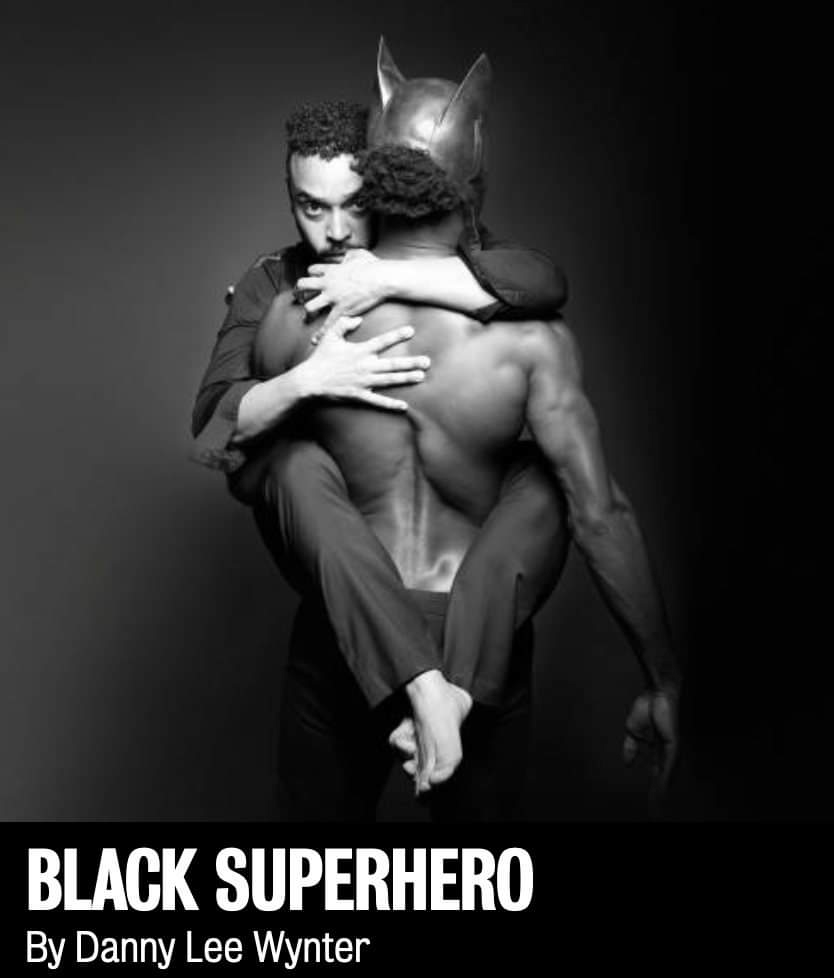
In BLACK SUPERHERO, his debut play as a writer, Danny Lee Wynter (last seen on stage in Dominic Cooke's beautiful revival of The Normal Heart) casts himself as the protagonist, David, a mixed race actor who's working none-too-contentedly alongside his sister Syd (Rochenda Sandall) as a children's entertainer. David has been struggling to get acting jobs and attributes that struggle to the whiteness of the industry. Among David's social circle, though, are others having more success. These include the African American King (charismatic Dyllón Burnside, of Pose), who heads up the "Crawtopia" superhero franchise and who is dealing with the particular pressures and liberations that such a high-profile mainstream gig entails.
David's been nursing a crush on King for years, but when a hedonistic night results in a tryst in Shoreditch the pair's relationship gets more complicated - not only by the fact of King's marital status but also by what is gradually revealed as David's troubled childhood which, the play indicates, has resulted in projections and fantasies about a saviour/father figure - a bill which the combo of King and his superhero alter ego seems to fit.
For better and for worse, BLACK SUPERHERO is very evidently an actor's first play, and Wynter's own trajectory from being an usher at the Court in the early 2000s to having his debut script staged in its main auditorium has been irresistibly rehashed in the publicity. Clearly, the piece draws on his own personal and professional experiences as both actor and activist (including his founding of the admirable Act for Change initiative). Both soul- and body-baring, BLACK SUPERHERO is open in its critique of casting processes and gay and Black representation across various levels of the industry, while contrasting takes on such contemporary cultural touchstones as Moonlight and Fairview are also offered up in the characters' on-the-nose debates.
Throughout, in fact, the play revels in refs and quotations ranging from Big Brother to Hamlet - some of these are funny and revealing while others are a bit forced and gratuitous. And influences from Edmond to Angels in America to Daddy are evident in its own design, albeit filtered through a very British sensibility, language and rude humour.
If the end result feels less self-indulgent than it might, that's down to Wynter's populating the play with some sharply-drawn characters surrounding David, especially the conflicted King who resents his status as a Black spokesperson (and is evading specifics about his sexuality in interviews) and fellow actor Raheem (Eloka Ivo) whose easygoing, anti-activist attitude contrasts with David's combative militancy. The character of Syd also serves to give a different account of their childhood and to call David out on his narcissism (though Sandall often overacts here as she did in Steve McQueen's Mangrove).
Not all of the characters are as sympathetically created, though. The white roles, in particular, feel strategically caricatured, though both Ben Allen and Dominic Holmes get their laughs, with Allen playing King's prissy spouse (a relationship that the play doesn't manage to make convincing) and a passive aggressive Australian interviewee quizzing the star on his personal life.
What's more, for all the concern over representation, the writing sometimes defaults dishearteningly to stereotype - from the appearance of a predatory bisexual (played with redeeming gusto by Ako Mitchell) to the presentation of David as a protagonist messed up by paternal absence who just wants some reassurance that Daddy cared after all. (Though dedicated to the playwright's mother, it's one of the oddities of the piece that David's relationship with his mum is barely referred to at all.)
The first half of BLACK SUPERHERO is the more confident and entertaining. The play is at its best when exploring the blurred lines of gay intimacy: King and David's hook up is super-sexy and believable, with post-coital playfulness perfectly played by the two actors. The second half, with David accompanying King on an Australian promo tour, feels more scattered and attenuated, and doesn't quite make good on the opening's promise. Part of the problem may be in the writing but it's also due to the fact that Daniel Evans' production, though proficient, fails to give the hallucinatory elements - David's fantasies of Craw's appearances - enough crazy conviction and heft. A final encounter is confusingly staged, though redeemed somewhat by a quiet, cleansing coda. The combination of wider cultural concerns with a whole heap of unresolved Daddy issues ultimately doesn't quite come off, but BLACK SUPERHERO remains engaging and provocative at its best.
BLACK SUPERHERO is booking at the Royal Court until 29 April.


