Wednesday, 5 June 2019

"At the Beginning of the Road": Łódź Film School Actor Interviews (i): Piotr Pacek

Piotr Pacek (Photo abewu.pl)


As the place that produced the likes of Wajda, Polański, Kieślowski and Skolimowski, Łódź Film School remains the most storied and prestigious of such institutions in Poland. Recently featured in Variety's 2019 list of Best Film Schools, under the current Rectorship of Mariusz Grzegorzek, Łódź continues to nurture new talents in cinema and theatre. This was evidenced by the three terrific Diploma Shows (Fever, Angels in America, Slippery Words) presented this year at Teatr Studyjny and featuring this year's contingent of graduating Acting students. I had the pleasure of interviewing some of the actors over the last few months for pieces that will be published in full in my book of actor interviews next year. In the meantime, though, I wanted to share some shorter versions of the conversations here, as the actors reflect on their time at the School and look forward to future opportunities.

First up: Piotr Pacek, who features in the great Diploma show, Pomysłowe Mebelki z Gąbki (Fever), directed by Mariusz Grzegorzek (for which he won two prizes at the 37th Polish Theatre School Festival last month), and in the Diploma film Nic Nie Ginie (Nothing is Lost), directed by Kalina Alabrudzińska.

Alex Ramon: Tell me a bit about your background and when your interest in acting started.

Piotr Pacek: It was at school. I grew up in a small town near Bydgoszcz, where I was born. I was part of a theatre group in my class, when I was 15 or so. But the main thing was that I always loved movies and I remember many films from my childhood and adolescence that were really important to me: Tim Burton's Batman, Taxi Driver, Amadeus, Dr. Strangelove, The Deer Hunter, The Shining, Mean Streets, Midnight Cowboy, Goodfellas, Platoon. Seeing these films, it was just... pure love.

AR: So it was film rather than theatre that inspired your interest in acting?

PP: Yes, movies moved me so much. Watching them, analysing them, I felt: "This is my world." They were the place where I was looking for myself. It wasn't until I came to the school in Łódź that I really fell in love with theatre as well. The training here focuses more on theatre than film, which is a shame in some ways, but it's also through that that I got into stage work and began to love it.

AR: Who are some of the actors that inspire you?

PP: Answering about favourites is hard because there are so many great actors. But for me Robert De Niro is number one. I love Brando and Clift too, and Joaquin Phoenix and Philip Seymour Hoffman. When it comes to Polish actors, I admire Zbigniew Cybulski, Janusz Gajos, Bogumił Kobiela, Leon Niemczyk. In terms of the younger generation, I like Tomasz Kot and Borys Szyc. We have a lot of great actors here. I was lucky enough to work with Łukasz Simlat on a TV series and that was great. He's a great actor and a great person.

AR: Is there such a thing as a Łódź Film School actor or "method"?

PP: I think you make your own method. You're free. The best thing here is that you're getting all these different experiences and that you can experiment and discover things. For me, that's what's counted most in the training.
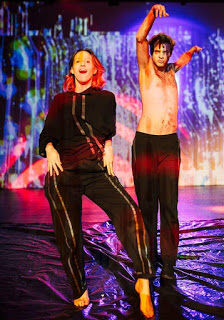
Anna Paliga and Piotr Pacek in Fever

AR: I love the Diploma show, Fever, so much. It really tests you all as actors in making you take on multiple roles, and incorporating elements of comedy, drama, singing, dancing, parody, the grotesque... How was making the show for you?

PP: It was a great time, and it still is. What I like is that it's a modern play. Some people say that theatre is over; this play shows otherwise. I very much like the Boss [Film School rector Mariusz Grzegorzek]. He's a great artist and I learned so much from him. He valued our input; it was a real collaboration and I think we made a good show. Every time we perform it it's a great adventure, you know.


Mateusz Grodecki and Piotr Pacek in Fever 

AR: Do you have any favourite moments to perform in the show? 

PP: I really like the Hutsul stuff; it was something I didn't know about before and I fell in love with it. The "Four Miles from Warsaw" sequence at the end is always powerful and challenging to do. I love the quiet scene that Mateusz Grodecki and I play as father and son. He's great and it's a very sensitive moment in all the craziness. At the beginning with "Swollen Problems" [a reality TV show parody], it was hard for me to catch the form, but I think that after a few performances I got it and now I enjoy it more and more.

Poster for Nic Nie Ginie (Nothing is Lost)

AR: And how was the experience of making the Diploma film Nic Nie Ginie (Nothing is Lost)?

PP: Along with Fever, it's been a highlight for me. Like I said, we don't have so much time with the camera at school and I learned a huge amount from Kalina [Alabrudzińska]. She's a great director and working with her was something special. We had a script but improvisation was encouraged too, and I felt very comfortable. Kalina and the crew really created that kind of atmosphere. Growing up, movies meant so much to me; now, my dream came true: I made one!

AR: In fact, you made two: you're also in Lech Majewski's Brigitte Bardot Cudowna (The Wonderful Brigitte Bardot).

PP: Yes, that was a crazy experience! I was kind of nervous because it was the first feature film I made and I was acting in English. But I learned a lot and I'm really curious to see the result.

AR: Do you think it's a good time for Polish film generally? 

PP: I think it's getting better, I think it's coming up. The success of Ida and Cold War was very important. We have some great directors, both from new and older generations: Smoczyńska, Szumowska, Holland.

Piotr Pacek (Photo: abewu.pl)

AR: Have you enjoyed living in Łódź during your studies? 

PP: Yes, I've felt very much at home. It's a weird city, just walking around you feel this different vibe: buildings from before the war, from the Communist times, then the revitalisation... It has that multi-culti element.

AR: Do you feel you can tap into the film history of the city, too?

PP: Yes, it's important. As soon as I came here I felt I was in a good place. I'm working on something now with rehearsals in Warsaw... almost everything is made there and it's necessary to be in the centre. At the same time, I don't feel like Warsaw is my place. It's a totally different city, faster-paced.

AR: Personally, I prefer Łódź.

PP: Me too, me too.
Piotr Pacek (Photo: Tomasz Wysocki) 

AR: What is your upcoming project? 

PP: It's an adaptation of Szczepan Twardoch's very popular novel Król (King) that Jan P. Matuszyński [The Last Family] is making into a series. It's exciting to be part of. I see it this way: I'm at the beginning of the road. And the best thing for me is meeting and working with people who love the craft.

AR: Are there international filmmakers you'd like to work with too?

PP: Kubrick... but he's dead! I always love Martin Scorsese.

AR: And any dream roles you'd like to play?

PP: (laughs) A drug addict!

AR: A drug addict for Martin Scorsese, right? 

PP: Of course! After school I'd definitely like to go to New York and try stuff. That whole scene meant so much to me, Strasberg, De Niro... So I'd like to go there, for sure. Just to touch it, you know. It's one of my dreams.

Fever is performed for a final time at Teatr Studyjny, Łódź, on 17 June. Nic Nie Ginie screens at TR Warszawa, Warsaw, on 8 June and is presented in competition at Młodzi i Film Festival in Koszalin, 10 -15 June.


NIC NIE GINIE /////// teaser ////// scenariusz i reżyseria Kalina Alabrudzińska from LODZ FILM SCHOOL on Vimeo.

Fever photos: Filip Szkopiński. 

Monday, 3 June 2019

Theatre Review: Wife (Kiln)


From Pillars of the Community and Mrs. Affleck through Larisa and the Merchants to the glory of The Light Princess, creative versions and adaptations have distinguished Samuel Adamson's output as a playwright, complementing his original work (Clocks and Whistles, Southwalk Fair) which has often focused on diverse relationships in modern, metropolitan contexts. In a sense, Adamson's new play, the ambitious, exciting Wife, combines the two strands of his output by placing and tracing a queer current around A Doll's House. 

Four (imagined) London productions of Ibsen's play are woven into the fabric of Adamson's. The first, in 1959, brings together Suzannah (the actress playing Nora) and a young art teacher, Daisy, who sees the production with her disgruntled spouse (his verdict: "My Fair Lady was better"), as the connection between the two women is revealed to be rather different than it initially appears. The second, in 1988, finds a gay couple in a straight pub, assessing the impact of a just-watched Norweigian production and Nora's enduring significance for queer audiences as a conformity-challenging heroine. The third, in 2019, shows an "intersectional" fringe production resonating with some of the histories of the play's characters and their descendants. The last turns what appears to be a flashback into a futuristic scenario that speculates on Nora's significance - and that of theatre itself - in the years to come. 

Through the characters' diverse reactions to the drama, Adamson examines the ways in which a canonical text like Ibsen's might maintain or modify its subversive potential through the years. Daisy's husband sees A Doll's House as lacking a fourth Act. Adamson provides that here, offering a rich exploration of the identity category of "Wife" and of (gay) liberation: what might happen after the (literal and figurative) slamming of the door. (And what might happen if the door doesn't get slammed, after all.) 

Aside from its intertextual engagement with Ibsen's play, Wife is an allusive work in other ways, incorporating references to Elizabeth Taylor (novelist and actress), Alan Hollinghurst, Gabriela Zapolska, My Beautiful Laundrette, Kirsty MacColl (cherishably described as "a Proustian madeleine for every fucking Dorothy in his fifties!") and (yup) Game of Thrones. In the backstage encounters, there's also a strong suggestion of another text that Adamson previously adapted for the stage, All About My Mother (and a line from All About Eve gets quoted here). In addition, a few unspoken but evident inspirations reveal themselves: Mark Ravenhill's Mother Clap's Molly House, Alexi Kaye Campbell's The Pride, and, especially, Michael Cunningham's The Hours, which also explored how a text might resonate for queer audiences through the decades. Wife develops its own tone, but these echoes are important, since they establish the play's place within the canon of gay literature, works that have endured through the years, connected, like the actresses who've played Nora, and the signed tarantella tambourine that's one of the play's significant symbols. 

Adamson's dialogue is generally a pleasure to listen to, the Rattiganese of the opening Act giving way to some breathtakingly rude put-downs in the contemporary scenes. With footlights ever present in Richard Kent's design, Indhu Rubasingham's fluid, involving production negotiates the play's shifts from tender emotion to acerbic filth with great skill. The transitions between time periods are deliciously handled - especially the one that takes us into the interval, with a supreme meta flourish that brings the house down. The choice of interval music - Christine and the Queens, Troye Sivan - is on-the-nose but exciting.

A couple of moments smack of flaunted research and the third Act, though lively and entertaining, is less convincing than the first two in some of its developments. But the cast keep things buoyant, creating vivid, memorable characters throughout. Effective doubling and tripling of roles allows Joshua James to be dislikeable as the threatened '50s spouse then gorgeously, waspishly, combatively gay as Ivar in the 1988 episode and hilarious as an eager-to-please "straight white male" gingerly navigating contemporary identity politics in 2019. Calam Lynch is brilliant as Ivar's closeted "swain" and, later, as a decidedly uncloseted actor, while Richard Cant triples beautifully as an eager, lovelorn '50s stage star, a homophobic '80s landlord, and then as the older Ivar, a former firebrand realising the extent to which he's compromised himself. 

Karen Fishwick brings a touching ardency to Daisy, alerted by Nora's example to the fact that "one should always get oneself out of one's bind" yet not quite able to follow that example in her own life. Sirine Saba is great as the four time-spanning Suzannahs, combining actressy wit with a sense of the tenacity needed to survive, personally and professionally. 

Adamson's astuteness means that Wife doesn't fall into the easy trap of merely sentimentalising theatre - witness the last Susannah's description of Nora as a "dizzy Norwegian troll." But, constructing a queer continuum around Ibsen's iconic drama, this moving, funny and surprising play nonetheless makes a complicated case for the form's ability both to preserve continuity and inspire change - for actors and audience members alike. 

Wife is booking at the Kiln until 6 July. 

Wednesday, 29 May 2019

Concert Review: Barb Jungr: Bob, Brel & Me (Purcell Room)


My review of Barb Jungr's Bob, Brel & Me show at the Purcell Room is up at PopMatters. You can read it here. 

Wednesday, 15 May 2019

Theatre Review: Death of a Salesman (Young Vic)


My review of Marianne Elliott and Miranda Cromwell's production of Death of a Salesman at the Young Vic is up at PopMatters. You can read it here. 

Thursday, 25 April 2019

An American in London (Theatre): My Interview with Joseph Mydell


My interview with Joseph Mydell, in which the actor talks about his career, including Angels in America memories, making Manderlay with Lars von Trier, and the upcoming Death of a Salesman at the Young Vic, is up at PopMatters. You can read it here. 

Saturday, 13 April 2019

Thursday, 4 April 2019

Theatre Review: Śliskie słowa (Slippery Words) (Teatr Studyjny, Łódź)


Chatting, singing, grinning, gurning, the eight-strong cast of Artur Urbański's Śliskie słowa greet the audience before we enter the auditorium at Teatr Studyjny, via two TV screens set up in the foyer that present the actors individually, against different backgrounds, as "talking heads." It's a cool introduction to a show, which, as its title ("Slippery words") suggests, is much concerned with language: its expressive capabilities and its limitations; how it can be embraced, deconstructed, transcended, remade.  


The third and (aw!) final Diploma Show for this year's graduating contingent of Łódź Film School Acting Students, Śliskie słowa is a different beast to its two predecessors, offering neither an exhilarating collage of material as in Mariusz Grzegorzek's visionary Fever nor a fresh, distilled take on a modern classic as represented by Małgorzata Bogajewska's production of Angels in America. Rather, the new show has been built up from improvisation, an experimental approach designed, in the words of director Urbański, to give the actors "a chance to think differently about dramatic structure and character-building." 


The results are confident, strange and exciting. A timely thematic throughline of male/female relationship dynamics emerges, from the haunting opening moments, in which Faustyna Kazimierska and Filip Warot - slacklining and headstanding - share a shadowy balletic introduction that's one of several thrilling moments of movement featured in the show (and co-choreographed by the actors).


The sequence segues into a bravura display from Karol Nowiński, who turns the stage-floor floury as a celeb chef with a dark side, one that's fully revealed later in a taut scene with the excellent Katarzyna Majda that shifts from playful seduction into deeply disturbing territory. 


Meanwhile, Anna Paliga's love-seeking cashier Renata has a memorable Żabka meltdown with Karol Kunysz's well-drawn divorcé. Aleksandra Skraba bounces in benignly as Małolta, before morphing into the show's most rebellious and questioning presence. Skraba is startlingly good here, whether unleashing an epic string of "kurwas!" or taking to the mic with punk zeal to continue her "A-Z" alphabet run down; this process is begun in one of the production's most magical interludes, the stage flooded with purple light and falling bubbles. It would have been great to see more of the striking Jan Hrynkiewicz as the enigmatic "Silk Boy" but he and Skraba at least get a few memorable moments together. 


As Natalia Spychała's animations spin letters into psychedelic shapes, there are surprise revelations; the gorgeously melancholic sound of Kevin Morby's "Harlem River"; and a re-appearance for Majda - clutching balloons in a red dress - that, intentionally or otherwise, evokes Rosalie Craig's Bobbie in Marianne Elliott's just-closed Company. You leave the theatre surprised, challenged, confounded - and assured that, thanks to the great talent and versatility of these emerging young actors, the future of the Polish dramatic arts is in safe - and daring - hands. 

Śliskie słowa is at Teatr Studyjny between 25-28 April. Further information here. 


Photos: Aleksandra Pawłowska