 |
| Ali & Ava (2021) |
For BFI online I wrote about 10 British films dealing with romance across social divides. You can read the piece here.
|
| Ali & Ava (2021) |
For BFI online I wrote about 10 British films dealing with romance across social divides. You can read the piece here.

I reviewed Maggie Gyllenhaal 's The Lost Daughter for the Spring issue of Cineaste. The review is available online here.

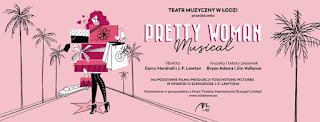
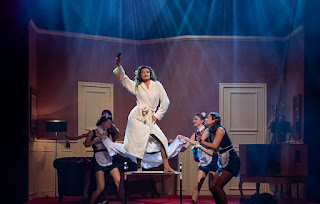 |
| Pretty Woman: The Musical © Teatr Muzyczny w Łodzi, Michał Matuszak |
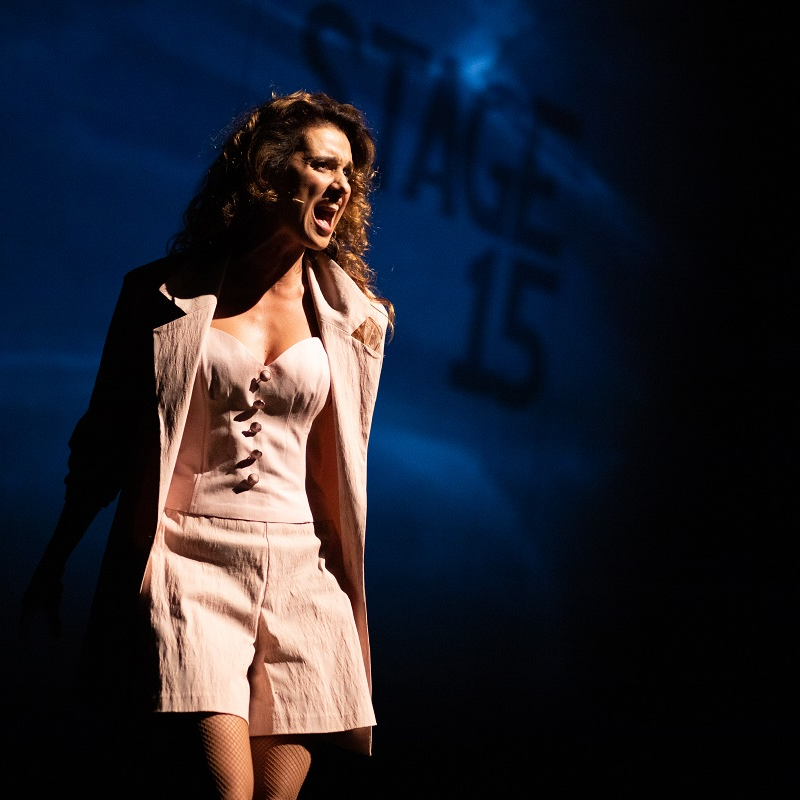 |
| Pretty Woman: The Musical © Teatr Muzyczny w Łodzi, Justyna Tomczak |

Its press night postponed twice and three weeks of performances cancelled due to Covid cases in the company, the National Theatre's new musical Hex seems to have fallen victim to the condition evoked by its title. Rufus Norris implied as much when he took to the stage before Wednesday night's performance, warmly welcoming the slightly sparse but nonetheless eager audience to a show he described as "particularly hard hit" over the previous weeks. The good news is that, all being well, Hex is now up and running again until 22 Jan.
As it turns out, the show that Norris (direction and lyrics), Tanya Ronder (book), Jim Fortune (music) and team have fashioned is a confounding mix of the enchanting and the inept. With a premise pitched somewhere between Into the Woods, Wicked and Tangled, Hex continues in the revisionist fairy tale mode, filtering the story of Sleeping Beauty through the perspective of the fairy who cursed her.
A stunningly beautiful opening sequence introducing us to that lonely "Fairy in the wood" (played by Rosalie Craig as a part-melancholy, part-mischievous vision in tattered white tulle) promises much but the show only intermittently recaptures the spirit of that blissful opening, notwithstanding the sustained exuberance of Katrina Lindsay's design and the dynamism of Paul Anderson's lighting which create some memorable stage pictures throughout.
A problem lies in Ronder's book which is patchy, to say the least. Lacking a strong dramatic centre, the show struggles to hold the characters in balance and the timeline is so confused in some stretches that it can be tricky to tell whether days or decades are meant to have passed. The ending is satisfying in terms of bringing the characters together but the themes don't quite emerge - at least not on a first encounter. In addition, Norris too often falls back on some of his bad habits of staging (familiar from his wonder.land and The Threepenny Opera productions, among others), with the cast facing out too much or scampering up and down wheeled-on ladders.
While the carryings-on of an ensemble of poncy princes and Prince-pricking thorns feel like forced fun, the show is at its strongest when at its darkest and most emotional. These are also the moments in which Fortune's score is at its most exciting and expressive, pushing beyond pop/rock parameters into more unpredictable, quasi-classical terrain. The independence anthem "Sixteen" delivered by Kat Ronney's Sleeping Beauty incarnation Rose feels too calculated and generic a belter, but the material written for the show's other women is much more arresting.
While there's little Light Princess finesse to these proceedings, Rosalie Craig gives another thrilling performance full of swift wit, surprise and soulfulness. She's matched by an astonishing Tamsin Carroll as the devouring ogre-momma Queenie, who is disturbed by, then hellbent on satisfying, her cannibalistic appetites. At first it feels retrograde that the show, like wonder.land before it, falls back on making a female character the antagonist. But Carroll brings so much power to the part that she gives the character mythic stature and a tragic dimension that blows the crummier elements of the conception away. Hex doesn't quite work as it stands, but I'm glad to have seen it: it has scattered moments of magic and daring, and two performances that are for sure the production's blessings.
Hex is in the Olivier at the National Theatre until 22 January.
At the time of writing these words, the prospects for live theatre again look precarious, with around half of West End shows cancelled or postponed, and more troubled times for an already beleaguered industry apparently in store. In this climate I'm grateful to have had the chance to see the amount of theatre that I have this year, in England and Poland; the 10 productions below are the ones that have stayed with me the most.
 |
| The Normal Heart (Photo: Helen Maybanks) |
 |
| Under Milk Wood (Photograph: Johan Persson) |
 |
| Powinniśmy być… (Photograph: HaWa) |
Directed and choreographed by Wiktor Moraczewski and Janusz Adam Biedrzycki, this dynamic one hour two-hander combining text, movement and dance seemed a deeply personal project for its talented young performers, Anastazja Bakhtyukova and Michał Rudkowski, suggesting both a portrait of a relationship and an internal dialogue with a divided self. Indelible moments of separation and symbiosis were created, as Tomasz Krukowski's lighting bathed the stage in a rich range of hues, the mood shifting from the playful to the combative to the tender.
 |
| The Cherry Orchard (Photo: Jack Merriman) |
The Cherry Orchard (Theatre Royal Windsor)
The (mostly) glowing reviews for Ian McKellen's Hamlet reflected more the current goodwill towards the actor than the merits of the endeavour, since, novelty value aside, neither production nor performance was very good. (The standout was Frances Barber's Polonius, all the more remarkable since Barber was a last-minute replacement for a browned off Steven Berkoff.) Far more accomplished was the follow-up production in Sean Mathias season. Partially cross-cast with Hamlet, this was a beautiful and insightful Cherry Orchard headed by Francesca Annis' magnificent Ranevskaya - and with the bonus of on-stage seating that made the experience an unforgettably intimate one.
 |
| Księżniczki (Photograph: Agnieszka Cytacka Fotografia) |
Uniting The Little Mermaid, Cinderella and Snow White, Julia Jakubowska's show offered a truly delicious mash-up of fairy tale figures, deconstructing archetypes in a manner at once witty, loving and provocative - and with a captivating trio of performers in Anna Maszewska, Katarzyna Gorczyca and Małgorzata Lipczyńska.
 |
Rockets and Blue Lights |
 |
Schulz: Pętla (Photograph: Agnieszka Cytacka Fotografia) |
Schulz: Pętla (Schulz: The Loop) (Teatr CHOREA, Łódź)
Expanded from last year's intense and distilled performance Schulz: Skrawki (Schulz: Scraps) director Konrad Dworakowski's production returned to several motifs from the earlier show but emphasised the power dynamics at the heart of the Bruno Schulz material; the sexy, surreal and unsettling ambience gradually moved into more obviously political terrain.
 |
| JA JESTEM PAMIĘCIĄ (Photograph: Agnieszka Cytacka Fotografia) |
JA JESTEM PAMIĘCIĄ (Teatr Nowy, Łódź)
Wojciech Faruga's JA JESTEM PAMIĘCIĄ (I AM MEMORY) evoked the culture and history of the Lemkos - the Carpathian highlanders who lived in the Beskid Niski mountain area for four centuries, until a 1947 decree was issued to resettle them- in a way that was both expressionistic and attuned to lived, daily detail, giving the piece the haunting quality of a requiem.
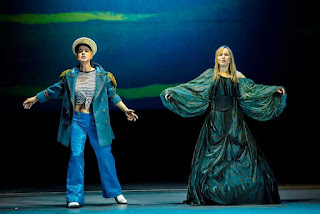 |
| Twelfth Night (Photograph Krzysztof Bielinski) |
Twelfth Night as opera buffa: the musical elements added to Piotr Cieplak's fragrant new production gave some pleasing fresh textures to the most lyrical of Shakespeare's comedies.
All the individual Top 10 Films of the Year lists by Sight and Sound contributors can be read here. My list as submitted is below... along with a few honourable mentions and extra categories.

1. The Power of the Dog (dir. Jane Campion)

2. Annette (dir. Leos Carax)

3. Leave No Traces (Żeby nie było śladów) (dir. Jan P. Matuszyński)

4. The Souvenir: Part II (dir. Joanna Hogg)

5. The Tragedy of Macbeth (dir. Joel Coen)

6. Mosquito State (dir. Filip Jan Rymsza)

7. The Lost Daughter (dir. Maggie Gyllenhaal)

8. Never Gonna Snow Again (Śniegu już nigdy nie będzie) (dir. Małgorzata Szumowska)

9. Everyone Has a Summer (Każdy ma swoje lato) (dir. Tomasz Jurkiewicz)

10. My Wonderful Life (Moje wspaniałe życie) (dir. Łukasz Grzegorzek)
Honourable Mentions (or seen after submitting the Top 10):


Hyacinth (dir. Piotr Domalewski)

Passing (dir. Rebecca Hall)

Ammonite (dir. Francis Lee)

Poly Styrene: I Am a Cliché (dir. Celeste Bell, Paul Sng)

Drive My Car (dir. Ryûsuke Hamaguchi)
Baffling Acclaim Awards: IWOW: I Walk on Water, Beginning, Bad Luck Banging, or Loony Porn, Last Night in Soho, Ultraviolence
So Bad it's Good Award: Diana: The Musical (rather this than Spencer, any day)
Favourite Scores: The Power of The Dog (Jonny Greenwood), The Lost Daughter (Dickon Hinchliffe)
Favourite Credit Sequence: Mosquito State
Cinematographer Heroine: Weronika Bilska (Everyone Has a Summer, Bo we mnie jest seks, My Wonderful Life, Songs About Love, Simple Things)
TV: Uprising (BBC, dir. Steve McQueen, James Rogan), Stephen (ITV, dir. Alrick Riley)
Unexpected Crush: Adam Woronowicz (My Wonderful Life, Zupa Nic)

The Winter issue of Sight and Sound is now availabe. It includes the Top 50 Films of the Year list (individual Top 10s are online here), and interviews with Joanna Hogg, Maggie Gyllenhaal, and Paul Thomas Anderson among lots of other features. I wrote a tribute to Melvin Van Peebles and a piece on Nigel Finch's The Lost Language of Cranes for this issue. More details here.


