Showing posts with label Home Alone. Show all posts

Sunday, 22 December 2024

Sight and Sound (Winter 2024-25)


The Winter issue of Sight and Sound is out now, including the Top 50 Films of the Year list. I wrote about Home Alone for the "Endings ..." column in this issue. More about it here.

Friday, 7 December 2018

the LAMb Poll: Best Christmas Films: Home Alone (dir. Columbus, 1990)


[Written for the LAMb Best Christmas films poll]


With its 30th anniversary - yikes! - on the horizon (and hopefully a spectacular cast reunion in prospect to celebrate that fact), Chris Columbus's Home Alone remains as popular now as ever, its glorious mixture of smart quips, sentiment and slapstick seemingly winning over new generations every time. As a Christmas film, it has everything you could want: warmth and wit, a wonderfully schmaltzy John Williams/Leslie Bricusse song with lyrics about "feeling that gingerbread feeling," and an appreciation of family values that's nicely tempered by ambivalence and scepticism.


8-year-old Kevin McCallister gets his Christmas wish to have his family disappear, thereby fulfilling the desire of many a kid who's grown up feeling lost or unappreciated within the hub bub of their own household. Of course, he eventually wants his folks back - but not before he's proved himself perfectly capable of surviving without them, whether that's by braving the basement that previously terrified him, going on a coupon-savvy shopping trip, bonding with an unfairly maligned neighbour (in that way the movie advocates seeing beyond the family unit, too), or, most famously, fending off Joe Pesci and Daniel Stern's "Wet Bandit" burglars with a dazzling display of booby-trap ingenuity that gives kiddie vigilantism a good name.


I and many others who were children when the film came out aspired to be like the enterprising Kevin, naturally. And Home Alone became a turning point in our movie-going lives, a moment in which films stopped being something we went to just "to pass the time" and instead turned into an all-consuming passion. Watched and re-watched in the cinema, and then at home on video (and not just at Christmas, either), endlessly quoted and acted out, Home Alone delighted, thrilled and empowered us.


The film was a turning point for its screenwriter John Hughes, too, marking his move from teen cinema and adult comedies into the lucrative realm of family-friendly fun, and for its star, Macaulay Culkin, discovered by Hughes in Uncle Buck, who was catapulted into the big leagues thanks to his performance here. Culkin's charisma is at the heart of the film's appeal, but the terrific supporting cast shouldn't be overlooked, either, from bro Kieran as the bed-wetting cousin ("Fuller, go easy on the Pepsi!"), to John Candy at his most adorable, to Catherine O'Hara, irresistibly funny and touching as the mother who - inevitably? - feels the guiltiest about leaving Kevin home alone. (For all the comedy that it milks from extended-family tensions, the film still feels like a mother/son story at heart.)


The little movie that could, Home Alone's phenomenal box office success indicates just how strongly the picture resonated worldwide. I live in Poland these days, where I'm delighted to discover that the film (titled "Kevin sam w domu") is totally adored (Michał Oleszczyk outlines the reasons why in some great just-published remarks here), with the traditional TV screening on the Polsat network still regularly pulling in the biggest audience of the season. For sure, in our uncertain, divided times, there are few experiences more comforting than settling down to the umpteenth viewing of Home Alone and the happy reassurance that Culkin and co. will get us laughing, shedding a tear or two, and - of course - "feeling that gingerbread feeling" all over again.

Vote here!


Friday, 21 June 2013

Mixtape Movies Blogathon: Childhood Portraits


Following the A Life in Movies and Desert Island DVDs Blogathons, the inventive Andy at Fandango Groovers has come up with another idea. This time, the challenge is for bloggers to compile a list of five or six movies (plus one wildcard) that serve as a cinematic equivalent of a Mixtape by complementing each other or fitting together in some thematic way. Since a recent conversation revealed just how many of my childhood memories are actually cinema-going memories, and since I eagerly await the appearance of Mark Cousins’s latest doc A Story of Children and Film (which sounds like a Mixtape Movie itself, if ever there was one), I’ve picked childhood as the theme for my selections. Kids coming to terms with absence, with their own gifts and abilities, and confronting beasts and burglars are the heroes and heroines of the films  below. 



Home Alone (Columbus, 1990)

“This is my house, I have to defend it,” intones Master Culkin. Vigilantism, self-sufficiency and family values, Hughes-style. Given its message, is it any wonder that Home Alone wowed children pretty much the world over? A kid may miss his family eventually, this movie says. But in the meantime he’s entirely capable of surviving perfectly well without them.


Paradise (Donoghue, 1991)

Encompassing grief, friendship, empowerment and resolve, Donoghue’s movie - about the summer spent by a sadsack city boy (Elijah Wood) with his mother’s friends in the country – looks at its adult and child protagonists with equal affection and tenderness, slowly revealing the connections between their emotional experience of the world.


The Long Day Closes (Davies, 1992)

“Mam, can I go to the pictures?” Movie love. The rituals of home, church and school. A first scary stirring of homosexual desire. Davies makes the intimate experience of his 1950s Liverpool childhood something universal, far-reaching, embracing and profound here. If there’s just one sequence to demonstrate the rapturous, melancholic uniqueness of The Long Day Closes it’s this one.


Beasts of the Southern Wild (Zeitlin, 2011)

 A child’s eye view of the bayou, this could be a Maurice Sendak book brought to the screen by Terrence Malick. And in Quvenzhane Wallis’s enterprising Hushpuppy, Zeitlin creates one of the most memorable heroines of the recent American screen. I find the shot of the kids returning to the Bathtub following their dreamy night on the boat to be overwhelmingly powerful.


The Sixth Sense (Shyamalan, 1999)

Forget the ghosts, forget the twist. What makes The Sixth Sense such an enduring, deeply affecting childhood portrait, for me, is that it's about a kid coming to terms with an ability that it takes him the whole movie to recognise as a gift rather than a curse.
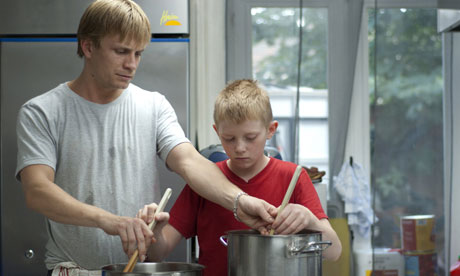


The Kid With A Bike (Dardennes, 2011)

With characteristic Dardennes doggedness, Cyril (Thomas Doret) sets about seeking out his errant father. The renunciation of the pursuit is the point of the story. And the humanity of the movie is cemented by its heart-wrenching final shot.


And...


Michael (Schleinzer, 2011)

An icily enigmatic coda to the (mostly) affirmative films listed above is provided by Marcus Schleinzer’s deeply subversive drama, which presents a middle-class office worker holding a young boy captive in his basement. And shows this predicament to have more in common with a traditional parent/child dynamic than we might care to admit.

Monday, 12 December 2011

5 Christmas Films


Five to watch within the next couple of weeks. Which films will make your list?


Home Alone (Columbus, 1990) 
“This is my house - I have to defend it.” Vigilantism and family values, John Hughes-style. A childhood obsession, this one, and still capable of inspiring warm and fuzzy feelings.


Gremlins (Dante, 1984)
“And that’s how I found out there wasn’t a Santa Claus…”


Dans Paris (Honoré 2006)
I love grumpy père Guy Marchand dragging a Christmas tree through the Paris streets and returning home to find Romain Duris having his 80s pop moment. Screen with Honoré's equally adorable wintry musical Les Chansons d'amour (2007) for maximum festive enjoyment.


Joyeux Noël (Carion, 2005)
Christian Carion’s sincere and touching film about the Christmas truce.


It’s A Wonderful Life (Capra, 1946)
Must we? Oh, go on then.