.jpeg)
My review of Terence Davies's new film Benediction is up at the Sight and Sound website. You can read it here.
My review of Terence Davies's new film Benediction is up at the Sight and Sound website. You can read it here.

Playing Nathuram Godse, the man who murdered Gandhi in 1948, in Anupama Chandrasekhar's exciting new play The Father and the Assassin, Shubham Saraf rises out of the Olivier stage to tell his character's story in retrospect. He does so with witty, audience-implicating self-consciousness and a contemporary awareness that includes references to Richard Attenborough's "fawning film"... and Brexit.
In this way, Chandrasekhar makes The Father and the Assassin not merely a memory play but also a postmodern, beyond-the-grave reminiscence. Avoiding the reverential tone and ponderousness of the aforementioned Attenborough film - which Pauline Kael famously claimed had her leaving the cinema feeling "the way the British must have when they left India - exhausted and relieved" - The Father and the Assassin has a surprising formal playfulness, but one that doesn't detract from the seriousness of its concerns.
It's a play about radicalisation, about colonial oppression and Indian in-fighting, about violence versus non-violence, and, especially, about hero worship curdling into hatred. (The Hindu Godse started out as a Gandhi acolyte before becoming an opponent when he came to feel that Gandhi had made too many concessions to the Muslim minority.)
It's also, modishly but persuasively, a play about gender. The loss of several children led Godse's parents to raise him as a girl, a fact that, Chandrasekhar suggests, resulted in identity issues that reflect India's wider struggles. Godse is seen seeking out father figures: first in Gandhi (here presented as the first man to call Godse "son") and then in Vinayak Savarkar, whose anti-Muslim, Hindu-nationalist stance proves a fatally radicalising influence, and who in one scene schools Godse in "masculine" behaviour.
The play's narration-dependent form results in dialogue that's sometimes something of an exposition blitz. But Indhu Rubasingham's production never feels fusty, zipping the action along at a clip, as Rajha Shakiry's flexible dusty design moves us from prison to seashore, backwards and forwards in time, with filmic fluidity.
The charismatic Saraf commands the auditorium with such casual ease that he might be standing in a living room. Announcing his tale as "a potboiler," starting his narrative proudly and confidently ("Once you know my story you'll celebrate me!"), he becomes compellingly disquieted as his version of events starts to be challenged by other conflicting voices and hauntings in his head.
Equally vivid acting comes from Ayesha Dharker and Tony Jayawardena as the parents; from Sagar Arya as Savarkar; and from Paul Bazely, whose brilliantly fresh performance embodies Gandhi without resorting to cliché. I remember seeing Bazely on stage as Aziz in Shared Experience's adaptation of A Passage to India about 20 years ago, and there's a touch of that company's emphasis on expressionistic movement to the ensemble work here. An episode depicting Partition strife looks a bit awkward, and the lengthy dialogue exchange that precedes Godse's violent act doesn't convince, either. But this remains a highly entertaining and enlightening evening that succeeds in balancing epic sweep with emotional intimacy.
The Father and the Assassin is booking at the National Theatre until 18 June. Further information here.
Related Reading:
Review of Hex

For BFI online I wrote about 10 films focusing on ageing or elderly characters. You can read the piece here.
 |
| Ali & Ava (2021) |
For BFI online I wrote about 10 British films dealing with romance across social divides. You can read the piece here.

I reviewed Maggie Gyllenhaal 's The Lost Daughter for the Spring issue of Cineaste. The review is available online here.


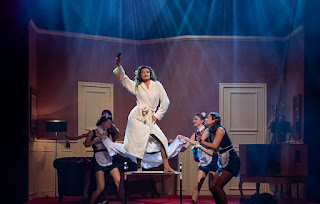 |
| Pretty Woman: The Musical © Teatr Muzyczny w Łodzi, Michał Matuszak |
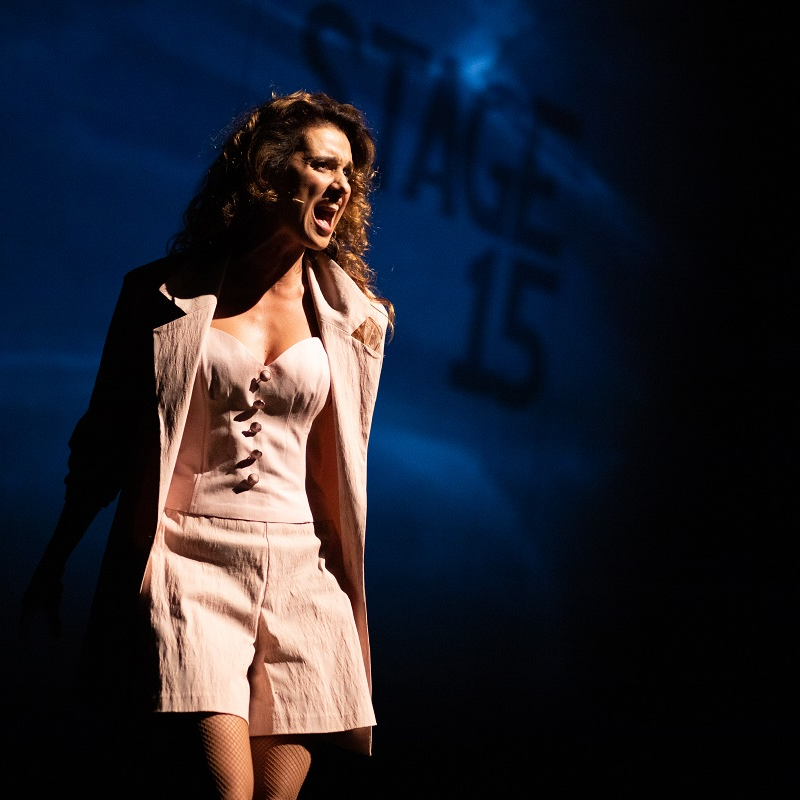 |
| Pretty Woman: The Musical © Teatr Muzyczny w Łodzi, Justyna Tomczak |

Its press night postponed twice and three weeks of performances cancelled due to Covid cases in the company, the National Theatre's new musical Hex seems to have fallen victim to the condition evoked by its title. Rufus Norris implied as much when he took to the stage before Wednesday night's performance, warmly welcoming the slightly sparse but nonetheless eager audience to a show he described as "particularly hard hit" over the previous weeks. The good news is that, all being well, Hex is now up and running again until 22 Jan.
As it turns out, the show that Norris (direction and lyrics), Tanya Ronder (book), Jim Fortune (music) and team have fashioned is a confounding mix of the enchanting and the inept. With a premise pitched somewhere between Into the Woods, Wicked and Tangled, Hex continues in the revisionist fairy tale mode, filtering the story of Sleeping Beauty through the perspective of the fairy who cursed her.
A stunningly beautiful opening sequence introducing us to that lonely "Fairy in the wood" (played by Rosalie Craig as a part-melancholy, part-mischievous vision in tattered white tulle) promises much but the show only intermittently recaptures the spirit of that blissful opening, notwithstanding the sustained exuberance of Katrina Lindsay's design and the dynamism of Paul Anderson's lighting which create some memorable stage pictures throughout.
A problem lies in Ronder's book which is patchy, to say the least. Lacking a strong dramatic centre, the show struggles to hold the characters in balance and the timeline is so confused in some stretches that it can be tricky to tell whether days or decades are meant to have passed. The ending is satisfying in terms of bringing the characters together but the themes don't quite emerge - at least not on a first encounter. In addition, Norris too often falls back on some of his bad habits of staging (familiar from his wonder.land and The Threepenny Opera productions, among others), with the cast facing out too much or scampering up and down wheeled-on ladders.
While the carryings-on of an ensemble of poncy princes and Prince-pricking thorns feel like forced fun, the show is at its strongest when at its darkest and most emotional. These are also the moments in which Fortune's score is at its most exciting and expressive, pushing beyond pop/rock parameters into more unpredictable, quasi-classical terrain. The independence anthem "Sixteen" delivered by Kat Ronney's Sleeping Beauty incarnation Rose feels too calculated and generic a belter, but the material written for the show's other women is much more arresting.
While there's little Light Princess finesse to these proceedings, Rosalie Craig gives another thrilling performance full of swift wit, surprise and soulfulness. She's matched by an astonishing Tamsin Carroll as the devouring ogre-momma Queenie, who is disturbed by, then hellbent on satisfying, her cannibalistic appetites. At first it feels retrograde that the show, like wonder.land before it, falls back on making a female character the antagonist. But Carroll brings so much power to the part that she gives the character mythic stature and a tragic dimension that blows the crummier elements of the conception away. Hex doesn't quite work as it stands, but I'm glad to have seen it: it has scattered moments of magic and daring, and two performances that are for sure the production's blessings.
Hex is in the Olivier at the National Theatre until 22 January.

