Showing posts with label Actors. Show all posts

Tuesday, 18 June 2019

"The most important thing for me is diversity": Łódź Film School Actor Interviews (iv): Ksenia Tchórzko

Ksenia Tchórzko (Photo credit: Julia Klewaniec)

Ksenia Tchórzko plays multiple roles in the Diploma show, Pomysłowe Mebelki z Gąbki (Fever), directed by Mariusz Grzegorzek (for which she won prizes at the Morocco International Drama Schools Festival and the 37th Polish Theatre School Festival). She also plays the Rabbi, Ethel Rosenberg and Hannah Pitt in Angels in America, directed by Małgorzata Bogajewska, and  features in the Diploma film Nic Nie Ginie (Nothing is Lost), directed by Kalina Alabrudzinska. 


Alex Ramon: When did your interest in acting start?

Ksenia Tchórzko: From kindergarten! By the time I got to primary school, I already knew that I wanted to be an actress and really there was nothing else for me. 

AR: Why Łódź Film School?

KT: I think Łódź chose me. I had exams for three schools - Warsaw, Krakow, and Łódź - and this was the one where I was successful. 

AR: What are your feelings about the training here?

KT: There are good and bad things, ups and downs. There are some gaps in the training. You don't end up with particular techniques and methods, for example. On the one hand, that's a downside: I still feel like I need more of those things, and I'm a bit uncomfortable without them. On the other hand, there were some amazing teachers here who gave me a lot of great inspiration and advice.

AR: Which professional actors inspire you, from here in Poland or abroad?

KT: Christoph Waltz is exceptional to me. I very much admire that he's an international actor. It's the kind of career I would hope for. In Poland I notice that there are many actresses who really get into their stride when they're in their 50s. People like Aleksandra Konieczna, Agata Kulesza, Dorota Kolak - they were always great actresses, of course, but they get better and better, and find some of their most interesting roles now they're older. Their way wasn't the usual one, and that's very inspiring to me as a young actress.

AR: Which filmmakers do you admire?

KT: I immediately think about Tarantino! I like old French and Italian cinema very much too, and contemporary directors like Paolo Sorrentino. Here in Poland, directors like Bartosz Konopka, Agnieszka Smoczyńska and Jagoda Szelc are doing such interesting, challenging work. 

AR: Does the political situation in Poland make it difficult for artists right now?

KT: Perhaps, but sometimes when the political situation is not in its best state the culture improves, in a way, because it gives people something to react to strongly and fight against. 

     (Photo: Tomasz Wysocki) 

AR: How was it to work on the first Diploma show, Fever, with Mariusz Grzegorzek - which is a challenging, oppositional show in many ways?

KT: It was so exciting mainly because of Mariusz's personality. Sometimes in the morning he'd be like: "Oh God, I can't do it, I have such a headache!" Then by the afternoon there's no stopping him! We gave him our trust at the beginning and it paid off. It was definitely hard work. Mariusz is the kind of director who has a vision and will do everything to achieve it. I much prefer that to someone who doesn't really know what they want. But there was room for spontaneity, and our suggestions and ideas were always encouraged.

AR: Was the material that he brought in familiar to you?

KT: The Hutsul material was new for me, and it was wonderful to learn about it. We needed that in the show as a contrast. "Swollen Problems" is the kind of thing you can see on TV all the time, but the Hutsul traditions were our soul and it was great to explore them.

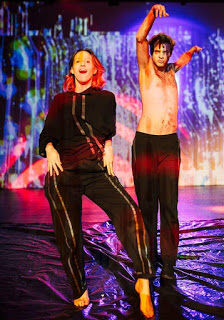
Fever (Photo: Filip Szkopiński) 

AR: Do you have some other favourite moments to perform in the show? 

KT: I do like "Swollen Problems," both being in it and watching my colleagues as they try out different things each time. It's very inspiring. And I like the last "Four Miles from Warsaw" sequence very much. I'm close to the audience and can see their reactions as I'm singing. It's my moment of direct contact. 

AR: How was it to perform this very Polish show at the FIESAD festival in Morocco?

KT: It was quite crazy! There were so many people, too many for the room. Reactions were very vivid and vocal - people were shouting out. They liked "Swollen Problems" a lot; this kind of TV show is international and everyone can relate to it. But they were speechless after the last part, that very intense scene.


Fever (Photo: Filip Szkopiński)

AR: How did making Angels in America compare?

KT: At the beginning I thought: No way! I'd seen the HBO series and knew about the iconic Warlikowski production, and I thought there was no way we could do this, or do the piece justice by only doing the first half. Rehearsals weren't so comfortable because we were in Krakow and the change of environment was challenging. And also, I had three roles. But in the end that proved very interesting: this strange combination of characters: a Rabbi, a Mormon, and a Jewish woman. Following in the footsteps of Meryl Streep is quite special! We did a lot of research on American history, and an academic specialist on the play spoke to us. For Polish viewers it can be hard to get to grips with the complicated American context, so this was very helpful. 

I met a Rabbi and Mormons to learn about the cultures and traditions. I like this part of work very much. It was also interesting that Mariusz and Gosia [Bogajewska] work in totally different ways, and have very different personalities as directors. Mariusz has a clearer vision from the beginning. Gosia is more about trying out different things during the rehearsals and asking the actors to prepare individually.

The Angels in America company (Photo: Filip Szkopiński)

AR: How was it to meet Joseph Mydell who played Belize in the original National Theatre production and who saw your production when he visited Łódź? 

KT: It was really touching because he was so moved by the performance. It was amazing that he saw the show for the first time in 25 years in Łódź. And I think that was the moment when I thought: OK, maybe it was worth it after all. Up to that point I didn't feel so confident about the production, but his reaction convinced me that we were doing some good things.

AR: How was working on the Diploma film, Nic Nie Ginie?

KT: I don't have a big part but it was a great experience. I was a bit angry about the situation at first, because not everyone has a part like they did in Monument last year but once I got on set my attitude changed, mostly because of Kalina. She is amazing: her openness, her confidence. It was a short time but I learnt a lot.

AR: How about your future plans or dream roles?

KT: I have some upcoming work in theatre and film, and I'm excited to work in both of those mediums. In terms of dream roles, it's hard to say; there are many things I would like to play. The most important thing for me is diversity. The idea of playing a character of the opposite gender is always interesting. In that way, Angels in America became a dream, playing those three different parts. As it happened I'd started learning Hebrew before I was cast; maybe it was intuition or something. 

I think it's possible to find something interesting about every project. In Angels, I would say that I learnt how to be a supporting actress. It can be challenging not to be at the centre, but through this experience I learnt how to support my friends on stage and to really be there for them. It's one of the main things I take away from this production.

Angels in America is performed for a final time at Teatr Studyjny tonight, 18 June. 


Monday, 17 June 2019

"Humanity is the key to our work": Łódź Film School Actor Interviews (iii): Paweł Głowaty


(Image: Tomasz Wysocki)


Paweł Głowaty plays Roy Cohn in Angels in America, directed by Małgorzata Bogajewska, for which he won the Kaleidoscope Award at the Polish Theatre Schools Festival this year. He features in the Diploma Film Nic Nie Ginie (Nothing is Lost), directed by Kalina Alabrudzińska, and also works as a director.


Alex Ramon: When did you become interested in performing?

Paweł Głowaty: For me it all began 7 or 8 years ago, when I started dancing. This was in Bytom. I was accepted to study there after exams. But I chose the Film School because I fell in love with theatre and with words. My Polish language teacher got me interested in literature and in poetry. I felt that it would be great to say such wonderful words on stage. As actors our job is to feel the words, to say them, and to say them with respect. So when I was accepted here I made the decision to come to Łódź, and, at the end of my studies now, I don't regret it at all. I think that Łódź was the place for me and I learnt many new things here. The most important thing here has been the people.

AR: What are some of the most significant things that you take away from the experience?

PG: One thing I learnt for sure is that I hate methods. They don't work for me. So I started going my own way. Literature teaches me the most. There you can learn the real history of people. I didn't realise that War and Peace would be so important for me. This is the way I came to know about humanity. That's what I think an actor should be: humanity. Humanity is the key to our work.

I also learnt that I don't like film work so much, and I'm less interested in pursuing it. I don't feel the energy in the same way on a film set. In theatre I know that I can make a move from my heart and soul and that I can bring everything I have inside me to the performance. Also, the connection with the audience is important. So I see it like this: work in theatre - great. Work in film - OK.

AR: Tell me about working on the second Diploma Show, Angels in America, in which you play a very challenging role: Roy Cohn. Were you familiar with Kushner's play before you started rehearsals?

PG: I'd heard about it but I didn't know the play before we started reading it. And my first thought was that it's a very hard text for young actors to do, very challenging. In particular, the role of Roy...well, I wondered if I could reach the level of playing this historical person. Of course, everyone knows the TV series version, with Al Pacino in the role. So I thought: Oh my God! I'm 23. How can I do it?!

Kamil Rodek and  Paweł Głowaty in Angels in America
(Photo: 
Filip Szkopiński)

AR: So what was the process like? 

PG: I did a lot of research into him, and watched video footage closely. I was amazed by this strange energy he had. The way he looked at people. I was amazed, but scared too. Gradually I started to catch his mindset... And then - I don't know exactly how it happened - but my posture was different, my voice changed, I started moving my hands in a certain way. There was this transfomation.

AR: How does is it feel to play someone people tend to hate?

PG: During School I almost always played bad guys. Because of my not so "cute" face, I suppose! So when [director] Gosia Bogajewska told me "Paweł, you'll be Roy Cohn", I thought "Oh, it happened again!" I read an article online when I was preparing which described Cohn as "the worst homosexual in history." He was the person he himself could hate the most. He was anti-Semitic - and Jewish. Homophobic - and gay. All of this self-loathing was there. Playing a bad guy is not so hard for an actor, but playing a bad guy with different angles and levels - that's the challenge.

AR: Is it the actor's duty to make such a character "sympathetic"?

PG: A few performances ago I started to play the last scene not just with anger but with huge sadness and desperation. He's losing everything, and you need to feel that. I started to discover it more and more. The mother of Robert Ratuszny, who plays Prior, told me: "During most of the play I hated your character but at the end I felt something different." That was important to me. That people see him as something more than "the worst homosexual in history" and that you find some different colours. I especially like playing that last scene. It's intense, I'm sweating... But I feel like I have wings there.

AR: Angel wings, I guess... What was it like to meet with Joseph Mydell who played Belize in the original National Theatre production and who saw your production when he visited Łódź?

PG: It was a beautiful moment. We saw how moved he was and it seemed that the production had connected him to the past and given him some strong memories. That was very important for us.

(Photo: Tomasz Wysocki)
AR: Which theatres in Poland do you like?

PG: I admire the work of Teatr Powszechny in Warsaw, for one, because they focus on the Polish reality. I think at this time in our country it's important for theatre to be an oppositional force ... to stand against the not so colourful reality. I think that's the destiny of theatre.

AR: And what do you think of the condition of Polish cinema at the moment?

PG: I think it's having a renaissance. There are some great young directors. The 90s was not a good time for Polish film, but now it really feels like the art cinema is back in a great way.

AR: What are your plans for the future?

PG: I have a huge list of texts that I'd like to work on in future. I'm also starting to work as a director, which I like very much. When I'm directing I feel I can express more. With my collaborators, I can create a world from the beginning and be responsible for the vision. I think it changed my approach to acting as well. I was thinking about taking some directing course, but after these years of study to be honest what I want most is to get out there and do things, and I feel prepared for that. Every moment is a good moment to learn.

AR: How does it feel to be at the end of your studies?

PG: There's a sense of sadness because we've been so close as a group, and a part of our lives is coming to an end. But, on the other hand, there is freedom in that, because you can fly.


Angels in America is performed for a final time at Teatr Studyjny on 18 June.

Tuesday, 11 June 2019

"Acting is About Being Close to People": Łódź Film School Actor Interviews (ii): Anna Paliga

Anna Paliga (Photo: abewu.pl)

Anna Paliga plays multiple roles in Pomysłowe Mebelki z Gąbki (Fever) and the character of Renata in Śliskie słowa (Slippery Words) at Teatr Studyjny, Łódź. She also plays Susannah Walcott in The Crucible (Czarownice z Salem) at Jaracz Theatre.

Alex Ramon: How does it feel to be at the end of your training and at the point of saying goodbye to your colleagues?

Anna Paliga: When you're in such a group for four years it feels like a family - and it is a family, in a way. Our year is a very young one - we don't have any students over 24 years old - so it feels like we started out as kids and really grew up together. So when I think about the end of school, I mostly think about losing that special bond. Of course it will still be there, but we won't be seeing each other all the time now.

AR: Turning the clock back, when did your interest in acting start?

AP: It started very early for me. I always had this need to be watched, I think. My family told me that when I was little they called me "the gypsy child" because I would always leave them behind, head off on my own, and talk to other people. I'm from Rzeszów and I was part of a theatre group with some other children. We were brought together by a director and we used to travel around Poland performing at festivals. So from an early age my life was made up of these experiences. It was later that I decided I wanted to make it professional. I was searching for a kind of community - maybe a "commune" in a hippy or gypsy sense. A place where people are open and are doing something together, and where they have the same direction.

Anna Paliga (Photo: Tomasz Wysocki)

AR: And why Łódź Film School? 

AP: I had just turned 18 when I graduated from high school and I wasn't sure that anywhere would want me, being so young. I also felt that maybe I wanted to know a bit more about life, and have more experiences. But I decided to go for the exams and I was accepted. So the fact that I came to Łódź is a matter of chance, really.

AR: How has the training at the School changed or challenged your views about acting?

AP: Well, when I was in high school I thought that I wanted to be in the theatre, mainly. But when I started studying here, I realised that it isn't my way, and that what I actually want to focus on is film. I've been in a lot of short films during my time at the School, made by lots of different directors. And I feel that in film there's something that you can't reach in theatre. Also, I like the fact that it's not repetitive. A disadvantage of the training here is that we mostly focus on acting for theatre. So it was challenging and rewarding to be in the short films: although I was helping the directors by participating, they were also teaching me many things and I liked that they could see something in me and what I was trying to do. So these student directors were also my professors in a way.

Anna Paliga in Aquarium (2017)

AR: Going back to theatre, how was making the first Diploma show, Fever, for you?

AP: It was very interesting. But hard because we didn't study the grotesque at all, or even have many comedy classes. Łódź Film School is famous for making students feel things, for being dramatic and depressed, for crying... So I'm perfect at crying and I can feel a lot of things! But other elements we had to learn while making the show. And also how to play with the audience. I think we are still learning that, because it's different every time.

But it's an important show for us because we could say something about Poland with it. I particularly love the Hutsul scenes; I think they're very powerful. "Swollen Problems" was traumatic for me at the start, because it's not my kind of humour. But now, after 30 performances or however many we did, I enjoy it more and found my way into it. It's been interesting with this show, because I feel like I couldn't do a lot of things at the beginning but that I learned things through the whole process. And I realised that that's why I'm here: to push myself into different things, things that might feel uncomfortable. I didn't expect that that would be so important for me.

Anna Paliga and Faustyna Kazimierska in Fever 

AR: How did making the third Diploma show, Śliskie słowa with Artur Urbański, compare?

AP: We had input into Fever, but with Śliskie słowa we improvised a lot and created whole scenes and characters. We were looking for something that was personal to us.

AR: So did you always dream of working in Żabka like your character Renata?

AP: When I was in high school I started talking to some of the homeless people in my town. I had my favourite ones to chat to. And when I moved to Łódź, well, I found that it was full of such people! I had a bad car accident my first year here; I was on crutches afterwards and had to rest a lot as I went around the city. So I'd sit on benches with homeless people and they'd help me with my leg and tell me about their lives. Then those friendships became a part of my life.

I often find that I have strong relationships with shop-workers as well! And I had my favourite Żabka lady in a branch near the theatre. She was amazing, and we were having all these funny conversations every time I went into the shop. I was telling my colleagues about it at the theatre, and Urbański said: "You have to play this!" So that's how Renata was born.

Anna Paliga in Śliskie słowa (Photo: Aleksandra Pawlowska)
AR: What do you find interesting about playing her?

AP: She's looking for love and she can't find it. It's something that everybody goes through. And they end up using the Internet to meet people or going to a psychiatrist just to be listened to. I think it's a disaster for society, a lot of the time. And I wanted to talk about that in the show.

AR: Tell me about being in The Crucible at Jaracz Theatre. 

AP: The work was amazing. We created a female group - the "girly group" - and worked a lot on the possession scenes. We liked each other so much that it was - and is - very special to play. We all feel supported by each other - that we can do anything and someone will catch us. That goes for the whole group. So we're getting more and more possessed from one show to the next! It's like a fast moving train.

"The Girly Group" in The Crucible (Photo: Magda Hueckel) 

AR: So we've ended up talking a lot about theatre and it sounds like it has its rewards for you, after all. What about your upcoming film projects?

AP: I'm working on a Polish/Israeli film. I'll also play the lead in a Polish horror film that I'm very excited about but can't talk about in detail yet. One of my favourite films is Possession, so, like I said, I'm thrilled about this project. Film is definitely what I'm more into for the future. I'm very inspired by Gabriela Muskała. We worked with her last year at the School and we loved her so much. It was inspiring that she wrote the script for Fuga because she was looking for something very challenging to play. I like to write as well; I didn't have time during my studies but I want to do it in the future because I think it's a big advantage for an actor to be able to write your own scripts.

AR: And how do you feel about Łódź as a city? You mentioned that you like hanging out with the street people...

AP: Yes. When I first came here I felt it was too much for me: too big, too many people. But now I feel very connected to Łódź. I think the city's cultural life is so exciting. It has a different feel to other cities. It's not posh, but it's artistic. Yeah, people can be negative about it. But you know, Polish people like to be negative. So this keeps them happy in a way.

AR: Finally, could you say a few words about what acting means to you: as a craft, as a profession?

AP: People like to say a lot of things about acting - OK, I've been doing it now - but what I really think is that it's not something so special. It's about being near to people, not above them. That's why it's interesting, because it's not about being above. I need to be on the ground, close to people. I think that's my job as an actor, and that's why I love it.


Śliskie słowa is performed for a final time at Teatr Studyjny tonight, 11 June. Fever is performed for a final time on 17 June.


ANNA PALIGA SHOWREEL 2017 from Ania Paliga on Vimeo.

Wednesday, 5 June 2019

"At the Beginning of the Road": Łódź Film School Actor Interviews (i): Piotr Pacek

Piotr Pacek (Photo abewu.pl)


As the place that produced the likes of Wajda, Polański, Kieślowski and Skolimowski, Łódź Film School remains the most storied and prestigious of such institutions in Poland. Recently featured in Variety's 2019 list of Best Film Schools, under the current Rectorship of Mariusz Grzegorzek, Łódź continues to nurture new talents in cinema and theatre. This was evidenced by the three terrific Diploma Shows (Fever, Angels in America, Slippery Words) presented this year at Teatr Studyjny and featuring this year's contingent of graduating Acting students. I had the pleasure of interviewing some of the actors over the last few months for pieces that will be published in full in my book of actor interviews next year. In the meantime, though, I wanted to share some shorter versions of the conversations here, as the actors reflect on their time at the School and look forward to future opportunities.

First up: Piotr Pacek, who features in the great Diploma show, Pomysłowe Mebelki z Gąbki (Fever), directed by Mariusz Grzegorzek (for which he won two prizes at the 37th Polish Theatre School Festival last month), and in the Diploma film Nic Nie Ginie (Nothing is Lost), directed by Kalina Alabrudzińska.

Alex Ramon: Tell me a bit about your background and when your interest in acting started.

Piotr Pacek: It was at school. I grew up in a small town near Bydgoszcz, where I was born. I was part of a theatre group in my class, when I was 15 or so. But the main thing was that I always loved movies and I remember many films from my childhood and adolescence that were really important to me: Tim Burton's Batman, Taxi Driver, Amadeus, Dr. Strangelove, The Deer Hunter, The Shining, Mean Streets, Midnight Cowboy, Goodfellas, Platoon. Seeing these films, it was just... pure love.

AR: So it was film rather than theatre that inspired your interest in acting?

PP: Yes, movies moved me so much. Watching them, analysing them, I felt: "This is my world." They were the place where I was looking for myself. It wasn't until I came to the school in Łódź that I really fell in love with theatre as well. The training here focuses more on theatre than film, which is a shame in some ways, but it's also through that that I got into stage work and began to love it.

AR: Who are some of the actors that inspire you?

PP: Answering about favourites is hard because there are so many great actors. But for me Robert De Niro is number one. I love Brando and Clift too, and Joaquin Phoenix and Philip Seymour Hoffman. When it comes to Polish actors, I admire Zbigniew Cybulski, Janusz Gajos, Bogumił Kobiela, Leon Niemczyk. In terms of the younger generation, I like Tomasz Kot and Borys Szyc. We have a lot of great actors here. I was lucky enough to work with Łukasz Simlat on a TV series and that was great. He's a great actor and a great person.

AR: Is there such a thing as a Łódź Film School actor or "method"?

PP: I think you make your own method. You're free. The best thing here is that you're getting all these different experiences and that you can experiment and discover things. For me, that's what's counted most in the training.

Anna Paliga and Piotr Pacek in Fever

AR: I love the Diploma show, Fever, so much. It really tests you all as actors in making you take on multiple roles, and incorporating elements of comedy, drama, singing, dancing, parody, the grotesque... How was making the show for you?

PP: It was a great time, and it still is. What I like is that it's a modern play. Some people say that theatre is over; this play shows otherwise. I very much like the Boss [Film School rector Mariusz Grzegorzek]. He's a great artist and I learned so much from him. He valued our input; it was a real collaboration and I think we made a good show. Every time we perform it it's a great adventure, you know.


Mateusz Grodecki and Piotr Pacek in Fever 

AR: Do you have any favourite moments to perform in the show? 

PP: I really like the Hutsul stuff; it was something I didn't know about before and I fell in love with it. The "Four Miles from Warsaw" sequence at the end is always powerful and challenging to do. I love the quiet scene that Mateusz Grodecki and I play as father and son. He's great and it's a very sensitive moment in all the craziness. At the beginning with "Swollen Problems" [a reality TV show parody], it was hard for me to catch the form, but I think that after a few performances I got it and now I enjoy it more and more.

Poster for Nic Nie Ginie (Nothing is Lost)

AR: And how was the experience of making the Diploma film Nic Nie Ginie (Nothing is Lost)?

PP: Along with Fever, it's been a highlight for me. Like I said, we don't have so much time with the camera at school and I learned a huge amount from Kalina [Alabrudzińska]. She's a great director and working with her was something special. We had a script but improvisation was encouraged too, and I felt very comfortable. Kalina and the crew really created that kind of atmosphere. Growing up, movies meant so much to me; now, my dream came true: I made one!

AR: In fact, you made two: you're also in Lech Majewski's Brigitte Bardot Cudowna (The Wonderful Brigitte Bardot).

PP: Yes, that was a crazy experience! I was kind of nervous because it was the first feature film I made and I was acting in English. But I learned a lot and I'm really curious to see the result.

AR: Do you think it's a good time for Polish film generally? 

PP: I think it's getting better, I think it's coming up. The success of Ida and Cold War was very important. We have some great directors, both from new and older generations: Smoczyńska, Szumowska, Holland.

Piotr Pacek (Photo: abewu.pl)

AR: Have you enjoyed living in Łódź during your studies? 

PP: Yes, I've felt very much at home. It's a weird city, just walking around you feel this different vibe: buildings from before the war, from the Communist times, then the revitalisation... It has that multi-culti element.

AR: Do you feel you can tap into the film history of the city, too?

PP: Yes, it's important. As soon as I came here I felt I was in a good place. I'm working on something now with rehearsals in Warsaw... almost everything is made there and it's necessary to be in the centre. At the same time, I don't feel like Warsaw is my place. It's a totally different city, faster-paced.

AR: Personally, I prefer Łódź.

PP: Me too, me too.
Piotr Pacek (Photo: Tomasz Wysocki) 

AR: What is your upcoming project? 

PP: It's an adaptation of Szczepan Twardoch's very popular novel Król (King) that Jan P. Matuszyński [The Last Family] is making into a series. It's exciting to be part of. I see it this way: I'm at the beginning of the road. And the best thing for me is meeting and working with people who love the craft.

AR: Are there international filmmakers you'd like to work with too?

PP: Kubrick... but he's dead! I always love Martin Scorsese.

AR: And any dream roles you'd like to play?

PP: (laughs) A drug addict!

AR: A drug addict for Martin Scorsese, right? 

PP: Of course! After school I'd definitely like to go to New York and try stuff. That whole scene meant so much to me, Strasberg, De Niro... So I'd like to go there, for sure. Just to touch it, you know. It's one of my dreams.

Fever is performed for a final time at Teatr Studyjny, Łódź, on 17 June. Nic Nie Ginie screens at TR Warszawa, Warsaw, on 8 June and is presented in competition at Młodzi i Film Festival in Koszalin, 10 -15 June.


NIC NIE GINIE /////// teaser ////// scenariusz i reżyseria Kalina Alabrudzińska from LODZ FILM SCHOOL on Vimeo.

Fever photos: Filip Szkopiński.