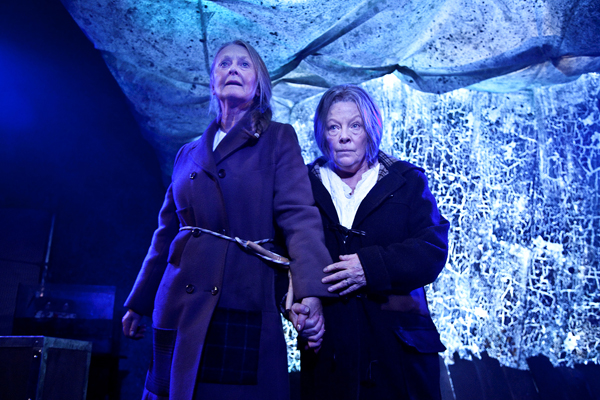
Hamish Pirie’s production of Tim Price’s new play opens the second Donmar at Trafalgar Studios season: a twelve-week residency showcasing the work of the Donmar’s Assistant Directors. Poetic, strange and singular (though The Winter Guest [1995] and Ladies in Lavender [2004] might cross your mind at various points as you watch), Price’s play is a rather lovely thing. And, pitched between domestic realism and dreamscape, Pirie’s production does it full justice. It might have been titled Two Sisters: the focus is on the strong bond between two elderly twins, Iola (Anna Calder-Marshall) and Anest (Anna Carteret), who live in a run-down cottage on the north coast of Pembrokeshire. Iola is an Alzheimer’s sufferer who’s been cared for by Anest for a number of years, a situation that has become increasingly difficult due to Iola’s violent outbursts. A letter suggesting a suicide pact between the pair prompts the arrival of Anest’s daughter Menna (Imogen Stubbs) to the cottage, and the drama focuses upon the interactions between the three women.
Chloe Lamford’s clever womb-ish design and Anna Watson’s lighting bring warmth and atmosphere to a play that combines the mythic and the mundane with ease. Throughout, small incidents are made to vibrate with profound emotion, their resonance accentuated by the intimacy of the space. A mother reaches out to touch the back of her bending daughter. A confused woman’s distress is calmed by the singing of a folk song. An awkward seaside picnic gives way to an elating game of hopscotch. In a moment that may generate a special thrill for some audience members, a mobile phone meets the fate it deserves: boiled in a teapot.
The eccentricities feel honest, earned. And they’re given depth and believability by the actresses. Stubbs sketches Menna’s insecurities with skill, but the evening belongs to Carteret and Calder-Marshall, who deliver as remarkable a pair of performances as you can currently see on a London stage. Sometimes it seems that every new play involving elderly characters (and there aren’t that many really, are there?) must feature an Alzheimer’s sufferer among its number, but Calder-Marshall’s heart-rending performance, moving from warmth to childishness, confusion to anger, takes its place as one of the most realistic depictions of the disease that I’ve ever seen. And Carteret conveys both the selflessness and the frustration of the care-giver just as movingly. There’s nothing even remotely modish about Salt, Root and Roe, and that’s what’s so bracing about it: it’s a deeply humane and touching piece that marks both Price and Pirie out as talents to watch.
One complaint: Roger Evans’s role as the local policeman (and, briefly, the twins’ father) seems an afterthought, and his encounters with Stubbs’s character lack the credence and complexity of the women’s scenes. Mostly, the actor seems to have been employed to do the production’s between-scenes heavy lifting. I was put in mind of Duncan Preston’s remark in Acorn Antiques: The Musical as his disgruntled actor surveyed a chunky-looking bit of scenery that he was expected to shift: “I trained at RADA, not Pickfords.”
The production runs for 1 hour 40 minutes without interval and is booking until 3rd December. Further information
here.