Thursday, 26 January 2023

Film Review: The Fabelmans (dir. Steven Spielberg, 2022)


With the blessed exception of Charlotte Wells' Aftersun, the spate of "personal" projects produced by filmmakers recently (perhaps a result of lockdown introspection) have been disappointing affairs: strangely bogus and superficial in feel. In general, the more high-profile the filmmaker, the worse the result, and Steven Spielberg's The Fabelmans - a lightly fictionalised account of the director's cine-struck youth, experiences of anti-Semitism and his parents' troubled marriage - is one of the weakest of the bunch. 

The widespread critical acclaim for The Fabelmans - "the movie we've been waiting 45 years for Spielberg to make," claims Rolling Stone, madly - seems more to do with sentimental affection for the director and a vogue for personal "revelation" from celebrities - no matter how familiar, as is the case with much of the stale material that Spielberg and Tony Kushner recycle here.  

What goes wrong with The Fabelmans ranges from its look - Janusz Kaminski's would-be warm but artificial and sickly cinematography - to its obvious, strained writing (with the exception of Lincoln, Spielberg and Kushner don't bring out the best in each other as collaborators, and they really don't here) to some painfully unshaped performances (the usually-great Michelle Williams, already undone by a terrible haircut and overdoing every reaction and gesture as the wayward matriarch). 

Apart from a few small moments, The Fabelmans offers the non-Spielberg acolyte viewer little - so little that the cinephile-pleasing  concluding cameo (in a dramatisation of an anecdote Spielberg has told many times before) has been treated as if it was something special indeed. Watching the movie, I kept thinking back to other, much better films that it occasionally evokes, and wishing that some of the humour and feeling of Woody Allen's Radio Days (1986) or Barry Levinson's Avalon (1990) were evident in the over-extended vanity project that Spielberg delivers here. 


The Fabelmans opens in UK cinemas tomorrow.


Monday, 9 January 2023

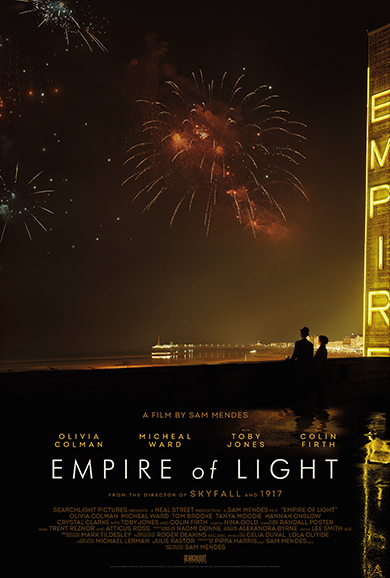
Film Review: Empire of Light (dir. Sam Mendes, 2022)


In late 2002, I remember attending a "farewell" talk at the Donmar Warehouse by Sam Mendes, as he prepared to leave the theatre he'd successfully put on the map as artistic director over the previous 10 years. At the Q&A, a young audience member raised a question about what she termed Mendes's "defection to America", following his Oscar-winning triumph with American Beauty (1999) and the then-imminent release of his second film, the father/son gangster drama Road to Perdition (2002). Mendes was visibly annoyed at the remark, emphasising that he had no intention of turning his back on the UK. 

In fact, though, Mendes's career, particularly in film, has tilted substantially toward the US in the subsequent two decades, and those of us who were huge fans of his earlier work have often felt that his choice of projects - diverse as it may have been - was consistently failing to play to his considerable strengths as a director. 2019's 1917 suggested something of a creative rebirth, though, and raised expectations for his latest film.

For its first 30 minutes or so, Mendes's new venture, Empire of Light, looks like just the kind of film some of us had been hoping he'd make for many years: an intimately-scaled drama of relationships in an English context. Set in 1980-1981, the film (which Mendes wrote himself and which he's emphasised the "personal" nature of in numerous interviews) follows Hilary Small (Olivia Colman, yet again) the middle-aged duty manager of a fading south coast cinema, who forms a bond and then a romance with a new young employee, Stephen (Micheal Ward).


Mendes pitches the opening scenes confidently, presenting Hilary's work routines, interaction with colleagues  and coercive relationship with her boss (Colin Firth) who requests sexual favours in his office. In its careful and nuanced presentation of Hilary's brisk professional competence and personal loneliness, the film has something of the intimacy and frankness that Mendes brought to the best parts of American Beauty, and the initial scenes between Hilary and Stephen (effectively underplayed by Ward, who was Franklyn in Steve McQueen's Lovers Rock [2020]), also mostly hit the right notes. (Though Stephen demonstrating his loveability  by tending to a heavily symbolic broken-winged bird is a little much.)

Collaborating again with Roger Deakins, Mendes also succeeds in making the film visually distinctive: the cinema, with its art deco foyer and seductive but slightly seedy ambience and the sea visible through its glass doors is both grand and faded, and feels just right as Hilary's domain. 

It's a shame, then, that Empire of Light's scenario gradually turns out to be an excuse for a clunkingly heavy-handed glance at two of the culture's current favourite topics: mental health and racism. Ducking out of really exploring or developing the relationships it's established, the film defaults to shriller dramatic territory in scenes depicting Hilary's breakdown and Stephen's abuse at the hands of loitering National Front bovver boys. Neither aspect is deftly handled: affecting in quieter moments, Colman over-pitches Hilary's off-medication diatribes, and a sequence of an NF attack on the cinema is badly staged. The early 80s context ultimately feels sketched in, too, with Stephen schooling Hilary in the realities of racism via a quick mention of the New Cross Fire. 

Nor, even more oddly, does the film's attempt to celebrate "the magic of the movies" come across as deeply felt. Toby Jones's proud projectionist is alotted a would-be rhapsodic monologue on light that may have you wistfully thinking back to his role in Peter Strickland's tougher-minded Berberian Sound Studio  (2012), while a screening of Being There  (1979) converts Hilary from cinema agnostic to wide-eyed acolyte with record speed.  The opening scenes promise much, but, pandering to the modish topics of the moment in a way that gradually reduces its characters to representative figures rather than individuals, the shallow Empire of Light sadly ends up failing as both relationship drama and cinema tribute, feeling both calculated and counterfeit. 


 Empire of Light is released in UK cinemas today. 


Saturday, 31 December 2022

Review of 2022: Theatre - 8 Favourite Productions


Trzy ćwierci do śmierci (Three Quarters to Death)


Romans (Love Affair)
(Fabryka Sztuki)

In a somewhat more stable year for the industry at large, but a slightly scattered and erratic theatre year for me, a few productions stood out as remarkable achievements. Chief among them was the unforgettable pair of Trzy ćwierci do śmierci (Three Quarters to Death) and Romans (Love Affair), two extraordinary examples of female-led puppet theatre presented at Łódź's Fabryka Sztuki. Seen in summer, as part of this year's Retroperspektywy Festival, Natalia Sakowicz's Romans explored abuses of power and coercive control in relationships to devastating effect. Seen in winter, as part of the Przestrzenie Sztuki ("Spaces of Art") season, Karolina Martin's Trzy ćwierci do śmierci drew on folktales to evoke the regrets and losses experienced by a woman cursed with longevity as she recalls various episodes of her life. With indelible stage pictures and superb puppetry, the bracing intimacy and emotional range of these bold shows made them feel like companion pieces. Both were profound experiences that left the viewer shaken, moved, and changed.


The Father and the Assassin
(NT)

Gandhi's murderer narrates his own story in Anupama Chandrasekhar's  play, which, in Indhu Rubasingham's exciting production, combines an intimate, personal tone with historical sweep. Meanwhile, in her other (less loved) NT production this year - of April De Angelis's Kerry Jackson - Rubasingham proved equally adept at skewering contemporary English tensions and embarrassments, in a cusp-of-caricature mode.


Ragnorok
(Fabryka Sztuki)

The apocalypse and after, captivatingly rendered. 


Blues for an Alabama Sky 
(NT)

Digging out Chekhov and Williams echoes, Lynette Linton's production of Pearl Cleage's Harlem Renaissance melodrama teemed with life and joy and sadness. 


Arms and the Man
(Orange Tree)

A specialism of Paul Miller's Orange Tree tenure has been George Bernard Shaw revivals that also manage to satisfy Shaw sceptics. With his last OT production Miller does it again, offering a juicy, generous-spirited rendering of Shaw's satire on militarism that boasts delicious performances from a cast including Alex Waldmann, Rebecca Collingwood, and Miranda Foster (the latter turning "Come, let me show you the electric bell" into the year's sexiest invitation). 


Matka Joanna od Aniołów
(Teatr Narodowy)

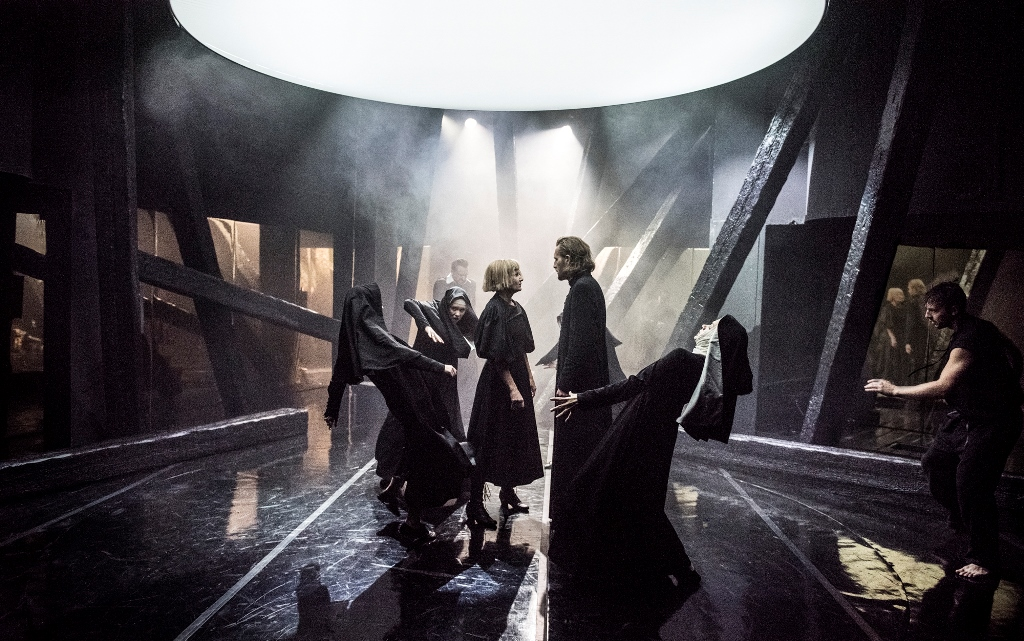
The story of the demonic possession of the nuns of Loudon is best known through the Kawalerowicz and Ken Russell films it inspired, but Jarosław Iwaszkiewicz's novella receives a boldly distinctive expressionist staging by Wojciech Faruga for Warsaw's Teatr Narodowy - axe-twirling, black blood, and all.


 Hex
 
(NT)

The National Theatre's latest fairy tale musical, riffing (all over the place...) on Sleeping Beauty, ended up bookending my theatre year, as the first and last production I saw in 2022. The show's original staging was repeatedly cursed by Covid cases in the company, so I was lucky to see it back in January with its full cast intact, including a phenomenal Tamsin Carroll and Rosalie Craig. Despite a clearer narrative time line, the revamped version, currently in the Olivier, was in no sense an improvement, with the loss of the beautiful opening sequence and the addition of several generic new songs. Still, while certainly no Light Princess substitute, the wonky Hex boasts some bite and charm, plus a sumptuous design that helps the viewer through the rough spots.


Photos: HollyBaba, Agnieszka Cytacka Fotografia, Ellie Kurttz, Brinkhoff-Moegenburg


Thursday, 22 December 2022

Review of 2022: Cinema - 10 Favourite Films (Sight & Sound Top 50)


The Sight and Sound 2022 Best Films of the Year poll just been published. You can read the whole poll here, and my ballot is below. All the critics lists can be read here.


Monday, 7 November 2022

Film Review: Roving Woman (dir. Michał Chmielewski, 2022)


I reviewed  Michał Chmielewski's new film Roving Woman for Film International. You can read the review here.  

10 Great British Social Realist Films (BFI online)


To coincide with the 25th anniversary re-release of Gary Oldman's Nil By Mouth, I wrote about 10 Great British Social Realist films for BFI. You can read the piece here. 

Thursday, 6 October 2022

Film Review: Roald Dahl's Matilda The Musical (dir. Matthew Warchus, 2022)


One of the true great British musical successes of the past decade, Tim Minchin and Dennis Kelly's Roald Dahl adaptation Matilda The Musical reaches the screen with its main personnel - including the director of the original stage production, Matthew Warchus - intact, but its charm considerably diminished. 

In fact, keeping Warchus on board as director probably wasn't the best idea, after all: in many sequences, the film feels very much like a theatre director's basic idea of making a musical cinematic: all overly bright colour and manic quick cutting (editor Melanie Oliver does not distinguish herself here, and neither do the designers). The sequence for the opening number "Miracle" is particularly unpleasant: a garish kids and parents display that does more to repel the viewer than draw them in. 

This pushy, forced energy scuppers several anticipated moments, with even the show's best song, the brilliant self-reliance anthem "Naughty," marred by an overly-fussy visual treatment. When the film calms down and trusts the witty, warm songs a bit more, it's more successful: Miss Honey's "My House" (well delivered by Lashana Lynch) is particularly lovely here. 


Also on the plus side, some of the other performers come through: Alisha Weir acquits herself well in the title role, with the right mix of intelligence, sensitivity and mischief. Evidently seeking to avoid certain types of gender trouble in the reception, the film's Miss Trunchbull is played by Emma Thompson (the role has always been played on stage by a male actor, and Ralph Fiennes was originally tipped for it here). Thompson brings a level of Expressionist mania to her performance that makes her another of the film's assets, though a bizarre fantasy moment in the middle of "The Smell of Rebellion" is haunting for all the wrong reasons. On the other hand, the icky elements of class contempt in the portrayal of Matilda's parents feel particularly overt in Andrea Riseborough and Stephen Graham's braying interpretations, which need more witty touches (like the wonderfully casual little wave Riseborough's Mrs. Wormwood gives when bidding her daughter farewell forever). 

Unfortunately the film has little fludity, to the extent that one of the show's most famous songs, "When I Grow Up," feels completely crowbarred in here in a superfluous sequence. The feel-good climax, featuring what can only be described as the flagrant blowing of an Ofsted budget and scored to a not-very-distinguished new song whose sentiments somewhat violate those of "Naughty," is also wildly over-pitched and ends up more more laughable than joyous.  Lacking finesse, and only satisfying in scattered moments, on film Matilda The Musical ranks as a disappointment. 


Roald Dahl's Matilda The Musical is released in UK cinemas on 25 November and internationally on 9 December, before hitting Netflix.