Wednesday, 30 August 2023

'Generations' Said...: A Report on the 12th Retroperspektywy International Theatre Festival, Łódź, 18-27 August 2023


Among the most joyous screenings at this year's New Horizons Film Festival  last month was that of Agnieszka Zwiefka's Vika! (2023), a documentary dedicated to the life and work of the Warsaw-based octogenarian Wirginia Szmyt, a former teacher and correctional facility director turned Poland's (and, let's face it, probably the world's) oldest DJ. 

Combining stylised music video-inspired sequences with footage of Vika on the decks at Pride marches and parties in Poland and abroad, plus intimate  reflections on her complicated family relations, lockdown isolation (and bonus appearances from her hilariously troublesome cat), Zwiefka's film celebrated Vika as a figure whose energy and zest for life not only challenge ageist stereotyping but who also unites diverse demographics - groups that many (not least the mainstream media) prefer to present as irredeemably polarised right now. 
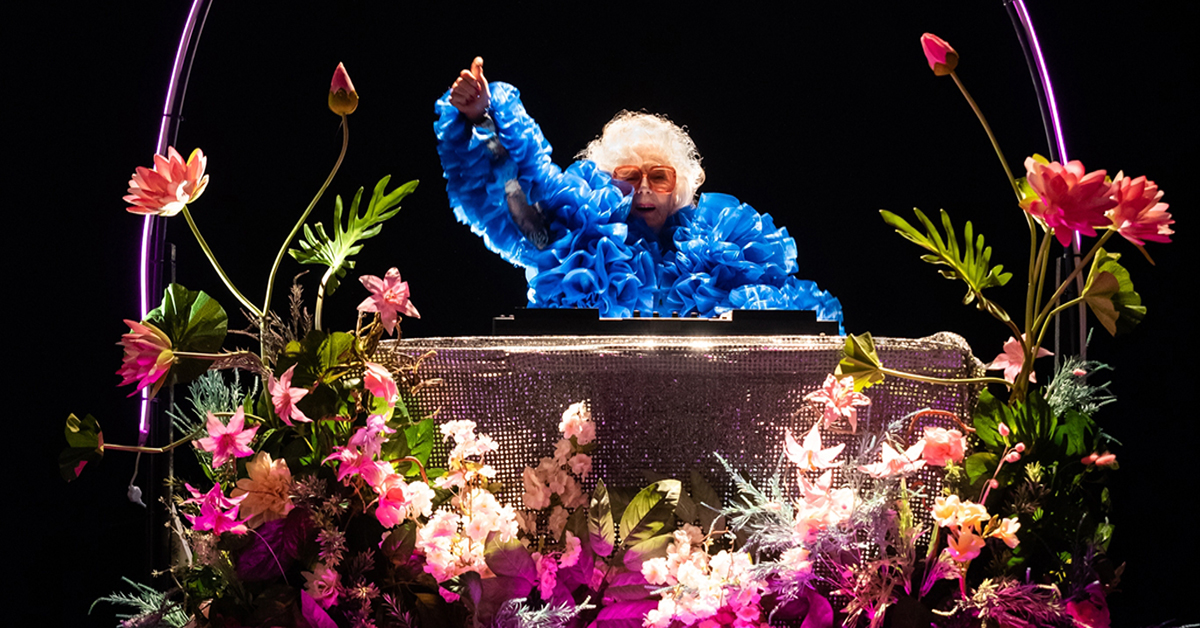
Vika! (2023)

As usual taking place at Fabryka Sztuki and other venues in Łódź across 10 days in August, Teatr CHOREA's Retroperspektywy International Theatre Festival (RPS) this year took as its theme the subject of "Generations," exploring conflicts, correspondences, and, in the words of Artistic Director Tomasz Rodowicz, "attempts to find oneself in intergenerational relationships." (Evidently the topic is of particular concern to Polish creatives and curators at present, since this year's Hommage a Kieślowski festival, which happened in Sokołowsko concurrently with RPS, also chose "Generations" as its theme.) Given the festival's focus, the appearance of DJ Vika at the RPS final Friday party was perfect; the DJ brought the youngest and oldest attendees to the dance floor with a fun, eclectic set that spanned styles and decades. 

I've attended Retroperspektywy for the past 5 years, always finding it among the most multifaceted, inclusive and carefully curated of festivals. If anything, those qualities seemed enhanced this year - perhaps appropriately, given the festival's theme. This 12th edition was one of the strongest yet, as the programme encompassed plays, puppetry, concerts, dance, an  exhibition of work by young artists from Jola Kró­lic­ka's studio at the MSK Art Centre, a series of intergenerational ecological workshops, and meetings with creatives after each event. (Sadly, one much anticipated performance, Łukasz Kos's new take on An-ski's Dybuk, had to be cancelled due to an accident.)

Księ­gi nie­po­ko­ju.
Sta­ni­sław / An­to­ni / Fer­nan­do
 

The opening premiere, Księ­gi nie­po­ko­ju. Sta­ni­sław / An­to­ni / Fer­nan­do (Books of Disquiet. Stanislaw / Antoni / Fernando), directed by and starring Rodowicz alongside two charismatic young performers, An­to­ni Wój­cik-Urba­niak and Sta­ni­sław Gi­nal­ski, perfectly established the Festival theme, using a sustained chess metaphor to dramatise intergenerational tensions and moments of complicity. 

Księ­gi nie­po­ko­ju.
Sta­ni­sław / An­to­ni / Fer­nan­do
 

Lower-keyed and more distilled than some CHOREA opening shows, the piece nonetheless proved stimulating, incorporating translated text by Fer­nan­do Pes­soa, clever set and costume design by Kró­lic­ka, and - perhaps inevitably - a Seventh Seal homage, as well as benefiting hugely from Rodowicz,  Wój­cik-Urba­niak and Gi­nal­ski's evident rapport. 


I am OK

Like last year's edition, the Festival again boasted a significant Ukrainian presence, presenting two shows by Khar­kiv Sta­te Aca­de­mic Pup­pet The­atre. These productions were both directed by Oksana Dmitrieva, and each was finely attuned to the very different demands of the material.

I am OK was raw, direct and immediate in its focus on the diverging fates of four teenage friends (played by Li­liia Osie­ichuk, Ser­hii Sme­re­chuk, Olek­san­dra Ko­le­sni­chen­ko, and Yakiv Oze­rovin) in  Bucha from the first days of the Russian invasion; it wasn't surprising to see some audience members openly weeping by the show's climax.

Vertep

Vertep, by contrast, tapped into a deep well of ritual and tradition. Named in reference to the  Ukrainian portable puppet theatre which presents the nativity story and mystery plays, and which was suppressed by the Soviet state, the performance was full of rich symbolism, soulful singing and creative design. 

Ścia­na z wi­do­kiem

Teenage experience in a contemporary context was also explored in Grupa Coincidentia's Ścia­na z wi­do­kiem (Wall with a View), an idiosyncratic, wild but tender portrait of teenage lockdown loneliness. The pri­ze-win­ner of the Ar­ti­stic Event for Chil­dren and Youth Pro­ject, the show was undertaken in  collaboration with Chil­dren's Art Cen­tre in Po­znań un­der the au­spi­ces of the 23rd Bien­na­le of the Art for Chil­dren, but doesn't shy away from darker emotions. Still, the show placed emphasis on the saving possibilities of creativity and imagination.

Staged in traverse, with well-incorporated multimedia elements, and director and designer Kon­rad Dwo­ra­kow­ski on stage to add musical accompaniment alongside composer Ro­bert Jur­čo, the performance boasted a great central "duet" by the briskly multi-roling Dag­ma­ra Sowa and by Pa­weł Chom­czyk as the troubled teen. 

IV RP Snów

Several ambitious pieces in the programme used dance to express and meditate on existential anxieties. I wasn't convinced by Sto­wa­rzy­sze­nie Sztu­ka Nowa's IV RP Snów (4th Republic of Dreams), directed by Da­wid Ża­kow­ski and choreographed by Woj­ciech Gru­dziń­ski. Despite the clear commitment of its supple trio of performers (Ewe­li­na So­bie­raj, Bo­rys Jaź­nic­ki, Mi­chał To­kar­ski), the production teetered between arresting and risible, and succumbed to the latter in a key section scored to Diana Krall's uniquely painful rendition of "Cry Me a River." 

BUD
(Photo: Øystein Haara)*

On the other hand, BUD, presented on the large stage at Teatr Pinokio by the Bergen-based Carte Blanche - Norwegian National Company of Contemporary Dance as part of the ongoing ACT IN_OUT collaborative project, was explosively effective. 

Directed and choreographed by Roza Moshtagi, the gripping piece combined elements of dance and installation art to explore the condition of waiting and suspended time - its performers (Ire­ne Ve­ster­hus The­isen, Ole Mar­tin Me­land, Aslak Aune Ny­gård, Anne Lise Røn­ne, Tri­ne Lise Moe) variously sitting, laying, convulsing, or racing in the space. Enhanced by a soundscape that veered from otherworldly chants to pounding industrial noise (mu­sic is by Ly­kor­go­us Por­fy­ris), BUD is a major, original piece of work that deserves wide international attention. 

Full Measures

Also highly distinctive was Full Measures by Finland's Li­vsme­dlet director/ choreographer/puppeteer/performer duo San­dri­na Lind­gren and Ish­ma­el Fal­ke, which examined the human compulsion to quantify and measure sundry aspects of life experience as a form of control. 

Initially I was reminded a bit of the great central section of Martin Crimp's unloved play In the Republic of Happiness, as Lind­gren and Fal­ke communicated through a volley of exchanged averages, stats and percentages, delivered in an amusingly deadpan fashion that gestured at social critique.  But the piece evolves into something quite other in its frenzied, frantic later section. Throughout, a multitude of measuring sticks are employed as versatile and expressive aids and props, finally forming a forest that might, perhaps, be a space for our beleaguered protagonists to begin anew. 


Mo­rze ∞ moż­li­wo­ści

Generally exploring darker themes, puppetry has indeed often been a vital component of the festival over the years, testifying to Poland's exceptional creativity in this field. But this year's standout puppet performance, Fundacja Gra/nice's Mo­rze ∞ moż­li­wo­ści  (Sea of ∞  Possibilities), proved a bewitchingly gentle affair.

Mo­rze ∞ moż­li­wo­ści

Freely adapted from Kobi Yamada's book Maybe, this was a calming, beautiful family show that offered pure Sunday lunchtime enchantment, following its enterprising, wide-eyed protagonist (designed by Ju­sty­na Ber­na­det­ta Ba­na­siak) through various tasks and attempts, as they learn the value of trying again, and develop their potential. With a twinkling soundscape, and a simple video camera projecting elements of the set, the design conjures forest, ocean and mountainside up to to a final flight, and the show charmed audience members of all ages from beginning to end. 

Rejs

Two outstanding ensemble concerts book-ended this year's festival, both comprised of music composed and arranged by the esteemable Piotr Klimek - one of the undisputed heroes of this year's event. (Another hero would be the festival's tireless General Coordinator, Anna Maszewska.) Written, directed and conceived by Dworkowski, the first concert, Rejs (Cruise), brought together a diverse crew of performers as the MUR/BE­TON & Ga­da­ją­cy Pies (CONCRETE/WALL & Talking Dog) collective to take the audience on a journey through the courtyards of Łódź history as a wider metaphor for human experience. 


Rejs

Unpredictable weather forced the concert from its intended outdoor location on to a smaller inside stage that made the set-up seem slightly cramped. But the exhilarating, ramshackle energy of the piece still steamed through, with brilliantly sung contributions from CHOREA regulars Joanna Chmielecka and Mi­chał Jóź­wik, among others. 


Marja Mortenssen in
Li­vet. Su­ita dla Zie­mi 


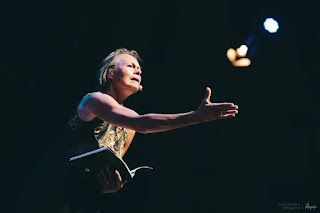
Chmielecka and Jóź­wik were also among the exceptional company assembled for the premiere performance of Li­vet. Su­ita dla Zie­mi (Life. Suite for the Earth), which was the Festival's soul-shakingly great culmination at the University of Music Concert Hall on Sunday night. 

Also part of the ACT IN_OUT project, and produced by Ola Shaya, this concert united Polish, Norwegian, Ukrainian and Bulgarian artists in an evening of song, with narration and spoken word interludes by the great Norwegian actress Juni Dahr, appearing throughout like a particularly graceful woodland spirit to delivery the poetry. (Alongside Erik Hil­le­stad and Tomasz Rodowicz, Dahr was also co-director of the piece.)


Li­vet. Su­ita dla Zie­mi 

Indeed, themes of human connection to nature were central, in a work dedicated to celebrating the uniqueness of the planet and all that lives on it.  The evening opened with the elegantly black-clad, barefoot ensemble of singers sitting in a circle before rising to take their places alongside a band comprised of Tord Gustavsen (piano), Eivind Aarset (guitar), Tore Brunborg (tenor sax), Hubert Zemler (percussion) and Piotr Rodowicz (double bass). 

Juni Dahr in
Li­vet. Su­ita dla Zie­mi 

Inspired by traditional music from all four countries, the show had a beautiful, seamless flow, placing tradition and modernity in dynamic dialogue through a fusion of folk, jazz and rock elements, supported by the amazing harmonies of the 13-strong choir.


Piotr Klimek in
Li­vet. Su­ita dla Zie­mi 

The all-female soloists brought different yet complementary energies to the evening - from the extraordinary, ebullient Saami joiks of Marja Mortenssen, embodying aspects of the natural world, to the heart-piercing tone of Elina Toneva, specialist in Bulgarian folk-singing, and the theatrical, impassioned style of Zoriana Dybovska, reaching back with intensity and pride into Ukrainian roots. 


Zoriana Dybovska in
Li­vet. Su­ita dla Zie­mi 

With voices soaring in lament or exaltation, complemented by some atmospheric lighting design, the effect was overwhelmingly powerful; the performers also radiated a mutual warmth, respect and love that was heart-warming to witness. As Dahr remarked in an interview: "We are in a very difficult moment in Europe. This is the right moment to join forces, create music, poetry, art together and thus give each other a little faith in the future."

Elina Toneva in
Li­vet. Su­ita dla Zie­mi 

A profound and transformative spiritual experience, Livet bestowed precisely that kind of faith. The concert represents art-making at the highest level, and deserves the widest possible international exposure. (October will see a second performance of the piece in Oslo, and an audio recording will be available soon.) It was an exquisite and unforgettable conclusion to a festival that creatively approached the theme of generations in all manner of resonant ways, adding up to an essential edition of Retroperspektywy that can best be described as one for the ages. 


Li­vet. Su­ita dla Zie­mi 

The 12th Retroperspektywy Festival took place between 18 - 27 August 2023.


With the exception of the image of BUD by Øystein Haara, all performance photos are by AGNIESZKA CYTACKA FOTOGRAFIA


Saturday, 5 August 2023

Blu-ray: Young Soul Rebels (dir. Isaac Julien, BFI)


The new Blu-ray edition of Isaac Julien's Young Soul Rebels is out on Monday. I wrote an essay on the film for the booklet in the new release. It's available to order here. 

Monday, 3 July 2023

"Where to Begin with Isaac Julien" at BFI online


I wrote a "Where to Begin..." guide to Isaac Julien's work for BFI. You can read it here. 

Sunday, 28 May 2023

Review: A Crack in the Mountain


My review of Alastair Evans' documentary A Crack in the Mountain is in this month's issue of Sight and Sound, and up on the website. You can read it here. 

Thursday, 11 May 2023

Theatre Review: The Circle (Orange Tree)


Part of the pleasure of W. Somerset Maugham's work is the way in which a seemingly conventional surface gradually splits open to reveal subversive elements. Maugham's plays may look like polite drawing room dramas or comedies but the middle-class trappings conceal  unorthodox thinking - whether that's an endorsement of euthanasia in The Sacred Flame, a critique of war in For Services Rendered, a defence of a dissatisfied patriarch's decision to leave his family in The Breadwinner, or a general vision of ever-shifting relationships that can still feel surprising today.

Predating those plays (it was first performed in 1921) the challenge to the sanctity of marriage offered in The Circle looks highly unlikely to inspire the boos that it apparently elicited in its premiere - especially since the play's final act is, in truth, a bit of a mess. Tom Littler's production - his first as Artistic Director of the Orange Tree, taking over following Paul Miller's successful 9 years - doesn't manage to solve those weaknesses but it makes for a sharply funny and entertaining evening nonetheless. Littler delivered a strong, Chekhovian production of For Services Rendered at the Jermyn Street Theatre in 2019 and clearly has a gift for presenting Maugham in small spaces, helped along here by a crack cast.

Like The Breadwinner, staged at the OT exactly 10 years ago, The Circle focuses on a parent's leaving of their family - but in this case it's the mother who the deserter, and the abandonment has happened some 30 years before the events of the play begin. Lady Kitty Champion-Cheney walked out on her husband Clive and young son Arnold to be with her lover Hughie. Decades on, Arnold's wife Elizabeth has organised a reunion: inviting Kitty and Hughie back to the Dorset family home, much to the chagrin of Arnold, who's now an MP. While she wants to reunite mother and son, Elizabeth's motives aren't entirely altruistic. Motherless herself, she's curious about Kitty whom she's come to admire for her bold stance in turning her back on convention to pursue her own desires. And with friend Teddie evidently interested in her, Elizabeth soon finds herself in a similar quandary that looks like it might result in a little case of history repeating.

The funniest parts of The Circle come in the second act, in which Elizabeth's romantic perception of Kitty is challenged by the reality of her appearance. Jane Asher delivers a glittering comic performance that digs into Kitty's vanity, superficiality and anxiety about her age  - not to mention her palpable disillusionment at the way her decision to leave has panned out. There's some hilarious sniping between her and Nicholas Le Prevost grumping, querulous, dentally challenged Hughie,  and Clive Francis proves their match in a hilariously wily  turn as the deserted spouse who can't help but relish their arguments, and whose own life hasn't lacked in sexual adventures.

The younger cast members -Pete Ashmore as Arnold, Olivia Vinal as Elizabeth, and Chirag Benedict Lobo as Teddie - don't manage to match the older generation: the necessary chemistry between Vinal and Lobo isn't quite there, but Ashmore does bring a memorable ferocity to the proceedings as Arnold realises he might be facing his father's fate. Some elements of the production feel like missed opportunities: Robert Maskell's Butler constantly seems on the cusp of doing something funny without ever quite delivering and Louie Whitemore's design is minimal, apart from some eye-catching costumes for Asher which nicely reflect the character's trajectory as the silly Kitty belatedly reveals some sensitivity.  The twists and turns of the climax don't manage to produce a satisfying conclusion but Maugham's tolerant writing distributes sympathy in unexpected places and there are enough comic highspots to make this pleasing revival worthwhile.

The Circle is booking until 17 June. 

Saturday, 22 April 2023

10 Great British Films of 1973 (BFI online)


I wrote about 10 British film celebrating their 50th anniversaries this year. You can read the piece here. 

Friday, 14 April 2023

Sight and Sound (May 2023 issue)


May's issue of Sight and Sound is out now. I wrote about the Arrow Blu-ray of The Last Emperor for this issue.