Showing posts with label Łódź Film School. Show all posts

Tuesday, 18 June 2019

"It's been the adventure of my life": Łódź Film School Actor Interviews (vi): Mateusz Grodecki

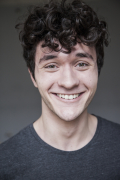
Mateusz Grodecki (Photo: Aleksandra Pawłowska)

Mateusz Grodecki plays multiple roles in the Diploma show Fever (Pomysłowe Mebelki z Gąbki), directed by Mariusz Grzegorzek, and the character of Louis Ironson in Angels in America, directed by Małgorzata Bogajewska. He also features in the Diploma film Nic Nie Ginie (Nothing is Lost), directed by Kalina Alabrudzińska.

Alex Ramon: Tell me a bit about your background.

Mateusz Grodecki:  Music came first for me. I was born in Przemyśl, a town close to the Ukranian border, and my favourite hobby, one of the things I loved most, was playing the guitar. I was in two bands playing rock and metal music. So my biggest dream when I was growing up was playing guitar on a huge stage to a big crowd. When I graduated high school I felt like the band was over, but I wanted to continue performing. I had performed in local theatre, and I found I was drawn to acting more and more. I didn't have professional lessons; I prepared alone, working with different texts. I auditioned for the Film School here in Łódź and got in.

AR: What are your feelings about the training, which I understand concentrates more on theatre than screen acting?

MG: Personally, I'm very happy with the training here. Theatre for me is the magical place where actors feel most at home and where the greatest actors are found. It's because of the connection with the audience and the fact that it's happening in the present moment. Film is great too, but in the end it's more the director's medium. Whereas in theatre the actor has more control over their performance and the telling of the story from beginning to end. At least, that's how I see it.

AR: So how was working on the two Diploma theatre shows you perform in, Fever and Angels in America?

MG: It was tiring and demanding, but great. Fever was the first of the Diploma shows and we were all very excited about it. Mariusz Grzegorzek, our director, is the wizard of theatre: a good man, and so creative. He encouraged our collaboration in the show, inviting us to bring in things we were interested in. For example, Ksenia [Tchórzko], Franek [Nowiński] and I created the tap dancing scene together.

Filip Warot, Karol Nowiński and Mateusz Grodecki in Fever
(Photo: Filip Szkopiński)

AR: It's such a lovely moment. Which other scenes do you most enjoy performing in the show?

MG: One of my favourites is when we all perform the Czesław Niemen song "Pieśń wojów" ("Warrior Song"). I hadn't heard the piece before and when Mariusz played it, I thought: "Oh my God!" It's a primal, Viking, warrior song. When I sing it with all my friends on the stage, I feel the emotions very, very strongly. I think about Poland - about the history of the country and what's happening now.

AR: How is it to perform the end sequence, "Four Miles From Warsaw", which is so daring in its staging?

MG: It's scary, to be honest! But exciting too. The text is an old ballad but it feels timeless. I see it as a warning from history.

Mateusz Grodecki and Piotr Pacek in Fever
  
(Photo: Filip Szkopiński)

AR: Piotr Pacek also mentioned the quiet scene that you play together as father and son.

MG: Oh yes, it's very special. We play it naturalistically. I try to focus on the real feelings of the character. When I'm waiting before we start the scene I take a big breath and cut out everything else for this moment. I feel very responsible for showing to the audience the feelings of this boy.

AR: How did working on Angels in America with Małgorzata Bogajewska compare?

MG: It's hard to compare because the experiences were so different. They both challenged and excited me, and made me use and develop totally different skills. I feel very happy because I'm a young actor and I already got the chance to play with different methods. That's what's exciting about this job.

In Fever, for example, the close contact with the audience is very important. We talk to them directly in some moments, acknowledging their presence. In Angels we're playing to each other. And playing one character, you have to create a whole history for them, and really get inside them. We had classes with Małgorzata  Bogajewska from our second year in School, and she decided to do the Diploma show with us, and chose the Tony Kushner text. I'd heard about it because of the series with Al Pacino and Meryl Streep, and the famous Warlikowski production. Of course our production has some very challenging scenes, like the sexual encounter in the park, and the wrestling scene where Kamil [Rodek] and I are naked.

Sebastian Śmigielski and Mateusz Grodecki
 in Angels in America (Photo:
 Filip Szkopiński)
AR: Did you do a lot of research into the period?

MG: Yes, we studied a lot about America in the 1980s, about Reagan, about AIDS. I enjoy this kind of research very much.

AR: Louis is a character who people often criticise, for his idealistic chatter and his abandoning of Prior. How do you feel about him?

MG: The fact is that in reality people don't always do the perfect thing. Louis loves Prior but he's a young man who can't deal with the situation and isn't prepared to sacrifice himself. With my performance, I try to encourage the audience to understand his conflicts and his desires, and maybe not to judge him so harshly.

AR: How was making the Diploma film, Nic Nie Ginie?

MG: I liked it a lot. I have one scene, playing the guitar in the forest, and singing a song created for the film. It's not a lot of screen time, but it's an important scene, quite controversial.

AR: Do you like Łódź as a city?

MG: Many people say it's horrible but I always reply that you need to live here for a few years to really discover it. It's a mysterious city with many surprises. And thinking about the film history is very important too.

Mateusz Grodecki (Photo: Aleksandra Pawłowska)


AR:  What are your future plans? Who are some directors you'd like to work with?

MG: I feel like I'm a free man! There are a few theatres I would really like to work in - here, in Warsaw, in Gdańsk  and Krakow. As for international directors - well, Quentino Tarantino! Of course we all feel quite encouraged that Rafał Zawierucha is playing Polański  in Once Upon a Time in Hollywood! In terms of Polish filmmakers, I admire Smarzowski for making intelligent films that address problems in society. And I would love to work with Jagoda Szelc who I think will have a great career. With Tower. A Bright Day and Monument it feels like she really started something new in Polish cinema.

AR: Are you interested in Shakespeare? You'd make a great Hamlet.

MG: Wow, thank you! Yes, I love Shakespeare: he's a God! He writes about human nature in all its aspects and with the most amazing language.

AR: It seems like you're very positive about your time here and what the future holds.

MG: Yes, like I said, coming here to Łódź was great for me. It's been the adventure of my life. I met some very good people: some of my professors taught me... not only acting skills -  but they opened my mind up to so many new things. I'm very grateful to the School for that.

Angels in America is performed for a final time at Teatr Studyjny tonight, 18 June. 

Other interviewees: 

Piotr Pacek
Anna Paliga
Paweł Głowaty
Ksenia Tchórzko
Karol Franek Nowiński

"The school helps you to open your mind": Łódź Film School Actor Interviews (v): Karol Franek Nowiński


Karol Franek Nowiński (Photo: Aleksandra Pawłowska)
Karol Franek Nowiński plays multiple roles in Fever (Pomysłowe Mebelki z Gąbki) and the character of Leo in Śliskie słowa (Slippery Words). He also features in the Diploma Film Nic Nie Ginie (Nothing is Lost), directed by Kalina Alabrudzińska.


Alex Ramon: Was it always your ambition to be an actor?

Karol Franek Nowiński: It's funny you should ask that because just the other day my parents sent me a message. They were clearing up my room and had found some old notebooks from when I was 11 or 12. In one of them I'd written down my dreams for the future. The first one was "To be an actor on the stage." This was followed by "Become a lawyer" - a classy alternative! - and "Become a chef."

I'm from Warsaw. We have some fringe stages there, and when I was 16 I auditioned for a part in Grease and got the job. I'd been in some drama groups before that, and played some roles, but this was my first professional job. Later, at school, we did a version of Miss Saigon. I enjoy musicals very much; and when I've visited London I've always made sure to see some West End shows. More recently, with my colleagues here, we put together a show based around songs by Agnieszka Osiecka. I'd originally thought of going to Gdańsk where they have a good school for musical acting. But my friend told me about Warsaw and Łódź so I auditioned. I got in here, and forgot about my original plan!

AR: How has your time at the School been and what are some of the most important things you've learnt over the four years?

KFN: It's a huge question. I could write a book about it! But overall I feel positive about the four years: what I got from my professors, my friends, the guys from other departments. One problem, and its not unique to Łódź, is that the school is "closed" in the sense that you can't go to auditions while studying. I didn't have such problems but some of my friends had to make hard decisions about whether to stay at the school or not if a job opportunity of some kind came up.

I guess that "Trust yourself" is one of the big lessons I take away from the training here. It's easy to say it, but it took me four years to really develop that belief. Before school, I thought I was stronger and more confident than I actually was. So it was a good, hard lesson. The school helps you to open your mind, to look deeply inside - not in the sense that you're "raping" yourself - but in a careful and supported way.

Filip Warot, Karol Nowiński and Mateusz Grodecki in Fever
(Photo: Filip Szkopiński)

AR: How was the experience of making the Diploma shows, Fever and Slippery Words (Śliskie słowa)?
KFN: Very interesting because I'm in two shows which are not typical dramas made from an existing text. With Fever, Mariusz Grzegorzek didn't know exactly what the end result would be but he came with texts and ideas, also wanting our input. He has an amazing brain and knows so many things - from classics to the very latest music.

At our first meeting for Śliskie słowa, Artur Urbański  said to us all: "We don't know each other. Tell me a story." He was observing us, seeing our energy. I'm very grateful to Artur and the atmosphere he created, which gave us a chance to experiment and try things. I love writing as well, and it was great that we could create our own scenes and characters through improvisation. We were inspired a lot by material we found on YouTube, and by the writing of Dorota Masłowska, which fed into Ola Skraba's character, Ala, in particular.

AR: How did your character, the chef Leo, evolve?

KFN: Originally I was thinking to create a character based around Mikey Walsh's memoir Gypsy Boy  but it happened that I made dinner for everyone and Artur was rather inspired by this! I like cooking, and, as I told you, being a chef was one of my ambitions, but I wasn't sure I wanted to play one. However, I trusted Artur, and I'm happy with the direction we went in. Again, trust is so important in this job - trusting yourself and your colleagues. I also watched Marco Ferreri's La Grand Bouffe, which proved to be a big inspiration for me.

(Photo: Aleksandra Pawłowska)

AR: How was making the Diploma film, Nic Nie Ginie?

KFN: I don't have a huge part but I really enjoyed the experience. Kalina [Alabrudzińska] is a good person and the energy on the set was great. We didn't have a lot of time, but she created space, things never felt rushed. Our cinematographer, Nils Croné, was excellent and so was the whole crew. I had a great time.

AR: What are your future plans?

KFN: I'm going back to Warsaw and thinking about auditioning for the music Academy there. I feel like musicals are getting stronger and stronger in Poland, and it's exciting to be part of that. As for dream roles... well, anything from Cabaret! I saw the production at Teatr Dramatyczny five times. I like American drama and I'd love to perform in Tennessee Williams plays, in Edward Albee's Who's Afraid of Virginia Woolf...

AR: Is it a good moment for Polish culture, in your opinion?

KFN: Well, the political situation isn't good, and we're all ashamed about that. But there are some positive things, too, with the first Polish Netflix series and some interesting directors coming through with different visions and ideas. So it's getting better, but with small steps, and the government doesn't help. What I like about Fever is that it reminds us of the richness of Polish culture, and that there are many things to be interested in and inspired by in our cultural history.

AR: Will you miss Łódź?

KFN: Yes, I really like it here. The city centre has a great vibe, with many good venues, clubs, and restaurants with vegetarian and vegan food. It's very cool. It's slower paced than Warsaw, but there's a lot happening, too.


"The most important thing for me is diversity": Łódź Film School Actor Interviews (iv): Ksenia Tchórzko

Ksenia Tchórzko (Photo credit: Julia Klewaniec)

Ksenia Tchórzko plays multiple roles in the Diploma show, Pomysłowe Mebelki z Gąbki (Fever), directed by Mariusz Grzegorzek (for which she won prizes at the Morocco International Drama Schools Festival and the 37th Polish Theatre School Festival). She also plays the Rabbi, Ethel Rosenberg and Hannah Pitt in Angels in America, directed by Małgorzata Bogajewska, and  features in the Diploma film Nic Nie Ginie (Nothing is Lost), directed by Kalina Alabrudzinska. 


Alex Ramon: When did your interest in acting start?

Ksenia Tchórzko: From kindergarten! By the time I got to primary school, I already knew that I wanted to be an actress and really there was nothing else for me. 

AR: Why Łódź Film School?

KT: I think Łódź chose me. I had exams for three schools - Warsaw, Krakow, and Łódź - and this was the one where I was successful. 

AR: What are your feelings about the training here?

KT: There are good and bad things, ups and downs. There are some gaps in the training. You don't end up with particular techniques and methods, for example. On the one hand, that's a downside: I still feel like I need more of those things, and I'm a bit uncomfortable without them. On the other hand, there were some amazing teachers here who gave me a lot of great inspiration and advice.

AR: Which professional actors inspire you, from here in Poland or abroad?

KT: Christoph Waltz is exceptional to me. I very much admire that he's an international actor. It's the kind of career I would hope for. In Poland I notice that there are many actresses who really get into their stride when they're in their 50s. People like Aleksandra Konieczna, Agata Kulesza, Dorota Kolak - they were always great actresses, of course, but they get better and better, and find some of their most interesting roles now they're older. Their way wasn't the usual one, and that's very inspiring to me as a young actress.

AR: Which filmmakers do you admire?

KT: I immediately think about Tarantino! I like old French and Italian cinema very much too, and contemporary directors like Paolo Sorrentino. Here in Poland, directors like Bartosz Konopka, Agnieszka Smoczyńska and Jagoda Szelc are doing such interesting, challenging work. 

AR: Does the political situation in Poland make it difficult for artists right now?

KT: Perhaps, but sometimes when the political situation is not in its best state the culture improves, in a way, because it gives people something to react to strongly and fight against. 

     (Photo: Tomasz Wysocki) 

AR: How was it to work on the first Diploma show, Fever, with Mariusz Grzegorzek - which is a challenging, oppositional show in many ways?

KT: It was so exciting mainly because of Mariusz's personality. Sometimes in the morning he'd be like: "Oh God, I can't do it, I have such a headache!" Then by the afternoon there's no stopping him! We gave him our trust at the beginning and it paid off. It was definitely hard work. Mariusz is the kind of director who has a vision and will do everything to achieve it. I much prefer that to someone who doesn't really know what they want. But there was room for spontaneity, and our suggestions and ideas were always encouraged.

AR: Was the material that he brought in familiar to you?

KT: The Hutsul material was new for me, and it was wonderful to learn about it. We needed that in the show as a contrast. "Swollen Problems" is the kind of thing you can see on TV all the time, but the Hutsul traditions were our soul and it was great to explore them.

Fever (Photo: Filip Szkopiński) 

AR: Do you have some other favourite moments to perform in the show? 

KT: I do like "Swollen Problems," both being in it and watching my colleagues as they try out different things each time. It's very inspiring. And I like the last "Four Miles from Warsaw" sequence very much. I'm close to the audience and can see their reactions as I'm singing. It's my moment of direct contact. 

AR: How was it to perform this very Polish show at the FIESAD festival in Morocco?

KT: It was quite crazy! There were so many people, too many for the room. Reactions were very vivid and vocal - people were shouting out. They liked "Swollen Problems" a lot; this kind of TV show is international and everyone can relate to it. But they were speechless after the last part, that very intense scene.


Fever (Photo: Filip Szkopiński)

AR: How did making Angels in America compare?

KT: At the beginning I thought: No way! I'd seen the HBO series and knew about the iconic Warlikowski production, and I thought there was no way we could do this, or do the piece justice by only doing the first half. Rehearsals weren't so comfortable because we were in Krakow and the change of environment was challenging. And also, I had three roles. But in the end that proved very interesting: this strange combination of characters: a Rabbi, a Mormon, and a Jewish woman. Following in the footsteps of Meryl Streep is quite special! We did a lot of research on American history, and an academic specialist on the play spoke to us. For Polish viewers it can be hard to get to grips with the complicated American context, so this was very helpful. 

I met a Rabbi and Mormons to learn about the cultures and traditions. I like this part of work very much. It was also interesting that Mariusz and Gosia [Bogajewska] work in totally different ways, and have very different personalities as directors. Mariusz has a clearer vision from the beginning. Gosia is more about trying out different things during the rehearsals and asking the actors to prepare individually.

The Angels in America company (Photo: Filip Szkopiński)

AR: How was it to meet Joseph Mydell who played Belize in the original National Theatre production and who saw your production when he visited Łódź? 

KT: It was really touching because he was so moved by the performance. It was amazing that he saw the show for the first time in 25 years in Łódź. And I think that was the moment when I thought: OK, maybe it was worth it after all. Up to that point I didn't feel so confident about the production, but his reaction convinced me that we were doing some good things.

AR: How was working on the Diploma film, Nic Nie Ginie?

KT: I don't have a big part but it was a great experience. I was a bit angry about the situation at first, because not everyone has a part like they did in Monument last year but once I got on set my attitude changed, mostly because of Kalina. She is amazing: her openness, her confidence. It was a short time but I learnt a lot.

AR: How about your future plans or dream roles?

KT: I have some upcoming work in theatre and film, and I'm excited to work in both of those mediums. In terms of dream roles, it's hard to say; there are many things I would like to play. The most important thing for me is diversity. The idea of playing a character of the opposite gender is always interesting. In that way, Angels in America became a dream, playing those three different parts. As it happened I'd started learning Hebrew before I was cast; maybe it was intuition or something. 

I think it's possible to find something interesting about every project. In Angels, I would say that I learnt how to be a supporting actress. It can be challenging not to be at the centre, but through this experience I learnt how to support my friends on stage and to really be there for them. It's one of the main things I take away from this production.

Angels in America is performed for a final time at Teatr Studyjny tonight, 18 June. 


Monday, 14 January 2019

Theatre Review: Fever (Pomysłowe Mebelki z Gąbki) (Teatr Studyjny, Łódź)


Premiered in November, and already honoured at FIESAD, Morocco's International Drama Schools Festival (where it collected two prizes), Mariusz Grzegorzek's Fever (more opaque Polish title: Pomysłowe Mebelki z Gąbki) now returns to its "home town" to confound, challenge, delight and excite audiences anew. This production is the Diploma Show of the Acting Students at Łódź Film School, and, as such, serves as something of a showcase for the emerging talents of one of Poland's most prestigious and storied institutions. Since the 2018 Diploma Film from the school, Jagoda Szelc's Monument, was one of the best things that I saw on screen last year, and Grzegorzek's production of Jennifer Haley's The Nether was one of the best that I saw on stage, Fever seemed the ideal occasion to make my first visit to Teatr Studyjny, particularly as the performance was subtitled in English (which the theatre plans to make a more regular feature of its productions). 


And so it proved. By turns playful and political, serious and silly, raucous and reflective, the 3 hour Fever roars across the stage with dynamic youthful energy from its opening moments. Dance, music, poetry, trash TV and worrying Web 2.0 culture are among the grab bag of modes and cultural references that the show draws from. The kaleidoscopic collage structure of the piece both imitates and subverts the restlessness of Internet surfing or TV channel hopping by mobilising those tendencies for avant garde theatrical purposes. The audience is seduced and challenged by being whisked briskly from one contrasting scenario to the next then surprised with longer sequences that require sustained and immersive engagement.


Inevitably some of the scenes and interludes are more successful than others. But the mixing of wildly heterogenous material generates its own cumulative excitement. Fluidity is the name of the game here, with the show leaping from punk (an exhilarating shared scream through Buzzcocks' "Ever Fallen in Love") to classical (David Lang's "The Little Match Girl Passion") to a hilariously filthy take on Disco Polo ("Ass Dance"). 


The shifts from wicked parody to heart-wrenching sincerity test the vocal and physical prowess of the multi-tasking cast of 13 - Izabella Dudziak, Mateusz Grodecki, Faustyna Kazimierska, Karol Nowiński, Piotr Pacek, Anna Paliga, Zuzanna Puławska, Robert Ratuszny, Aleksandra Skraba, Michał Surosz, Ksenia Tchórzko, Filip Warot and Elżbieta Zajko - who work together wonderfully well. At times - lined up and striding towards us - they suggest a mob: insolent and looking for trouble. At others - when forming a supportive circle or gently holding on to Tchórzko's hair - they're an empathetic, caring coterie. We're clearly seeing the emergence of some Polish stage and screen stars of the future here. 


The amount of time given over to the TV reality show parody "Nabrzmiałe Problemy" ("Swollen Problems") - which documents a Łódź teen love triangle - may seem excessive, but the constant switching up of the performers keeps it fresh and funny. Check out, for instance, the brilliantly contrasting ways in which the actors playing the TV announcer approach that role, offering sinister relish (Filip Warot), cool dismissiveness (Robert Ratuszny), sincere interest (Mateusz Grodecki) and self-satisfied camp pose-striking (magnetic Piotr Pacek). Meanwhile, Aleksandra Skraba, Zuzanna Puławska, Izabella Dudziak and Elżbieta Zajko (the latter two also feature in Grzegorzek's Czarownice z Salem) all distinguish themselves with their memorable takes on the show's highly-strung heroine, Sandra. (And be warned: the hilariously inane theme tune of "Swollen Problems" is a definite earworm.) 


Complementing such sharing of roles, notions of family relationships and community form a thematic throughline, as the show slyly addresses the question posed by Bradley Cooper in A Star is Born's "Shallow" (and quoted early on here): "Tell me something, girl, are you happy in this modern world?" The brashness of the TV show parody is contrasted with sober sections dedicated to Hutsul customs in which attention to community rituals gives the performance a charged collective and historical sense. Some of the most potent moments of the night draw deeply from Polish literary tradition and history, too: witness the rousing choral rendition of the Gall Anonim/Czesław Niemen "Pieśń wojów" ("Warrior Song") or the grotesque and absurdist take on Władysław Bełza's poem "Kłamstwo brudzi" ("Lies Stain"). We're then brought bang up-to-date again with a daring sequence that directly confronts xenophobia and recent political woes. 


Grzegorzek's visionary directorial signatures are, of course, much in evidence, including projections that range from trippy psychedelia to simple black-and-white beauty (with a twist), while the sensational costume designs of Tomasz Armada (alum of Łódź Academy of Fine Arts and co-founder of the Limanka Fashion House) also ensure that the production is a visual feast as well as an aural one. Fine vocal coaching from Izabela Połońska and highly creative choreography from Mateusz Rzeźniczak further contribute to the dynamism of the event. 


The most breathtaking sequence is saved for last - an expressionist rendering of the bloody, tragic folk ballad "Four Miles From Warsaw," accomplished with bowls of water, towels, a sheet, brilliant accordian-playing from Leszek Kołodziejski - and spine-tingling vocal and physical commitment from the whole cast. It's hard to imagine seeing a more transfixing and imaginative piece of staging this year. Yet that's not everything, after all. Following the intensity of that sequence, a joyful, cleansing coda leaves the audience on a high as it takes us firmly into the liberating territory of Dionysus - by way of Donna Summer. I felt love. 

Fever is performed at Teatr Studyjny on 20th, 26th and 27th January. Further information here. 

Photo credit: Filip Szkopiński.