Showing posts with label Łódź. Show all posts

Monday, 31 August 2020

Body / Memory/ History - A Report on Retroperspektywy Festival 2020, Łódź


The organisation of a theatre festival - particularly one as audience-inclusive and interactive as Teatr CHOREA's Retroperspektywy was when I attended it for the first time last year - seems a challenging, not to say a foolhardy, endeavour in the current climate. 

Festival Opening (Fot. Polecam się-Piotr Wdówka)

"Social distance" is the antithesis of the ethos of most live events. And it's certainly so at this festival, where performers make close contact with audience members not just during the intense, highly physical shows, but also at Q&A discussion panels, and other events held at the converted factory buildings that make up the great Fabryka Sztuki complex in Łódź.

Festival Opening (Fot. Polecam się-Piotr Wdówka)


But this most creative of companies pulled off the daunting challenge of this year's Festival in a grand manner, with a rich and diverse programme made up of a mixture of online events, recorded shows, film screenings, VR spectacles and live performances. Audience contact details were taken before each event; masks were mandatory; hand sanitiser provided; and if social distancing was not strictly adhered to at every moment, the Festival still provided a solid model for how to go about the creation and execution of such an event in the disturbing, disruptive times of Coronavirus. 

Schulz: Skrawki (Fot. Polecam się-Piotr Wdówka)

The title of this year's edition - Body, Memory, History - set the tone. The body is always central to the work of the Grotowski-influenced CHOREA, which mobilises the physicality of the performers on stage in totally distinctive, dynamic ways. Teamwork is key to the group's process and output, which seeks to draw on the power of collective expression while never sacrificing each performer's individuality. 

Schulz: Skrawki (Fot. Polecam się-Piotr Wdówka)

The premiere of the company's Schulz: Skrawki (Schulz: Scraps) proved a superb opener. The writer Bruno Schulz (1892-1942) is probably best known outside of Poland for Street of Crocodiles (itself adapted for the stage to much acclaim by Complicite and the NT in 1992), and a selection of his stories provide the inspiration for this new work. A combination of installation and physical theatre, the piece presents its six performers - Janusz Adam Biedrzycki, Joanna Chmielecka, Michał Jóźwik, Majka Justyna, Małgorzata Lipczyńska, and Tomasz Rodowicz - occupying separate spaces (including a bath, a chair, and a table) as the audience enters a silent, darkened auditorium. In stillness to start, the six gradually stir into movement, each engaged in a separate task or overlapping action, as director Konrad Dworakowski intones Schulz's prose live. 


Schulz: Skrawki (Fot. Polecam się-Piotr Wdówka)

A thematic concern with the transgression of matter and the human body emerged, and was vividly evoked thanks to Dworakowski's background in puppet theatre, with strings, wires and sticks integrated into the performers' movements. Enhanced by a perfectly tailored score composed by Paweł Odorowicz, the effect was thrilling and hypnotic: all the more so for being the first encounter with live performance for many months for most audience members.  

In a generous gesture, Schulz: Skrawki was filmed by Hollybaba / Rami Shaya and made available on YouTube for some days after the live premiere. The same was true for all the other shows, including Warsaw STUDIO Teatrgaleria's Więcej niż jedno zwierzę (More than One Animal), a hilarious parody of the anthropomorphising tendencies of certain nature documentaries. 
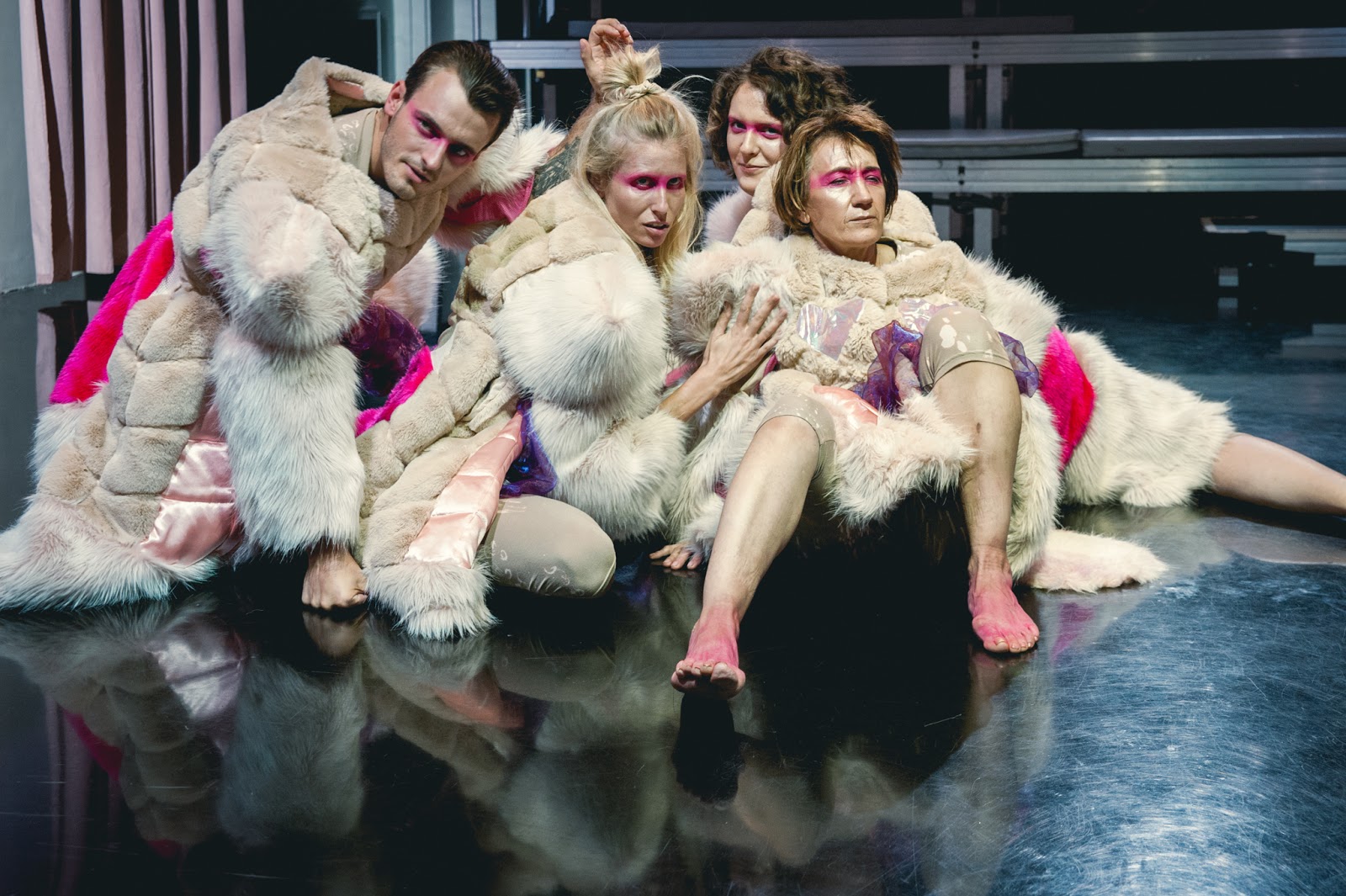
Więcej niż jedno zwierzę (Fot. Polecam się-Piotr Wdówka)


At times coming off as a wryly avant garde take on Cats, the show presented the antics and behaviour patterns of its indeterminate creatures with the aid of a deadpan voiceover delievered by Agnieszka Podsiadlik (the tricky matriarch of Kuba Czekaj's Baby Bump) and wonderful physical work by the cast: Sonia Roszczuk, Vira Hres, Błażej Stencel, and Agata Tragarz. 

Więcej niż jedno zwierzę (Fot. Polecam się-Piotr Wdówka)


A ludic, absurdist tone - accentuated by some brilliantly funny songs delivered by the duo of Robert Wasiewicz and Marcin Miętus - was sustained. But the show also makes serious and subversive points on issues from community to climate change, while a poetic visual flourish at the mid-point was a beautiful surprise.

iGeneration? (Fot. Polecam się-Piotr Wdówka)


Also exploring the issue of community, but within the context of young people's engagement with online culture, was iGeneration?, directed by Janusz Adam Biedrzycki, which was presented in a filmed version. The influence of Mariusz Grzegorzek's unforgettable student-developed extravaganza Pomysłowe Mebelki z Gąbki (Fever) was felt here, with dance, direct address, phantasmagoric sci fi elements, and songs by the band Mojo Pin incorporated into the show. 

iGeneration? discussion (Fot. Polecam się-Piotr Wdówka)

Like the Biedrzycki-directed recent piece Rój. Sekretne życie społeczne ("The Hive: Secret Social Life"), iGeneration? doesn't fear didacticism in its explicit critique of over-consumption and technology's detrimental effects on human connection. But the messages are conveyed via theatrical means that are exciting and surprising, such as the presentation of the web as a seething mass of bodies and masks called "the Great Tangle." In defiance of the numbing and dehumanising effects of the Internet, the show ends with a vivid and invigorating defence of emotion delivered by its excellent young cast. 

W zawieszeniu (Fot Polecam się-Piotr Wdówka)

Mortality was a theme in several shows, including Ukrainian company Golden Gate Theatre's Did You Love Me, Dad?, which was presented in a video performance, and the dynamic dance piece Salto Mortale by Majka Justyna and Joanna Jaworska-Maciaszek. Another powerful solo female production on the topic was Monika Wachowicz and Arti Grabowski's W zawieszeniu (Suspended), in which Wachowicz gave an astonishing, exposing emotional and physical performance as a cancer sufferer coming to terms (or not) with her prognosis. The apparent effortlessness with which Wachowicz moved from heightened emotional states - one minute crawling across the stage, gurning and grimacing - to casual, relaxed audience address was prodigious.


W zawieszeniu (Fot Polecam się-Piotr Wdówka)


Based on the words and real life experience of theatre practitioner Marta Paradecka, who died of cancer in 2018, age just 39, and also taking inspiration from Sontag's Illness as Metaphor and the philosophy of Karl Jaspers, the show was an unsettlingly intimate experience, with some haunting sequences. One such made use of Full Metal Jacket's version of the "Mickey Mouse March" on repeat, as the protagonist, caught in shafts of light, used a baton as a series of weapons, first to combat the illness and then to turn against herself. Yet, for all its demanding intensity, the piece was not, finally, a depressing experience. Ending with a toast, and with an angelic apparition scored to the sounds of David Bowie's "Blackstar," this show that looks dying squarely in the face proved a genuinely cathartic experience.


William's Things (Fot. Polecam się-Piotr Wdówka)

Two outdoor concerts also stood out in the Festival's diverse programme. On the first night, the trio William's Things, comprising Sean Palmer on vocals, Michał Górczyński on contrabass clarinet and Tomasz Wiracki on piano, transformed poetry by William Blake and Henry David Thoreau into a set of stunning jazz punk jams that captivated and confounded in equal measure in their creative approach to the original texts.

Combining folk troubadour sensitivity with theatrical, jazzman attitude and, at times, a Tom Waits-ish growl, charismatic vocalist Palmer also unleashed the most spectacular array of animal noises since Percy Edwards while still keeping every single word he sang crystal clear. From the moment he leapt up to initiate an audience singalong during the band's take on Blake's "The Blossom," the show sustained a great, cleansing energy.


NeoKlez

Meanwhile, on the penultimate evening of the Festival, the band NeoKlez - Stanisław Leszczyński (violin), Damian Szymczak (clarinet), Piotr Tomala (accordion / guitar), Kacper Bardzki (bass guitar / double bass), and Kamil Wróblewski (drums, percussion) - delivered a similarly exhilarating set combining Klezmer tradition with rock, funk and techno modernity. A moving moment came when Leszczyński and Szymczak spontaneously wrapped their arms around each other as they paused briefly to watch their colleagues play, transported by the magic of the music. For the audience, the entire Festival felt like just such an embrace, and a vibrant reminder of the power of performance to transform, unite, challenge and enlighten.


Body / Memory / History - Retroperspektywy Festival 2020 took place at Fabryka Sztuki, Łódź, between 21-30 August. Full details of the Festival programme can be found here. 

Saturday, 15 February 2020

Theatre Review: Rój. Sekretne życie społeczne (Teatr CHOREA)


Named for the Ancient Greek circular dance accompanied by singing, the Łódź-based CHOREA theatre company mobilises the bodies of its performers on stage in totally distinctive, explosive, unpredictable ways, creating dynamic shows that establish a deep connection with the audience as they awaken us freshly to the human body's expressive capabilities. 

Still, to call the company a "physical theatre" troupe seems reductive: rather, an important aspect of the group's work lies in its synthesis of classical models - the unity of singing, words and movement - with contemporary concerns and techniques derived from the experimental methods of Grotowski and beyond. As the company's Artistic Director, Tomasz Rodowicz, explains: "chorea is a kind of a model, which we try to partly recreate and, in a way, overcome, thus building a new chorea."

I first discovered the company thanks to last year's exciting Retroperspektywy Festival which presented the group's work alongside that of a wide range of international artists. A highlight of the Festival was Po Ptakach (After the Birds), a collaboration with the Welsh company Earthfall, which took off from Aristophanes's comedy to develop its own idiosyncratic take on community-building.


The influence of that show can be felt in the more recent piece Rój. Sekretne życie społeczne ("The Hive: Secret Social Life") which was presented yesterday as a festive Valentine's Day treat at the company's HQ of Art_Inkubator. The show uses movement, music, song and projections to explore the interactions of a species often employed by theorists and philosophers as a model for human society - and it comes with an urgent environmental message to boot. In short, having brought us "The Birds", CHOREA now brings us "The Bees."


Directed by Janusz Adam Biedrzycki from Wiktor Moraczewski's script, the show is in keeping with CHOREA's ethos of inclusivity in its appeal to kids and adults equally and isn't in any way dumbed down. Paweł Odorowicz's music, Jolanta Królicka's set, Karolina Burakowska's costumes, Tomasz Krukowski's lighting, Marcin Dobijański's sound design and Paweł Klepacz's projections synthesise to take us inside a beekeeper's dream and, from there, into a bees' nest. Here we're introduced first to the industrious workers, then to three sedentary drones philosophising in their "congregation zone" and, finally, to the Queen herself, sumptuously played by Dorota Porowska. 

With a startling array of movements and sounds, and then a sultry torch song, the brilliant Porowska stands out, but Rój is ultimately an ensemble enterprise in which the whole company - Joanna Chmielecka, Anna Chojnacka, Barbara Cieślewicz, Ewa Otomańska, Aleksandra Szałek, Aleksandra Ziomek, Antoni Kowarski, Odorowicz and Rodowicz - participates in rendering the bees' sophisticated "dance" language through the sophisticated language of Magdalena Paszkiewicz's choreography.

The notion of collective participation is, of course, a theme in itself, one that's apparent from the show's prologue in which Moraczewski appears with a large cardboard sheet containing an "ecological manifesto" for the assembled kids in the audience to sign - creating their own "swarm" as they do so. These opening moments connect with an ending which firmly confronts human responsibility for bees' decline due to industrial agriculture and climate change.

Some may find such preachiness problematic but it provides the show with an urgent edge - a necessary sting in the tale - and prevents the proceedings from becoming too cosy (as does an earlier scene of brutal "worker policing"). Seriousness of intent doesn't diminish the show's charm, and the didacticism dissolves in a gleeful coda celebrating nature's joys. Lyrical, playful, poignant and political, this pleasing show deserves to be widely seen.

Photos: HaWa

Further information here.


Sunday, 12 January 2020

Theatre Review: 4 x Hamlet (Teatr Studyjny, Łódź)


The sharing and doubling of roles has been a feature of almost all of the Łódź Film School Diploma shows I've seen so far (in particular Mariusz Grzegorzek's great devised extravaganzas Pomysłowe Mebelki z Gąbki and Nie Jedz Tego! To Jest na Święta!) - an approach that allows a range of actors to put their individual stamp on a character that they may all have had a hand in creating.


As its title suggests, the second of the 2019/20 shows, 4 x Hamlet, directed and designed by Jaracz Theatre Artistic Director Waldemar Zawodziński, continues the trend but applies it, this time, to a canonical text. The production shares this mightiest, most demanding of Shakespearean roles between four of the graduating actors. (Well, actually eight in total, since the production boasts two casts, whom you can watch perform on separate nights.)

In relation to Shakespeare's play, this seems a particularly apt - and democratic - gesture: Hamlet is, after all, to quote Harold Bloom, "a character so various that he contains every quality." At the performance I attended, Rafał Kowalski, Dominik Mironiuk, Krzysztof Oleksyn and Jan Butruk appeared in the title role, forming a compelling "relay" that rejects a "consistent" approach (if such a thing is ever possible in the case of Hamlet) to instead emphasise the contrasting qualities of the multifarious prince. 


If anything, the conceit could have been taken further: how about giving one or two of the female actors the chance to take on the role too, huh? But Kowalski, Mironiuk, Oleksyn and Butruk all bring interesting qualities to the table. Taking on the early sections of the play, his first soliloquy delivered directly to a particular audience member, Kowalski conveys both the prince's melancholy isolation and his scathing wit as he pops Gertrude's mourning veil over his head; still, his most galvanising moment occurs in the brilliant staging of the first encounter with the ghost. Mironiuk (who was memorable as the MC in Nie Jedz Tego!) brings a distinctive stealth savagery to the part, notably in the violence with which he turns on Rosencrantz and Guilderstern (a relationship that, it's suggested, goes beyond the platonic here) and, later, Ophelia. 


And Oleksyn is an absolute whirlwind, amazingly fast and dynamic in his movements, and equally dexterous with the language (the production mixes several Polish translations of the play); the closet scene, played between him and Victoria Zmysłowska's ever-imbibing Gertrude, is, as it should be, one of the evening's most intense and moving moments. 


The production itself provides a pacy, modern-dress context for the actors' committed efforts, with some illuminating ideas and also some questionable ones. Augmented by the between-scenes appearances of a posse of percussionists drumming frantically on barrels, the show seems to take its cue from those strident sounds; the early scenes are played with an upfront aggressiveness (plenty of shouting in faces) that sometimes cuts against the grain of the text. Far from a dodderer, tall, shaven-headed Michał Włodarczyk contributes the bolshiest Polonius I've ever seen, though his death scene - in plain sight here - is startlingly effective and disturbing.


Luckily, the tone is modulated as the evening progresses, allowing for some subtler touches and fine moments for Hubert Kowalcyz's well-drawn Claudius and Antonina Jarnuszkiewicz's exceptional, expressive-voiced Ophelia, who starts out in leather-jacketed, short-skirted stroppiness, succumbs to abuse, confusion and grief, yet still finds surprising strength in the character in a haunting performance. 


Complete with dressing room mirrors (where the Players pause to do their make up before delivering a Mousetrap with a touch of Drag Race about it), seating area (for the court to watch the Players' show and the final duel), plus a tomb at the front, Zawodziński's design nicely emphasises the themes of performance and mortality, while Maria Balcerek's costumes accentuate the notion of generational conflict, the suited older generation contrasting with the casually attired youth. 


A bold final flourish is somewhat fumbled, but, exactly ten years since Rory Kinnear performed the role for Nicholas Hytner at the National Theatre, Zawodziński and company provide one of the stronger stagings of the play I've seen since, and one that's far superior to Robert Icke's overpraised 2017 Almeida Theatre take, with its Bob Dylan songs and Andrew Scott's awful orgy of gesticulation. Zawodziński's is a production to be seen for its performances, for the power of individual moments, and, particularly, for its innovation in turning an iconic role from a star turn into a collective endeavour. 


4 x Hamlet returns to Teatr Studyjny next month. Further information here. 

Photos: Aleksandra Pawłowska. 

Tuesday, 19 November 2019

Experiencing synergy: An Interview with Ewa Podgórska about Diagnosis


 Ewa Podgórska

Nurtured and developed at some of the most prestigious film schools in Europe, documentary filmmaking in Poland remains a strong and ever-evolving component of the country's cinematic production. A unique city symphony, both intimate and monumental, in which the metropolis and the human psyche become indivisible, Ewa Podgórska's new film Diagnosis takes a distinctively stylised approach to the documentary form. A haunting sound design, slow zooms and some stunning overhead shots create a hypnotic, multifaceted portrait of Poland's prime cinema centre, former industrial hub and revitalisation success story, Łódź, one that might be described as an investigation into the city's subconscious.

As the title indicates, Diagnosis fuses elements of psychoanalysis with urban studies, as questions such as "If the city had parents, what would they be like?" and "If the city was a colour what would it be?" yield answers at once poetic and direct from a range of diverse interviewees, Łódź inhabitants whose insights create a deeper, more impressionistic vision of the city than one made possible by a focus on demonstrable facts. By turns moving, funny, surprising and disturbing, Diagnosis unfolds stories of caring and compromise, loss, disappointment and resilience, and clearly speaks to audiences outside of Poland, given its successful presentations at festivals in the UK, Egypt, the Netherlands, Singapore, Russia, and elsewhere. Here Podgórska discusses the approach of the film, the use of urban psychoanalysis theory, her collaboration with the crew and the protagonists, and her views on the current condition of Polish cinema. 


Alex Ramon: What was the inspiration for Diagnosis and why did you want to make a film about Łódź?

Ewa Podgórska: The idea of making Diagnosis came from my producer Małgorzata Wabińska. She wanted to do a film about the city.  During her research she found the 'urban psychoanalysis' theory. Knowing that I have a strong love/hate connection with my hometown she invited me to work on this project.

Why was it important to incorporate psychoanalysis into the film? 

The energy of a city has enormous influence on its citizens and at the same time its citizens have a great impact on the city itself. Urban psychoanalysis theory was a great starting point to explore this connection and to making the film. It was a useful tool because it allowed me to show something subtle that is difficult to translate into film language.

On the other hand, I've always wanted to explore what people experience when they "fall into themselves," for example during a tram ride. Why they are sometimes not aware of their surroundings. Why they don’t speak about it. To find the answers I had to expand the original 'urban psychoanalysis' to include my own ideas. 

You've written about documentary-makers. Did you have any particular models or inspirations in mind, in terms of other films, when making Diagnosis?

I like documentary films and I’ve seen a lot! So subconsciously I must have had some kind of inspiration, but consciously I didn’t. Although I encouraged the Director Of Photography, Marek Kozakieiwcz, to watch Atlas by Antoine d’Agata and The Sound of Insects – Record of a Mummy by Peter Liechti.

In both films, the narration is based on interior experience which is very difficult, some say even impossible, to show in documentary film. For me this makes these two outstanding films.


How did you find the people to appear in the film? What was the process like?

It was a long and hard process. I was looking for protagonists in different places like nightclubs, markets, streets, churches, etc. Members of the crew contacted me with their friends and family. We even made an announcement in the local newspaper. I spoke intimately with several hundred people - I am not exaggerating! Of course only a small group agreed to take part in the movie. Often people would withdraw just before the shooting began. It takes enormous courage to lie down on a couch in front of the camera and talk about feelings that have often never been shared with anybody beforehand. 

Yes, the participants reveal some very personal and sometimes painful things about their lives. How was the process of working with them in this very intimate and exposing way?

During the couch sessions I just listened to them. Without judgment, interruption, and, most importantly, I think, without any expectations. They knew that they could talk about everything, and that they could also be silent. I spent a lot of time with most of them before filming took place, so the actual shoot was just another meeting but with a camera present. There was just one protagonist that came to the set without knowing me. Of course, all "opening questions” like "If the city were an animal, which animal would it be?” were very useful. 

After shooting scenes on the couch, the protagonists would sometimes want to continue talking. We would speak on the phone days, sometimes weeks later and they would want to finish the stories they had begun.


What was your collaboration with the sound designer, composer, cinematographer and editors like?

I loved them and they loved me. I am deeply grateful that I could meet all these beautiful people and that we could experience this adventure together. During the process of making Diagnosis we experienced synergy. This film is something that happened between us, particular members of the crew, the protagonists and me. The DOP, editors, sound designer and composer are all are very talented, my role was to stimulate them and then stream their creativity. I am especially grateful to Marek Kozakiewicz, who helped me in many different ways. 

What has the reaction to the film been like so far, and how was it to screen the film for a Łódź audience at Transatlantyk Festival in July? 

I'm very happy because Diagnosis is communicating with foreign audiences. I remember one screening in Amsterdam, during which the audience was so focused and glued to the screen that nobody even coughed. It was amazing!

To make Diagnosis more universal we decided not to translate Łódź - the name of the city - in the subtitles. It’s just 'The City'. And what makes me happy is that nobody is interested which city is it. Viewers treat it as a symbol of the mental state of contemporary townspeople.

Of course screening at Transatlantyk Festival was special. It was the Łódź film premiere. I was very stressed about how citizens would react. But it was good. It is not an objective film about the city and they understood that. Much of the so-called "lodzermensch” identified with Diagnosis. That’s our success.


How was your experience of studying at Łódź Film School? What were the most important aspects of the training there for you?

Schools are very important. The Film School in Łódź is excellent. But my main teacher is life. I learned my craft mostly on film sets after school. 

Following a rather controversial edition of the Polish Film Festival in Gdynia, do you think that now is a good moment for Polish cinema? Are there some new directors whose work you particularly admire?

Polish cinema has never been in such a good position historically. It's hard to find an important international film festival without Polish films. It is a wonderful time for new directors with a fresh approach to the cinema. I hope that the people who are responsible for Polish culture understand this. There are a lot of new Polish directors, which I admire: Agnieszka Smoczyńska, Paweł Ziemilski, Jagoda Szelc and many more. 

What is your next project? Would you be interested in making a similar documentary about another city, or was Diagnosis a "one off" project of this kind for you? 

Diagnosis is a universal project and I don't need to do another film like that in a different city. However, if there was an interesting proposition for a town situated, for example, near the ocean…

I am already working on my next film. I hope it will be a surprise. 

Diagnosis screens this month at the Człowiek w Zagrożeniu (19-23 November) and Cinergia: European Cinema Forum (22-30 November) festivals in Łódź, and at HumanDOC festival in Warsaw (22-24 November). 


Thursday, 4 April 2019

Theatre Review: Śliskie słowa (Slippery Words) (Teatr Studyjny, Łódź)


Chatting, singing, grinning, gurning, the eight-strong cast of Artur Urbański's Śliskie słowa greet the audience before we enter the auditorium at Teatr Studyjny, via two TV screens set up in the foyer that present the actors individually, against different backgrounds, as "talking heads." It's a cool introduction to a show, which, as its title ("Slippery words") suggests, is much concerned with language: its expressive capabilities and its limitations; how it can be embraced, deconstructed, transcended, remade.  


The third and (aw!) final Diploma Show for this year's graduating contingent of Łódź Film School Acting Students, Śliskie słowa is a different beast to its two predecessors, offering neither an exhilarating collage of material as in Mariusz Grzegorzek's visionary Fever nor a fresh, distilled take on a modern classic as represented by Małgorzata Bogajewska's production of Angels in America. Rather, the new show has been built up from improvisation, an experimental approach designed, in the words of director Urbański, to give the actors "a chance to think differently about dramatic structure and character-building." 


The results are confident, strange and exciting. A timely thematic throughline of male/female relationship dynamics emerges, from the haunting opening moments, in which Faustyna Kazimierska and Filip Warot - slacklining and headstanding - share a shadowy balletic introduction that's one of several thrilling moments of movement featured in the show (and co-choreographed by the actors).


The sequence segues into a bravura display from Karol Nowiński, who turns the stage-floor floury as a celeb chef with a dark side, one that's fully revealed later in a taut scene with the excellent Katarzyna Majda that shifts from playful seduction into deeply disturbing territory. 


Meanwhile, Anna Paliga's love-seeking cashier Renata has a memorable Żabka meltdown with Karol Kunysz's well-drawn divorcé. Aleksandra Skraba bounces in benignly as Małolta, before morphing into the show's most rebellious and questioning presence. Skraba is startlingly good here, whether unleashing an epic string of "kurwas!" or taking to the mic with punk zeal to continue her "A-Z" alphabet run down; this process is begun in one of the production's most magical interludes, the stage flooded with purple light and falling bubbles. It would have been great to see more of the striking Jan Hrynkiewicz as the enigmatic "Silk Boy" but he and Skraba at least get a few memorable moments together. 


As Natalia Spychała's animations spin letters into psychedelic shapes, there are surprise revelations; the gorgeously melancholic sound of Kevin Morby's "Harlem River"; and a re-appearance for Majda - clutching balloons in a red dress - that, intentionally or otherwise, evokes Rosalie Craig's Bobbie in Marianne Elliott's just-closed Company. You leave the theatre surprised, challenged, confounded - and assured that, thanks to the great talent and versatility of these emerging young actors, the future of the Polish dramatic arts is in safe - and daring - hands. 

Śliskie słowa is at Teatr Studyjny between 25-28 April. Further information here. 


Photos: Aleksandra Pawłowska 


Saturday, 26 May 2012

Concert Review: Mike Greene Trio (Club Mandala, Łódź, 19/05/2012)


It was a pleasure, during my recent visit to Łódź for a conference, to also have the opportunity to see the Mike Greene Trio perform at Club Mandala on the penultimate night of their current tour. Comprising Greene on guitar and vocals, David Price on fetching aluminium double bass [see here] and Łukasz Wiśniewski on harmonica, the group delivered an assured and entertaining performance – tight and focused but with space for spontaneity - for the very eager crowd. The Trio’s approach to their classic blues and country material is traditional, in the main, but Greene’s appealing vocals, Price’s supple bass and Wiśniewski's superb, dynamic harmonica-playing added some fresh textures to even the most familiar songs. Highlights of the well-structured set included an innovatively-arranged “Smokestack Lightning” and an intense “Back Door Man,” as well as very pleasing takes on such staples as “Sixteen Tons,” “Poor Boy Blues,” “Hellhound on my Trail,” and “Nobody’s Fault But Mine.”

A warm and affable front-man, Greene kept the mood relaxed and intimate throughout the evening, while the enthusiasm of the crowd resulted in an impromptu extended coda to the proper set including “She Belongs to Me,” “Bright Lights Big City,” and Greene’s lovely original song “Souls in the Rain.” The Trio have further shows planned for Poland in September and October: keep an eye on Mr. Greene's Facebook page.